Moinho de martelos para forragem 9F-70 | Triturador de ração 5-20 t/h
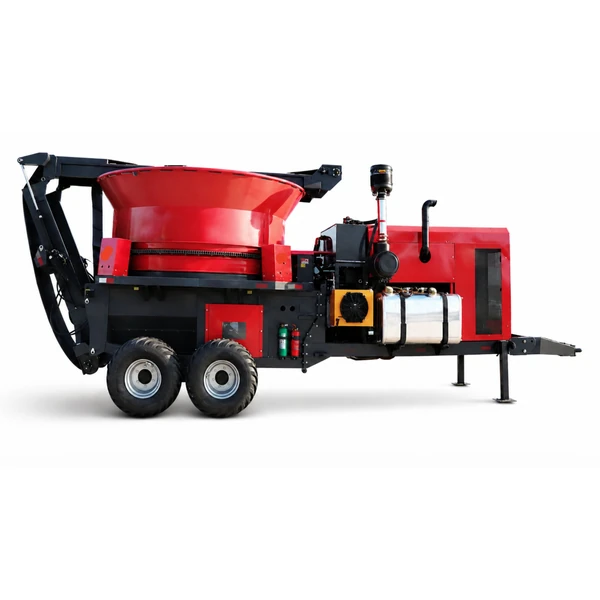
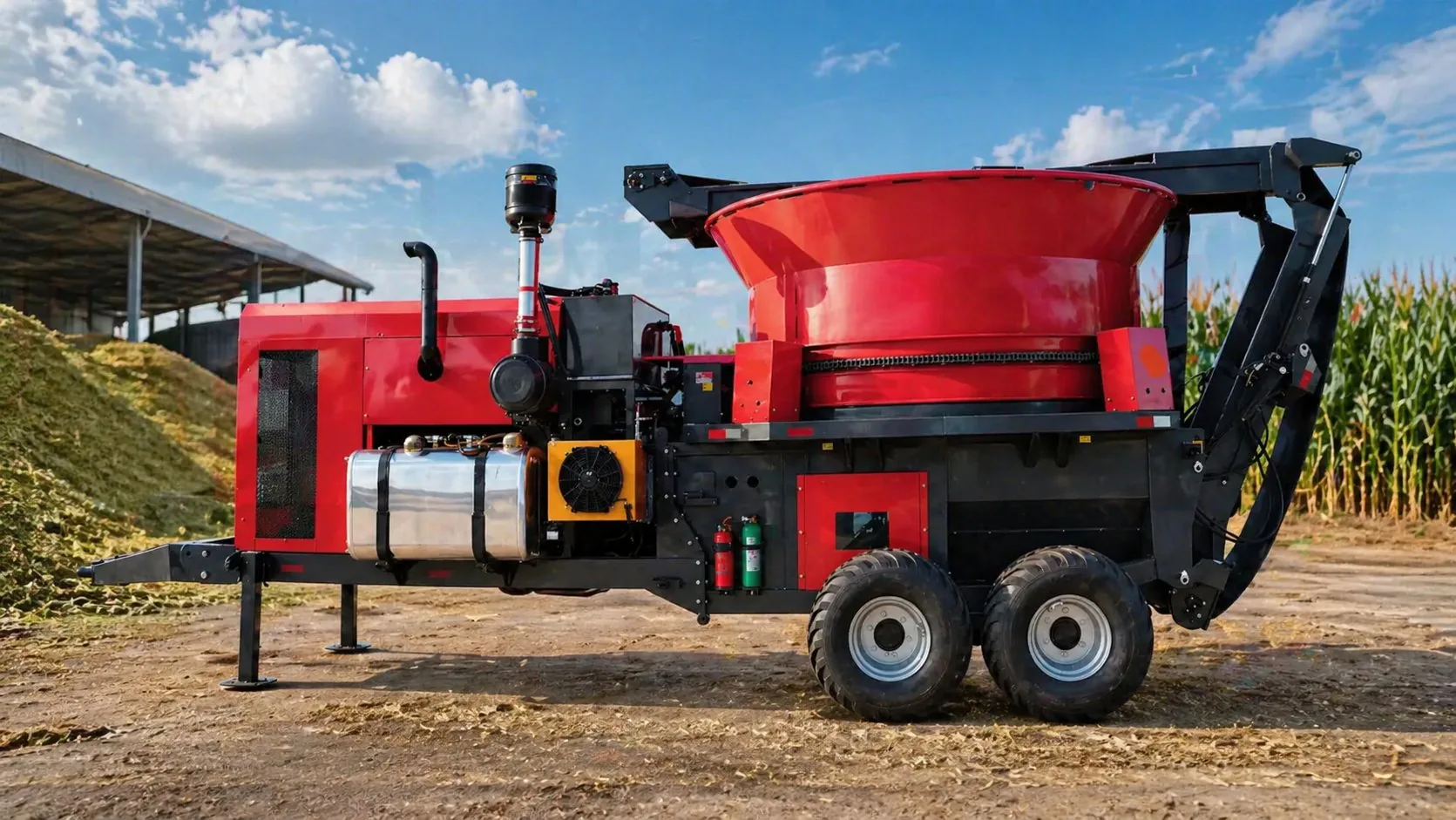
O Moinho de martelos para forragem 9F-70 É um triturador de ração estacionário e autossuficiente, projetado para confinamentos de gado de corte nos EUA, operações de ração total misturada (TMR) para gado leiteiro, usinas de pré-processamento de biomassa para etanol e empresas terceirizadas de moagem sob encomenda. A unidade funciona com um motor a diesel de 191 kW (≈ 256 HP), aciona um rotor de 700 mm de diâmetro de trabalho com 64 martelos a 1.800 RPM e processa palha, feno, alfafa, sabugo de milho e resíduos de colheita a uma taxa de 5 a 20 toneladas métricas por hora. Não há necessidade de trator, tomada de força ou contrato de serviço elétrico com a cooperativa local — o 9F-70 é um triturador pronto para uso, que se conecta ao silo de ração e começa a operar imediatamente.
Moinho de martelos para forragem 9F-70: Triturador estacionário a diesel para ração animal, destinado a operações nos EUA.
A tremonha cilíndrica aceita palha de talo longo, pedaços de fardos redondos despejados por uma empilhadeira telescópica e resíduos de silagem picados, sem os problemas de obstrução que afetam os trituradores de tambor com garganta plana em materiais úmidos. A largura da câmara de trituração é de 1.100 mm — o suficiente para que um único fardo redondo de 5x5 pés (1,5 x 1,5 m) alimentado em segmentos passe pelo triturador em menos de dois minutos. O tamanho das partículas é selecionável pelo operador através de peneiras aparafusadas com aberturas de 4 mm, 6 mm, 8 mm e 12 mm; peneiras mais finas reduzem a vazão, enquanto peneiras mais grossas a aumentam. Para uma pré-trituração típica de ração total misturada (TMR) em feno de gramíneas com granulometria de 6 mm, a vazão fica na faixa de 8 a 12 t/h; para o pré-processamento de biomassa com granulometria de 12 mm, a vazão sobe para o limite superior da faixa de 5 a 20 t/h.
A America Ever-Power Silage Baler Equipment INC. fornece o moinho de martelos para forragem 9F-70 a partir do depósito em Sacramento, com peças em estoque, manuais do operador em inglês e frete cotado para o seu município em até 48 horas. A unidade foi especificada a pedido de operadores de confinamento de gado no Nebraska que precisavam de um moinho de martelos independente para substituir a frota obsoleta de Haybuster H-1000 sem o custo adicional de um triturador comercial novo. Veja a lista completa. Equipamentos de processamento de forragem dos EUA ou acesse diretamente a tabela de especificações abaixo.
Especificações técnicas
A ficha técnica abaixo foi reproduzida na íntegra a partir do conjunto de desenhos do fabricante para o lote de produção de 2026, com conversões para o sistema imperial adicionadas em uma segunda coluna para os mercados dos EUA e Canadá. O moinho de martelos para forragem 9F-70 é enviado configurado para operação estacionária; o chassi é montado sobre patins soldados com quatro pontos de içamento para movimentação com empilhadeira entre currais de engorda ou pátios de biomassa.
O motor a diesel é fornecido por um grande fabricante de equipamentos originais (normalmente uma unidade compatível com o padrão Tier 4 Final para entrega nos EUA); o modelo do motor e os detalhes da certificação da EPA são confirmados no momento do pedido e impressos na ficha técnica. A capacidade do tanque de combustível é dimensionada para 8 a 10 horas de operação contínua entre os abastecimentos, o que corresponde a um turno típico de moagem personalizada. A estrutura sobre patins inclui quatro olhais de içamento certificados para movimentação com empilhadeira e quatro pontos de fixação com parafusos de ancoragem para instalação permanente em uma base de concreto. A calha de descarga é centralizada sob a carcaça do rotor para um fluxo simétrico, e o ângulo da calha é fixo para que o material triturado caia diretamente no nível do solo para posterior armazenamento em esteira transportadora ou vagão alimentador.
| # | Item | Unidade | Especificação | Referência Imperial/Americana |
|---|---|---|---|---|
| 1 | Modelo | / | Moinho de martelos para forragem 9F-70 | — |
| 2 | Configuração | / | Unidade estacionária | montado em skid |
| 3 | Dirigir | / | Autossuficiente | Não é necessário trator/tomada de força. |
| 4 | Fonte de energia | / | Motor a diesel | Em conformidade com o Nível 4 Final |
| 5 | Potência nominal do motor | kW | 191 | ≈ 256 HP |
| 6 | Habitação | / | Aço soldado | Q345B / ASTM A572 |
| 7 | Tipo de rotor | / | Martelo | pino oscilante |
| 8 | Número de martelos | peças | 64 | Mn13 fundido para desgaste |
| 9 | Disco do rotor Ø | mm | 450 | ≈ 17,7 polegadas |
| 10 | Rotor de trabalho Ø | mm | 700 | ≈ 27,6 polegadas |
| 11 | largura da câmara de britagem | mm | 1,100 | ≈ 43,3 polegadas |
| 12 | Dimensões totais (C×L×A) | mm | 7.700 × 2.600 × 2.900 | ≈ 25,3 × 8,5 × 9,5 pés |
| 13 | velocidade do eixo de transmissão | r/min | 1,800 | RPM do rotor com o motor em plena potência |
| 14 | Largura da pista | mm | 2,200 | ≈ 86,6 polegadas |
| 15 | Capacidade de processamento | t/h | 5 – 20 | ≈ 5,5-22 toneladas curtas/h |
| 16 | Peso líquido | kg | 5,500 | ≈ 12.125 lb |
| 17 | Sistema de alimentação | / | Tremonha cilíndrica | carregado por cima por manipulador telescópico |
Como funciona o moinho de martelos para forragem 9F-70
O moinho de martelos para forragem 9F-70 processa biomassa em um ciclo de quatro estágios: carregamento da tremonha, ação do rotor e dos martelos contra a peneira, seleção do tamanho das partículas por meio de peneiras aparafusadas e descarga para uma esteira transportadora ou silo de alimentação a jusante. Todo o processo é supervisionado a partir de um único painel de controle montado no lado do operador da unidade. Não há necessidade de um segundo operador no lado do carregador, pois a geometria cilíndrica da tremonha alimenta o rotor automaticamente com material, sem obstruções.
Etapa 1 — Carregamento da tremonha
O material é carregado na tremonha cilíndrica de alimentação superior por meio de um manipulador telescópico, minicarregadeira com garra ou pá carregadeira. A tremonha aceita palha de talo longo, pedaços de fardos redondos quebrados de fardos de 5x5 ou 5x6, silagem picada proveniente do despejo de um vagão forrageiro ou resíduos soltos de sabugo de milho. A geometria da tremonha inclui um cone interno de 30° que evita a formação de pontes em materiais úmidos ou fibrosos, sem a necessidade de alimentação por rosca sem-fim.
Etapa 2 — Ação do rotor e do martelo
O rotor de 700 mm de diâmetro útil gira a 1.800 RPM, acionado diretamente pelo motor a diesel através de um acoplamento com amortecedor de torção. Sessenta e quatro martelos com pinos oscilantes, montados no disco do rotor de 450 mm, trituram o material que entra contra a peneira. A geometria dos martelos é reversível: quando uma das arestas se desgasta, o operador gira o martelo 180° para expor uma aresta nova, dobrando a vida útil do martelo antes da substituição.
Etapa 3 — Seleção de tela (tamanho da partícula)
O tamanho das partículas de saída é definido pela tela aparafusada na parte inferior da câmara de trituração. As telas estão disponíveis em 4 mm (fina, para pré-moagem de ração para monogástricos), 6 mm (padrão para ração total misturada para gado leiteiro), 8 mm (intermediária, para ração de bovinos de corte) e 12 mm (grossa, para pré-processamento de biomassa em etanol ou matéria-prima para pellets). A troca da tela leva de 12 a 15 minutos e é realizada por dois operadores utilizando o conjunto de parafusos fornecido e uma chave dinamométrica.
Etapa 4 — Alta
O material triturado sai da peneira e cai em uma calha de descarga que desce até o nível do solo abaixo da unidade. A maioria dos operadores posiciona uma esteira transportadora de 60 cm (24 polegadas) ou um vagão alimentador estacionário sob a calha para transportar o material para o próximo processo — um misturador de ração total misturada (TMR) para laticínios, uma linha de ensacamento para usinas de biomassa ou diretamente para um silo de ração para confinamentos de gado de corte.
Principais vantagens do moinho de martelos 9F-70
Cinco escolhas de engenharia diferenciam o moinho de martelos para forragem 9F-70 dos trituradores mais antigos acionados por tomada de força e das unidades estacionárias movidas apenas por motor elétrico. Cada uma delas visa atender a uma necessidade frequente de operadores de confinamentos de gado, nutricionistas de gado leiteiro e processadores de biomassa nos Estados Unidos: capacidade máxima de produção, número de martelos e geometria do rotor, independência da rede elétrica, formato da tremonha e durabilidade da câmara em operações de alta intensidade.
Capacidade de produção de 5 a 20 t/h
Em um turno de 10 horas, operando a 12 t/h em sua capacidade média, a 9F-70 processa 120 toneladas métricas de biomassa — quantidade suficiente de ração total pré-moída para alimentar 5.000 cabeças de gado em fase de terminação por um dia, considerando taxas de inclusão típicas.
64 martelos a 1.800 RPM
Martelos fundidos em Mn13 resistentes ao desgaste, montados em um rotor com diâmetro de trabalho de 700 mm, garantem tamanho de partícula consistente em toda a faixa de produção. A geometria reversível dos martelos duplica a vida útil da aresta antes da necessidade de substituição.
Motor a diesel autônomo de 191 kW
Sem necessidade de trator, tomada de força ou contrato de serviço elétrico trifásico. Em conformidade com o padrão Tier 4 Final para entrega nos EUA. Posicione a unidade em qualquer lugar no curral de ração ou no pátio de biomassa e comece a trabalhar.
Tremonha cilíndrica, sem ponte
A tremonha cilíndrica com alimentação superior e inclinação interna de 30° aceita palha longa, pedaços de fardos redondos e resíduos úmidos de silagem. Não é necessário alimentador por rosca sem-fim, nem um segundo operador para remover material acumulado.
Câmara de aço soldada
Carcaça em aço Q345B / ASTM A572 com placa de desgaste de 12 mm nas zonas de impacto do martelo. Dimensionada para um ciclo de trabalho de 15.000 horas antes da necessidade de reconstrução da câmara — típica de empresas de retificação personalizada de alto volume.
Estrutura, Materiais e Qualidade de Construção
A carcaça do moinho de martelos para forragem 9F-70 é soldada em aço estrutural Q345B — o equivalente chinês ao ASTM A572 Gr. 50. A placa de desgaste nas zonas de impacto dos martelos dentro da câmara tem 12 mm de espessura, superdimensionada para operações com biomassa onde pedras, fragmentos de arame e outros contaminantes entram periodicamente no fluxo de alimentação. As soldas nas junções da câmara são protegidas com CO₂ e inspecionadas por ultrassom em cada unidade retirada da linha de produção. O disco do rotor é de aço usinado com precisão, com 450 mm de diâmetro e 64 furos para pinos de martelo perfurados com tolerância ISO H7.
Os martelos são fundidos em Mn13 — aço austenítico de alto manganês que sofre endurecimento por deformação sob impacto, a mesma família de ligas usada em revestimentos de britadores na indústria de mineração. A vida útil do martelo em feno e alfafa é de 1.200 a 1.500 horas de operação antes da substituição; em biomassa de sabugo de milho com contaminação por pedras, a vida útil cai para 600 a 900 horas. Os conjuntos de martelos de reposição custam aproximadamente 2,5 vezes o preço de tabela da unidade e são enviados do armazém de Sacramento sob demanda. Conjuntos de peneiras de 4, 6, 8 e 12 mm são estocados em profundidade total durante todo o ano; a troca rápida da malha é uma tarefa de 12 a 15 minutos com dois operadores.
A proteção da superfície é um processo de quatro etapas: pré-tratamento com fosfato, primer eletrostático, acabamento em poliuretano e cura em estufa — o mesmo sistema de acabamento da nossa linha de vagões para transporte de fardos pesados. Os resultados do teste de névoa salina, realizados pelo nosso laboratório de controle de qualidade interno, mostram uma durabilidade superior a 600 horas antes do aparecimento de ferrugem vermelha nas bordas dos riscos. O compartimento do motor a diesel é protegido por um painel de serviço articulado com trava de segurança; os pontos de acesso ao óleo do motor, líquido de arrefecimento e filtro de combustível são acessíveis sem a necessidade de remover o painel. Toda a unidade pode ser reparada em campo com um kit básico de ferramentas e uma chave dinamométrica com capacidade de 700 Nm para os parafusos do rotor e do disco.
Cenários de aplicação para operações de ração e biomassa nos EUA
As quatro categorias de aplicação abaixo abrangem aproximadamente 95% dos pedidos do modelo 9F-70 de operadores americanos. Se a sua operação não se encaixa perfeitamente em nenhuma delas — por exemplo, um programa de pré-moagem de substrato para cogumelos ou uma linha de processamento de cama para cavalos — entre em contato com o departamento de aplicações em Sacramento para que o pacote de peneiras e a configuração de descarga possam ser confirmados antes do envio do pedido.
Pré-moagem de ração total misturada (TMR) para confinamento de bovinos
Um confinamento típico de 5.000 a 15.000 cabeças de gado nas Grandes Planícies do Nebraska, Kansas, Texas Panhandle e leste do Colorado pré-moe feno de gramíneas, alfafa e palha de milho até atingir uma granulometria de 6 a 8 mm antes da mistura da ração total misturada (TMR). O moinho de martelos para forragem 9F-70, com capacidade de 12 t/h e peneiras de 8 mm, supre a necessidade diária de forragem de um confinamento de 5.000 cabeças em aproximadamente 4 a 5 horas de operação por dia. A maioria dos operadores posiciona a unidade ao lado do galpão de insumos e a opera em um turno fixo pela manhã para alimentar o ciclo diário de mistura da TMR.
Processamento de forragem para gado leiteiro
Operações leiteiras de médio a grande porte em Wisconsin, Idaho e no Vale Central da Califórnia utilizam o 9F-70 para pré-moer feno e palha secos na faixa de granulometria de 6 mm, que promove a passagem pelo rúmen e a ingestão consistente de matéria seca. Para uma fazenda leiteira com 1.500 a 2.500 vacas, o processamento diário de 8 a 15 toneladas métricas de forragem cabe em um turno de 1 a 2 horas na unidade. A consistência no tamanho das partículas produzidas é o que os nutricionistas valorizam — um moinho de martelos produz um desvio padrão mais estreito na distribuição de partículas do que um moinho de tambor com o mesmo tamanho nominal de peneira.
Operações de etanol e biomassa
Usinas-piloto de etanol celulósico em Iowa, Kansas e Nebraska utilizam o moinho de martelos 9F-70 para pré-moagem de palha de milho e capim-elefante antes da etapa de hidrólise enzimática. Com peneiras grossas de 12 mm, a unidade atinge sua capacidade máxima de 18 a 20 t/h em sabugos de milho secos — o suficiente para suprir a demanda de matéria-prima de uma usina de etanol celulósico de 5 milhões de galões por ano, operando em um único turno. Em operações de produção de pellets, o 9F-70 também é utilizado como britador primário antes do moinho secundário da peletizadora.
Serviços de moagem personalizados da cooperativa
Cooperativas de moagem personalizada no Centro-Oeste Superior e nas Planícies do Norte operam a 9F-70 em uma rota que atende de 10 a 30 pequenas e médias propriedades de gado leiteiro e de corte em um raio de 80 quilômetros. A cobrança típica é de $0,65 a $1,20 por 45 kg de ração acabada (valores verificados na primavera de 2026 — confirme localmente). Com uma capacidade de 12 t/h em peneiras de 6 mm, uma empresa terceirizada processa o equivalente a 100-150 fazendas clientes por mês durante o pico da temporada de alimentação de inverno.
Guia de Tamanhos e Seleção
Antes de encomendar o moinho de martelos para forragem 9F-70, revise esta lista de seis pontos com a equipe de atendimento em Sacramento. A maioria das devoluções de pedidos que vemos ocorre devido a uma incompatibilidade entre a peneira e o pacote — por exemplo, operadores que encomendam a unidade para processamento de biomassa sem confirmar se a peneira de 12 mm é adequada para a granulometria da ração da sua máquina de peletização. Todos esses problemas podem ser evitados na conversa pré-venda.
- Meta de produção diária. Calcule sua necessidade diária de forragem com base na taxa de inclusão por cabeça. Para um confinamento de gado de corte com 5.000 cabeças, considerando 8 libras de forragem por cabeça por dia, a produção diária é de 20 toneladas métricas — facilmente dentro da capacidade do 9F-70.
- Tamanho das partículas de saída. Confirme o tamanho da peneira: 4 mm para pré-moagem de ração para monogástricos, 6 mm para ração total misturada (TMR) para gado leiteiro, 8 mm para rações para bovinos de corte, 12 mm para biomassa e para a etapa anterior da peletizadora. Múltiplas peneiras podem ser encomendadas com a unidade para trocas a cada turno.
- Área ocupada pelo local. A área de 7,7 × 2,6 × 2,9 m, mais uma área livre de 5 m no lado de descarga, permite o acesso superior à tremonha cilíndrica, que requer 4 m de altura livre para a elevação da caçamba da manipuladora telescópica.
- Logística de combustível diesel. Um motor Tier 4 Final consome aproximadamente 28-38 L/h, dependendo da carga. Confirme a disponibilidade de um tanque de combustível no local com capacidade mínima de 1.000 L para um intervalo de serviço de 24 horas.
- Manuseio de descarga. Esteira transportadora, rosca sem-fim ou vagão alimentador estacionário para transportar o produto triturado a jusante. A Sacramento pode recomendar as especificações da esteira transportadora no momento do pedido.
- Redução do ruído. O ruído operacional a 1 m mede aproximadamente 95-100 dB(A). Confirme se o local de operação planejado é compatível com as normas locais de ruído e forneça proteção auditiva para os operadores.
Se sua operação processa mais de 5 toneladas métricas de biomassa por dia e você está cansado de esperar que uma rota de trituração personalizada passe pelo seu município, você é o comprador certo para esta unidade. Solicite um orçamento A partir do nosso escritório em Sacramento, informaremos o preço da unidade, do pacote de tela e do frete para o seu CEP em até 48 horas.
Como o 9F-70 se compara aos modelos Art's Way, Haybuster e Roto-Mix
Não temos qualquer vínculo com a Art's Way Manufacturing, DuraTech (Haybuster) ou Roto-Mix LLC, e o moinho de martelos para forragem 9F-70 não é uma falsificação de nenhum de seus produtos. A comparação abaixo visa auxiliar os compradores americanos a especificarem o triturador adequado para sua operação. Cada uma das máquinas de referência é um equipamento de alta qualidade; a questão é se a diferença entre preço e capacidade de produção justifica o custo adicional para o seu volume anual de processamento.
| Especificações | 9F-70 | Caminho da Arte 6105 | Haybuster H-1000 | Roto-Mix 920 |
|---|---|---|---|---|
| Tipo | Moinho de martelos estacionário | Triturador de tambor (TDP) | Triturador de cuba (autopropelido) | Misturador/triturador estacionário |
| Capacidade de processamento | 5-20 t/h | ~10-25 t/h | ~15-30 t/h | ~5-15 t/h |
| Poder | 191 kW diesel (autônomo) | TDP ≥ 200 HP | Motor diesel autopropulsado de aproximadamente 400 HP | Elétrico ou tomada de força |
| Formato de funil | Cilíndrico com alimentação superior | alimentação na banheira | alimentação na banheira | transportador de alimentação lateral |
| Contagem de martelos | 64 (fundido com Mn13) | ~36 (rotativo) | ~48 (rotativo) | Variável |
| Faixa de preço aproximada | $ — entrada para o meio | $$$ premium | $$$$ premium-plus | $$$ premium |
| Melhor ajuste | Curral fixo / biomassa | Jardins de tamanho médio acionados por tomada de força | Moagem personalizada de alto volume | Fábrica de ração estacionária |
Onde as máquinas de marca se destacam: densidade de concessionárias nos EUA (Art's Way e Haybuster têm redes de assistência técnica mais robustas no Cinturão do Milho e nas Grandes Planícies), valor de revenda (Art's Way e Haybuster mantêm melhor o valor residual no mercado de equipamentos usados dos EUA) e mobilidade autopropelida da Haybuster H-1000 para operadores que precisam se deslocar entre confinamentos distantes.
Onde a 9F-70 se destaca: preço de compra (normalmente 35 a 50% abaixo do preço de tabela de modelos comparáveis da Art's Way ou Haybuster), flexibilidade na quantidade de martelos e na configuração das telas (o rotor de 64 martelos produz uma distribuição de partículas mais uniforme do que um triturador de tambor com 36 martelos, com a mesma capacidade de produção) e frete a partir de Sacramento (compradores da Costa Oeste e dos estados montanhosos recebem suas máquinas de 4 a 7 dias mais rápido do que se compradas de armazéns de fabricantes originais em Iowa ou Dakota do Norte). Para operação estacionária no pátio, o acionamento direto por motor a diesel elimina o gargalo imposto pelos trituradores de tambor acionados por tomada de força durante os turnos de pico de moagem.
Certificações de Qualidade e Compromisso de Serviço
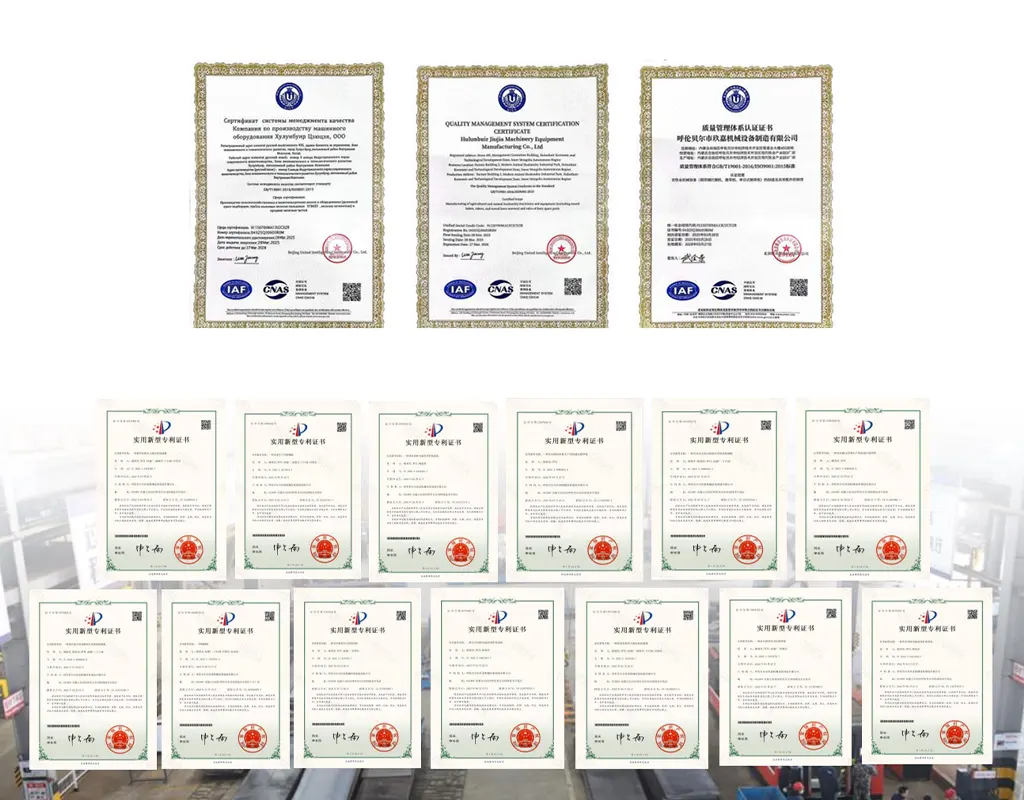
Cada moinho de martelos para forragem 9F-70 que sai da fábrica parceira é construído sob um sistema de qualidade ISO 9001:2015, auditado anualmente por uma entidade certificadora independente. Cada unidade passa por um teste a quente de 4 horas na linha de produção: amaciamento do motor diesel em rotação máxima, balanceamento do rotor para a classe G2.5, verificação da uniformidade do impacto dos martelos por sensor de vibração e um ciclo simulado de trituração em biomassa seca de sabugo de milho para confirmar a consistência da saída da peneira. Os resultados são registrados com o número de série da unidade e enviados juntamente com o manual do operador e a documentação do fabricante do motor.
Termos de garantia para compradores dos EUA e Canadá: garantia limitada de dois anos para o chassi soldado e o conjunto do rotor, garantia de um ano para os sistemas hidráulico e elétrico, garantia de seis meses para martelos e peneiras. A garantia do motor a diesel é separada e segue a rede de assistência técnica do fabricante do motor (normalmente Cummins, John Deere ou fornecedor equivalente Tier 4 Final — confirmado no momento do pedido). As peças são enviadas do armazém de Sacramento via UPS Ground ou frete LTL para endereços comerciais nos 48 estados contíguos dos EUA; pedidos feitos antes das 11h (horário do Pacífico) são enviados no mesmo dia para itens em estoque, o que abrange cerca de 88 SKUs de peças de desgaste.
Para clientes comerciais, um engenheiro de campo baseado em Sacramento é enviado para o primeiro comissionamento, orienta o operador e o chefe de oficina sobre o cronograma de manutenção do motor e deixa um cartaz com as especificações de torque na oficina. O suporte telefônico está disponível em inglês de segunda a sexta, das 7h às 18h (horário do Pacífico). Os contratos de serviço são oferecidos em três níveis: Bronze (somente peças, consultoria telefônica de 90 dias), Prata (peças mais inspeção anual no local) e Ouro (peças, inspeção no local e atendimento emergencial 24 horas na Califórnia, Oregon, Nevada, Idaho e nos principais estados produtores de milho). A maioria dos operadores de confinamento de gado opta pelo nível Prata após a primeira temporada.
Equipamentos complementares para programas de forragem
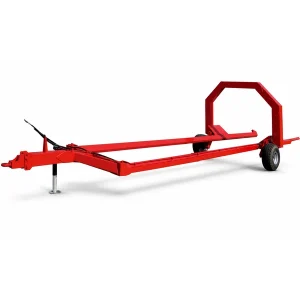
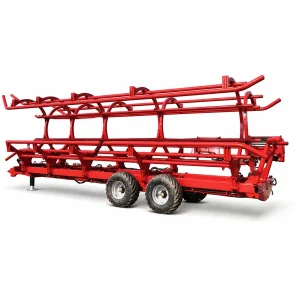
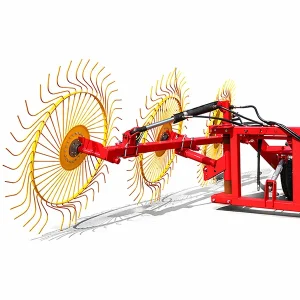
O moinho de martelos para forragem 9F-70 fica localizado na extremidade a jusante de um fluxo de trabalho mais amplo de feno e forragem. A maioria dos operadores de confinamento utiliza a unidade como triturador de segundo estágio após uma operação de enfardamento e enleiramento a montante. O par natural no lado do enfardamento é o enfardadeira redonda de feno Na série S9000 Ultra, para fardos de feno de alfafa e gramíneas de alta densidade. Para a preparação das leiras antes da enfardadeira, o rastelo de leiras é importante — leiras irregulares produzem densidade de fardos inconsistente, o que se traduz diretamente em rendimento irregular do moinho de martelos no final da cadeia de produção, no confinamento do gado.
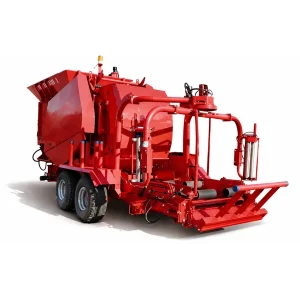
Para operações de gado leiteiro e de corte que utilizam um programa de alimentação com silagem enfardada, além de feno seco, a enfardadeira-embaladora de silagem se encaixa naturalmente antes de um moinho de martelos para a mistura total de ração (TMR). Os fardos de silagem enfardada geralmente não são pré-moídos no moinho de martelos — eles vão diretamente para o misturador de TMR —, mas os produtores que utilizam rações mistas de feno seco e silagem frequentemente instalam ambas as máquinas no mesmo local de confinamento para maior flexibilidade de turnos.
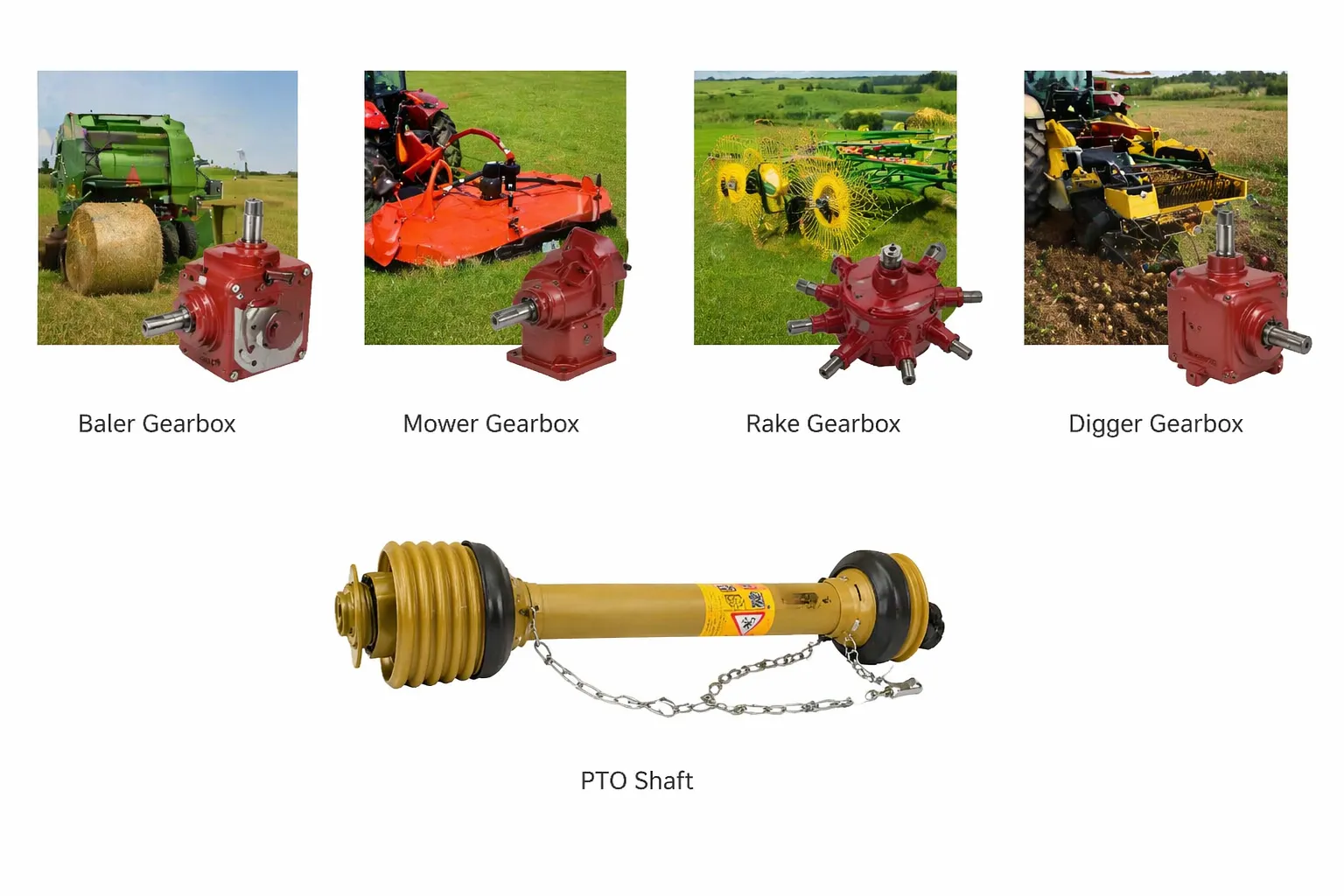
Os equipamentos acionados por tomada de força (TDF) no programa de feno a montante também se beneficiam de componentes de transmissão de qualidade. Os operadores que modernizam tratores utilitários mais antigos com apenas 1000 RPM ou que utilizam configurações incomuns de eixo estriado em enfardadeiras e ancinhos podem especificar um conjunto compatível. caixa de engrenagens de acionamento agrícola Proveniente de nossa fundição parceira, com relações de redução dimensionadas para uma saída de 540 RPM no lado do implemento. A própria 9F-70 não precisa de caixa de engrenagens — funciona com acionamento direto por motor a diesel — mas as operações da enfardadeira e do ancinho, a montante, dependem de acionamentos por tomada de força (TDF) para garantir confiabilidade diária.
Por que escolher a America Ever-Power Silage Baler Equipment INC.?
Existem diversos moinhos de martelo com especificações de importação no mercado americano. O que diferencia o 9F-70 da Ever-Power na prática para compradores comerciais — confinamentos de gado, usinas de biomassa, empresas de moagem personalizada e nutricionistas de laticínios que operam a unidade em regime de alta produtividade e priorizam tempo de atividade, consistência do tamanho das partículas e custo por tonelada processada — é o seguinte:
- ✔ Fábrica de Sacramento Na 1401 21st ST — envio de peças na mesma semana dentro dos EUA continentais, 7 a 12 dias úteis para o Canadá e México.
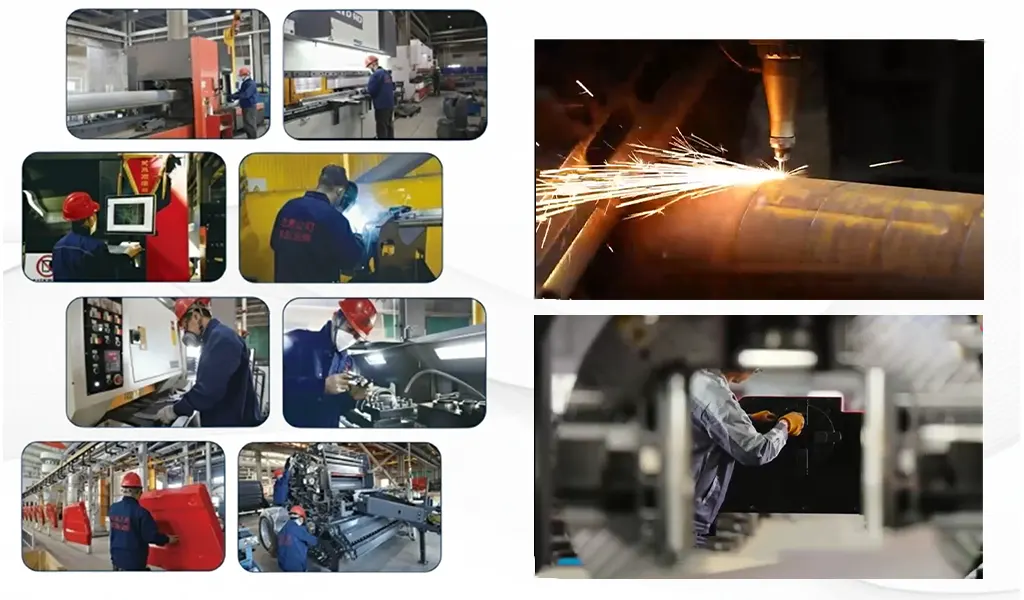
- ✔ Mais de 200 máquinas no chão de fábrica da empresa parceira — laser CNC, células de soldagem robotizadas, equipamento de balanceamento para cada rotor, linha de pintura automatizada.
- ✔ Certificação ISO 9001 desde 2023, fornecedor com classificação AAA e distribuidores regionais.
- ✔ Preços direto da fábrica — normalmente 35-50 % abaixo dos preços de tabela comparáveis da Art's Way ou da Haybuster.
- ✔ Engenheiros de campo que falam inglês, pagamento aceito via USDT e ACH, prazo de pagamento de 30 dias para clientes comerciais verificados.
- ✔ Garantia de dois anos para o chassi, com peças em estoque para 88 unidades do modelo % de SKUs comuns.
Perguntas frequentes — Moinho de martelos para forragem 9F-70
Qual é o consumo de combustível diesel?
Aproximadamente 28-38 L/h (≈ 7,4-10 gal/h), dependendo da carga. Com uma capacidade de 12 t/h em peneiras de 6 mm para moagem de feno, o consumo de combustível fica entre 32-34 L/h. Operadores com armazenamento de diesel no local geralmente reabastecem uma vez por turno, durante o intervalo.
Qual é a vida útil esperada de um martelo?
A vida útil dos martelos é de 1.200 a 1.500 horas de operação em feno de capim e alfafa com geometria reversível (inverter a cada 600-750 horas e substituir a cada 1.200-1.500 horas). Em biomassa de sabugo de milho com contaminação por pedras, a vida útil dos martelos cai para 600-900 horas. Os conjuntos de martelos de reposição custam aproximadamente 2,5 £ do preço de tabela unitário.
Quanto tempo demora uma troca de tela?
A instalação leva de 12 a 15 minutos com dois operadores, utilizando o conjunto de parafusos fornecido e uma chave dinamométrica com capacidade de 220 Nm para os fixadores da estrutura da tela. As telas estão disponíveis em aberturas de 4, 6, 8 e 12 mm; é possível encomendar várias telas juntamente com a unidade para trocas a cada turno.
Vocês oferecem uma versão com motor elétrico?
Sim — uma variante com motor elétrico trifásico de 200 kW e 480 V está disponível como opcional de fábrica para instalações fixas em fábricas de ração e usinas de biomassa com alimentação pela rede elétrica. O prazo de entrega é de 60 a 90 dias para a variante elétrica, em comparação com 30 a 45 dias para a variante a diesel padrão. Confirme a capacidade de fornecimento de energia elétrica no local da instalação antes de fazer o pedido.
Como a produtividade varia com o tamanho das partículas?
Relação inversa: peneiras mais finas reduzem a produtividade, enquanto peneiras mais grossas a aumentam. No feno de gramíneas, a produtividade é de aproximadamente 6 t/h em peneira de 4 mm, 10 t/h em peneira de 6 mm, 14 t/h em peneira de 8 mm e 18-20 t/h em peneira de 12 mm. Os valores específicos variam de acordo com a umidade e a densidade do material.
Qual é o nível de ruído?
95-100 dB(A) a 1 m da unidade durante a operação normal. O limite de proteção auditiva de 90 dB(A) da OSHA é excedido na estação do operador; é necessário o uso de proteção auricular em conformidade com a OSHA (NRR ≥ 25). Verifique as normas locais de ruído antes de instalar a unidade perto de uma divisa de propriedade residencial.
Quais são os intervalos de manutenção recomendados?
Diariamente: inspeção visual dos martelos e telas, verificação do nível de combustível, verificação dos fluidos do motor (5 minutos). A cada 250 horas: troca do óleo e filtro do motor conforme o cronograma do fabricante, inspeção e rotação dos martelos, se necessário. A cada 1.000 horas: lavagem completa do fluido hidráulico, inspeção das telas, verificação do balanceamento do rotor. Anualmente: medição do desgaste da placa da câmara, inspeção do acoplamento de transmissão, repintura completa da máquina, se necessário.
Qual é a disponibilidade de peças de reposição nos EUA?
Martelos, peneiras, acoplamentos de transmissão, revestimentos de funil e fixadores de chassis são estocados no armazém de Sacramento durante todo o ano. Conjuntos soldados maiores e conjuntos de rotor-disco são estocados em menor quantidade e podem ter um prazo de entrega de 7 a 14 dias durante a alta temporada de retificação. Peças originais de motores (OEM) são distribuídas através da rede de concessionárias do fornecedor nos EUA — geralmente com disponibilidade na mesma semana para componentes Cummins ou John Deere.
Avaliações de clientes de operadores de confinamento de gado e biomassa dos EUA
Todas as avaliações abaixo são de compradores verificados e foram publicadas com permissão. Os nomes são reais e os locais correspondem ao condado. As avaliações são atualizadas trimestralmente — as avaliações mais antigas são arquivadas, mas podem ser solicitadas ao escritório de Sacramento.
Doug B., Gerente do Pátio de Engorda, Condado de Cuming, NE (outono de 2025)
"Administro um confinamento de 6.500 cabeças de gado. Substituí um Haybuster H-1000 de 2008 que consumia £14.000 por ano em reparos. O moinho de martelos para forragem 9F-70 custou cerca de £40 a menos do que um H-1000 novo. Seis meses depois, a produção está atingindo 11-13 t/h em peneiras de 6 mm com feno de capim, exatamente o que Sacramento especificou. O desgaste dos martelos tem sido melhor do que o esperado — ainda estou usando os originais. O consumo de diesel está em 33 L/h, previsível o suficiente para que eu o incluísse no pedido mensal de combustível."
Marlene H., Nutricionista de Laticínios, Condado de Trempealeau, WI (verão de 2025)
"Prestamos consultoria para quatro fazendas leiteiras de médio porte no oeste de Wisconsin, com rebanhos de 800 a 1.800 vacas cada. Duas delas agora possuem o 9F-70 em seu galpão de alimentação. A peneira de 6 mm produz uma distribuição de partículas mais uniforme do que o triturador de tambor que usamos como referência, e as vacas estão percebendo a consistência na linha de leite — menos casos de seleção e rejeição no cocho. A análise granulométrica confirmou um desvio padrão inferior a 8 µg/cm² na saída da peneira de 6 mm."
Earl W., Empreiteiro de Retificação Personalizada, Condado de Pottawattamie, IA (outono de 2025)
"Faço um serviço de moagem personalizada no oeste de Iowa. São 14 paradas por mês durante a temporada de alimentação de inverno. O 9F-70 fica em uma carreta entre os trabalhos — um dos meus motoristas opera o equipamento no local de cada cliente. A montagem leva 25 minutos e a desmontagem, 20. A capacidade de processamento de biomassa seca de sabugo de milho com granulometria de 12 mm chega a 18 t/h, o que supera a unidade Roto-Mix que eu tinha antes. Os clientes estão satisfeitos, a fatura é transparente e os cálculos fecham."
Ramon S., Operador de Curral de Gado, Condado de Hartley, TX (outono de 2025)
"3.800 cabeças de gado, região do Panhandle do Texas, poeira e calor constantes. O motor 9F-70 tem aguentado firme. O resfriamento do motor permanece dentro das especificações com temperatura ambiente de 40,5 °C. A peneira de 12 mm para silagem de casca de algodão e palha de milho atinge 16 toneladas por hora em um turno normal. A Sacramento enviou um engenheiro de campo na segunda semana para nos explicar a programação do motor. Preço justo, operação justa, sem reclamações da equipe."
Tate J., Curral de Gado, Condado de Yuma, CO (verão de 2025)
"Confinamento de gado com capacidade para 4.200 cabeças nas planícies do leste do Colorado. Pré-moagem de feno de capim e palha de trigo no moinho de martelos para forragem 9F-70, resultando em uma granulometria de 8 mm para o programa de ração total misturada (TMR). Produção previsível, consumo de combustível previsível, desgaste dos martelos previsível. Comprei o equipamento com prazo de pagamento de 30 dias, o que manteve o fluxo de caixa estável durante um trimestre apertado. O engenheiro de campo veio de Sacramento para realizar a instalação. A tradução para o espanhol feita pelo operador em Sacramento ajudou minha equipe a se familiarizar com o equipamento mais rápido do que eu esperava."
Bryce N., Fábrica de Ração Pelletizada, Condado de Canyon, ID (outono de 2025)
"Operamos uma fábrica de pellets de alfafa. O triturador 9F-70 funciona como o triturador primário a montante da nossa peletizadora, reduzindo a alfafa enfardada a 8 mm antes da moagem secundária. A capacidade de produção de 11 a 13 t/h corresponde exatamente à capacidade da nossa peletizadora. A garantia de dois anos do chassi foi o fator decisivo em relação ao orçamento da Roto-Mix. A tremonha comporta pedaços de fardos redondos despejados pela nossa minicarregadeira sem obstruir — esse era um problema real na unidade que substituímos."
Karen O., Custom Grind, Condado de Reno, KS (outono de 2025)
"Tenho uma pequena operação de moagem personalizada no centro-sul do Kansas, atendendo 9 fazendas clientes em uma rota de alimentação de inverno. Comprei o moinho de martelos 9F-70 para substituir um moinho de tambor antigo com tomada de força que precisava de um trator de 220 HP que eu não tinha. O sistema de acionamento direto por diesel me permite deixar o trator em casa e simplesmente transportar o moinho de martelos de uma fazenda para outra. Os clientes gostam da saída de 6 mm e do tamanho consistente das partículas. O custo é de $0,85 por 100 libras (aproximadamente 45 kg) e o investimento se pagou em duas temporadas."
Solicite um orçamento para o moinho de martelos para forragem 9F-70.
Se a 9F-70 atender aos seus requisitos de produção e ao layout do seu pátio de alimentação, o próximo passo é solicitar um orçamento com frete incluso para o seu CEP. Envie sua meta de volume diário de processamento, a configuração de peneiras de sua preferência e a semana de entrega desejada para a nossa equipe em Sacramento e enviaremos o orçamento em até 48 horas. Descontos por volume se aplicam a pedidos de 3 ou mais unidades, e prazos de pagamento de 30 dias estão disponíveis para clientes comerciais verificados. Os detalhes de conformidade com o fabricante do motor a diesel e com a norma Tier 4 Final são confirmados na ficha técnica no momento do pedido.

Informação adicional
| Editor | Cxm |
|---|