Jawaban Singkat
The optimal baling ground speed for most hay operations is 4 to 7 mph for dry-hay round bales Dan 3 to 5 mph for baleage with a silage baler. Within these ranges, the specific speed depends on the windrow weight: heavier windrows require slower speeds to prevent overfeeding the baler chamber, while lighter windrows allow faster speeds to maintain throughput without under-filling the bale.
Silage baler (wet): 3–5 mph
Small square baler: 3–5 mph
Why Ground Speed Is the Operator’s Most Important Real-Time Decision
Once the hay is mowed, dried, and raked into windrows, the operator’s quality control shifts entirely to two variables at the mesin pengepak jerami bundar: ground speed and density setting. The density setting is adjusted once before the field and rarely changed during baling. Ground speed, by contrast, is adjusted continuously — sometimes multiple times per minute — as the windrow changes weight, the terrain changes slope, and the bale approaches its target diameter. An experienced operator reads the windrow ahead, listens to the engine load, watches the bale-diameter monitor, and adjusts the throttle and gear selection in real time to keep the feed rate inside the baler’s optimal operating window.
This continuous speed adjustment is what separates a skilled baler operator who produces 25 to 30 uniform, dense, well-shaped bales per hour from a novice who produces 15 to 20 irregular bales per hour with frequent plug stops. The skill is learnable, but it starts with understanding the physics of what speed does inside the baler chamber and why the optimal range exists.
The Physics: How Ground Speed Controls Feed Rate, Density, and Bale Shape
Ground speed determines how many pounds of forage per second enter the baler pickup. The pickup tines rotate at a constant speed (driven by the PTO at 540 RPM regardless of ground speed), sweeping forage from the windrow into the feed mechanism at whatever rate the tractor delivers windrow to the pickup. A heavier windrow at 6 mph delivers twice the pounds-per-second as the same windrow at 3 mph, because the pickup encounters twice as much linear windrow distance per second. The baler’s internal capacity to process forage — compress it, rotate it, and form it into a uniform cylinder — has a finite upper limit determined by the chamber diameter, the belt or roller speed, and the hydraulic density pressure. When the feed rate exceeds the baler’s processing capacity, the forage backs up at the throat, creating a plug that stops the baling process and requires 5 to 15 minutes of manual clearing.
Conversely, when the feed rate is too low — a light windrow at slow speed — the bale builds so slowly that the outer layers are overcompressed while waiting for the inner layers to accumulate. The result is a bale with a soft, loose core and a rock-hard shell that is difficult to unroll for feeding and stores poorly because the loose core absorbs moisture through the dense shell that should be protecting it. The ideal feed rate produces a bale that builds uniformly from center to perimeter, with consistent density throughout the cross-section and a smooth, round exterior profile.
5 Consequences of Driving Too Fast
- Baler plugs. The most immediate and costly consequence. A plug stops the baler, requires the operator to dismount, disengage the PTO, open the baler, and manually pull the jammed forage from the throat or feed rolls. Each plug costs 5 to 15 minutes of downtime. Three plugs per hour reduces effective baling time by 15 to 45 minutes — enough to lose 8 to 15 bales of production during the prime baling window. On a mesin pengepak pakan ternak handling heavy, wet baleage material, plugs are more frequent and harder to clear because the wet forage mats together more aggressively than dry hay.
- Soft, misshapen bales. When the feed rate exceeds the chamber’s compression capacity, the forage is not uniformly distributed around the bale circumference. One side of the bale receives more material than the other, producing an oval or egg-shaped bale that rolls unpredictably during handling, stacks poorly in storage, and sheds net wrap during transport.
- Pickup misses forage. At excessive speed, the pickup tines cannot sweep all the forage from the ground surface before the tractor moves past it. The missed forage remains on the stubble as a thin layer of windrow residue that represents 3 to 8 percent of the total crop — tons of hay that were mowed, dried, raked, and then driven over by the baler without being collected. Reducing speed by 1 to 2 mph typically eliminates this loss completely.
- Accelerated baler wear. The feed mechanism, chamber belts, rollers, and bearings are all rated for a specific maximum throughput. Operating above that throughput for sustained periods overloads the bearings, stretches the belts, and wears the pickup tines 30 to 50 percent faster than rated-speed operation. The $200 to $800 in annual maintenance savings from slower, steadier operation exceeds the value of the extra bales produced by running too fast.
- PTO overload and engine lugging. A heavy windrow at high speed can spike the PTO demand above the tractor’s available horsepower, causing the engine RPM to drop below the 540 PTO speed threshold. The resulting PTO slowdown reduces belt speed inside the chamber, which causes the partially formed bale to slip and stall rather than rotating smoothly. The operator hears the engine lug, the bale monitor shows erratic rotation, and the bale quality degrades until the operator reduces speed or the windrow lightens.
4 Penalties of Driving Too Slow
Each 1 mph reduction in ground speed reduces throughput by approximately 15 to 20 percent. An operator averaging 5 mph produces 25 bales per hour. The same operator at 3 mph produces 15 bales per hour — a 40 percent drop that extends the baling day by 3 to 4 hours on a 200-bale field and increases the risk of running into the evening humidity window that forces a shutdown.
The tractor engine consumes fuel whether the baler is producing bales quickly or slowly. At 3 mph the tractor burns the same gallons per hour as at 5 mph but produces fewer bales, raising the fuel cost per bale by 30 to 40 percent. On a 500-bale season, the excess fuel cost of chronic under-speeding totals $200 to $400.
A slow feed rate means the bale core receives thin, intermittent layers of forage that the chamber over-compresses between additions. The core becomes extremely dense while the mid-layers are normal density, creating a stress gradient that can cause the bale to crack or split when the tailgate opens and the compression is released.
The dry-hay baling window is 4 to 8 hours per day. Every unnecessary minute spent at slow speed is a minute subtracted from the available window. An operator who finishes 200 bales at 3 PM instead of 5 PM has 2 extra hours of buffer against an unexpected weather change. An operator still baling at 6 PM because of chronic under-speeding has zero buffer and may be forced to abandon the last 30 windrows to overnight dew.
6-Scenario Speed Guide: The Right Speed for Every Field Condition
| Field Scenario | Direkomendasikan Speed (mph) |
Mengapa Kecepatan Ini? | Bales/Hour (approx.) |
|---|---|---|---|
| Heavy 1st-cut windrow, dry, flat ground | 3.5 to 5.0 | Heavy feed rate — slow to prevent plugging | 20 to 28 |
| Light 2nd/3rd-cut windrow, dry, flat | 5.0 to 7.0 | Light feed — faster to maintain throughput | 22 to 30 |
| Heavy windrow, dry, hillside (8%+ slope) | 3.0 to 4.5 | Gravity + heavy bale weight = traction and steering priority | 15 to 22 |
| Baleage, heavy windrow, silage baler | 3.0 to 4.5 | Wet crop 40-80% heavier = higher PTO demand per foot of windrow | 12 hingga 20 |
| Baleage, light windrow, silage baler | 4.0 to 5.5 | Lighter windrow allows moderate speed increase | 15 to 24 |
| Small square baler, any windrow | 3.0 to 5.0 | Plunger cycle limits max feed rate regardless of windrow weight | 80 to 120 (small bales) |
The baleage rows (rows 4 and 5) show the critical speed difference that mesin pengepak silase operators must internalize. Wet forage at 50 percent moisture weighs 40 to 80 percent more per linear foot of windrow than dry hay at 16 percent moisture. That additional weight means the baler pickup, feed mechanism, and chamber are processing 40 to 80 percent more mass per second at the same ground speed. To keep the mass-per-second feed rate within the baler’s processing capacity, the operator must reduce ground speed by 1 to 2 mph compared to the same windrow baled dry. A mesin pengepak pakan ternak with heavy-duty bearings, an oversized pickup, and a drop-floor anti-plug system tolerates a higher feed rate than a standard round baler before plugging, which allows the forage baler operator to run 0.5 to 1.0 mph faster than a standard baler on the same wet windrow — a throughput advantage that accumulates across a 200-bale day into 20 to 30 additional bales produced during the same operating hours.
How to Read the Windrow and Adjust Speed in Real Time
The best operators do not set a speed at the start of the field and hold it constant. They adjust speed continuously based on 4 real-time signals that indicate whether the feed rate is within the baler’s optimal operating window.
- Signal 1: Engine sound. A steady, loaded engine hum at 1,900 to 2,100 RPM means the PTO is delivering full power and the feed rate is within capacity. A laboring, dropping-RPM sound means the feed rate is exceeding the available power. Slow down 0.5 to 1.0 mph immediately to restore PTO speed before the bale quality degrades.
- Signal 2: Bale monitor rotation indicator. Most modern round balers include a rotation indicator that shows the bale’s turning speed inside the chamber. A steady, consistent rotation means the forage is feeding smoothly. An erratic or slowing rotation means the feed rate is overwhelming the chamber capacity or the bale is encountering a wet slug. Slow down until the rotation steadies.
- Signal 3: Windrow height and density ahead. Look 50 to 100 feet ahead of the tractor. A tall, dense windrow section requires slowing before you reach it — not after the baler begins struggling. A thin section allows speeding up to maintain throughput. Anticipation is faster and smoother than reaction.
- Signal 4: Bale diameter gauge. Watch the rate at which the bale-diameter gauge advances. A steady advance at 1 to 2 inches per windrow-length means the feed rate is optimal. A rapid advance means too much material is entering too fast — the bale will reach full diameter before the target weight and will be lighter and less dense than intended. Slow down so the diameter and weight build at a matched rate.
Baler Design Features That Allow Higher Field Speed Without Sacrificing Quality
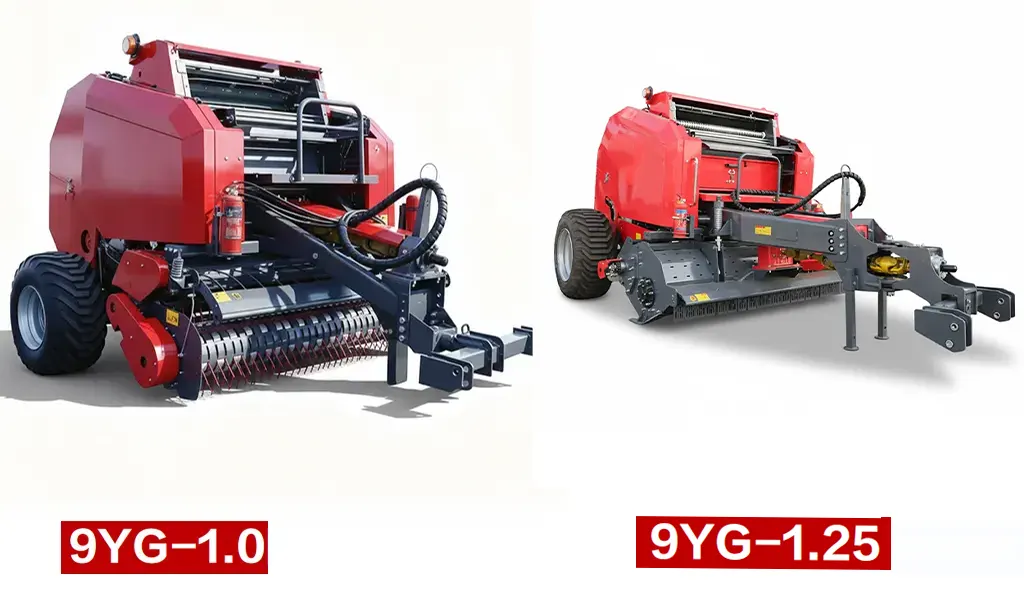
Not all round balers handle the same ground speed equally. Baler design determines the maximum feed rate the machine can process before plugging, which in turn determines the maximum productive ground speed the operator can sustain. Three design features separate high-throughput balers from machines that force the operator to creep.
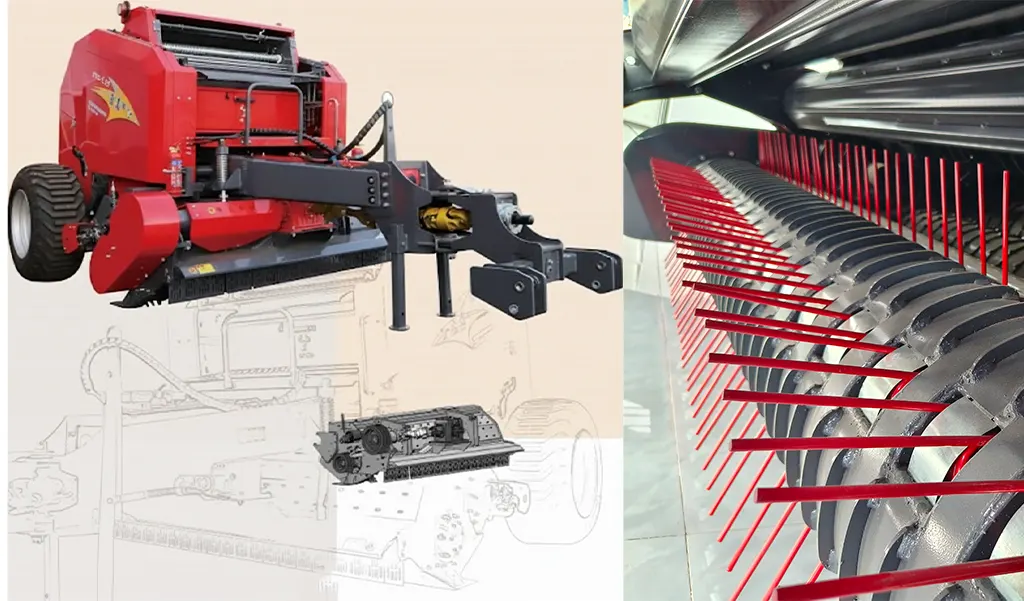
- Wide, aggressive pickup (5 to 6 ft). A wider pickup sweeps a wider swath of the windrow per revolution, processing more forage per second at the same ground speed than a narrow pickup. This allows the operator to maintain 5 to 6 mph on moderate windrows where a narrow-pickup baler would need to slow to 4 mph. America Ever-Power fixed-chamber mesin pengepak jerami bundar feature a full-width pickup designed for high-speed field operation on both dry and wet forage.
- Drop-floor anti-plug system. When a slug of heavy forage overloads the feed mechanism, a drop-floor system automatically releases the floor plate, allowing the slug to pass through rather than jamming the throat. The floor resets in 2 to 3 seconds and the operator continues without stopping. A baler without a drop floor requires a full stop, dismount, manual clearing, and restart for every plug — 5 to 15 minutes lost per event. A mesin pengepak silase with a drop floor operates at 0.5 to 1.5 mph faster sustained speed than a standard baler because the anti-plug system absorbs the feed-rate spikes that would otherwise force plug-avoiding crawl speeds.
- High-capacity feed rotor or pre-chamber. A rotor or pre-chamber between the pickup and the baling chamber acts as a buffer that meters the forage flow into the chamber at a consistent rate even when the pickup feed rate is variable. This buffering effect smooths out the windrow-weight variations that cause feed-rate spikes, allowing the operator to maintain a higher average speed without the momentary overloads that trigger plugs on direct-feed balers.
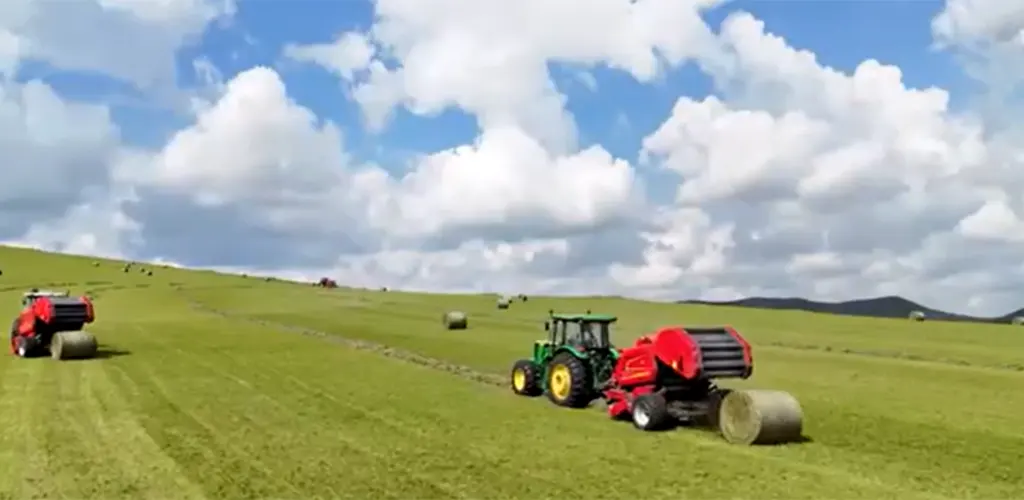
Speed Progression for New Operators: Start Slow, Build Confidence, Then Optimize
If this is your first season operating a round baler, do not attempt to hit the experienced-operator speeds in the table above on Day 1. Start at the low end of each range (3 to 4 mph for dry hay, 2.5 to 3 mph for baleage) and focus on producing consistently shaped, full-diameter bales with zero plugs. After 50 bales, increase speed by 0.5 mph and observe whether the bale quality holds. After 100 bales, increase again. By the end of the first season (200 to 400 bales), most operators have developed the ear for engine load, the eye for windrow weight, and the throttle instinct that allows them to operate at 5 to 6 mph on dry hay without conscious calculation.
The same progressive approach applies when switching from a dry-hay round baler to a mesin pengepak silase for baleage production. The wet crop behaves differently in the pickup and chamber — heavier, stickier, and more prone to slugging. Start 1 to 2 mph slower than your dry-hay comfort speed and build back up over the first 30 to 50 baleage bales. By the second baleage cutting, the operator adapts to the different feed characteristics and can run within 0.5 mph of the experienced-operator speeds for both products from the same machine.
More Bales Per Hour, Better Bales Every Hour
Ground speed is limited by the baler, not the tractor. America Ever-Power fixed-chamber round balers and silage-grade forage balers feature wide pickups, drop-floor anti-plug systems, and high-capacity feed mechanisms that allow sustained operation at 5 to 7 mph on dry hay and 4 to 5 mph on baleage — delivering 25 to 30 percent more bales per day than narrow-pickup, direct-feed balers. Tell us your acreage and windrow conditions for a matched recommendation. Dallas, TX parts depot for 3-day delivery.
Editor: Cxm