A Silage Baler Is Not a Single-Purpose Machine
The name “silage baler” implies a narrow function: making silage. In practice, the machine’s ability to handle forage across a wide moisture range — from 35 percent for wilted baleage to 65 percent for high-moisture silage — makes it the most versatile baling platform available to livestock operations. A silage baler produces fermented baleage for dairy cows on Monday, dry hay for the horse market on Wednesday (by reducing chamber density and skipping the wrapper), and emergency wet-baled feed from a rained-on cutting on Friday that would have been a total loss without the ability to bale and wrap at elevated moisture. No other single implement spans this range of products from the same field with the same operator.
Understanding the full scope of what a silage baler is used for reveals revenue opportunities that many operators miss because they think of the machine only as a silage tool. The 8 applications below are ranked by economic value and adoption rate across US and Canadian operations.
8 Real-World Applications of a Silage Baler
Dairy Baleage: High-Energy Feed for Milk Production
The primary and highest-value application. Dairy operations bale alfalfa or grass-legume forage at 45 to 55 percent moisture, wrap within 2 hours, and feed the fermented product 4 to 8 weeks later. University feeding trials show that properly fermented baleage produces 8 to 12 percent higher dry matter intake than dry hay from the same field, which translates directly into 2 to 4 lb more milk per cow per day. On a 100-cow dairy, that intake advantage generates $15,000 to $30,000 of additional annual milk revenue compared to feeding equivalent-quality dry hay.
Crop: alfalfa, clover-grass, orchard grass | Moisture: 45 to 55% | Wrap layers: 6 to 8
Beef Cattle Winter Feed: Weather-Proof Forage Preservation
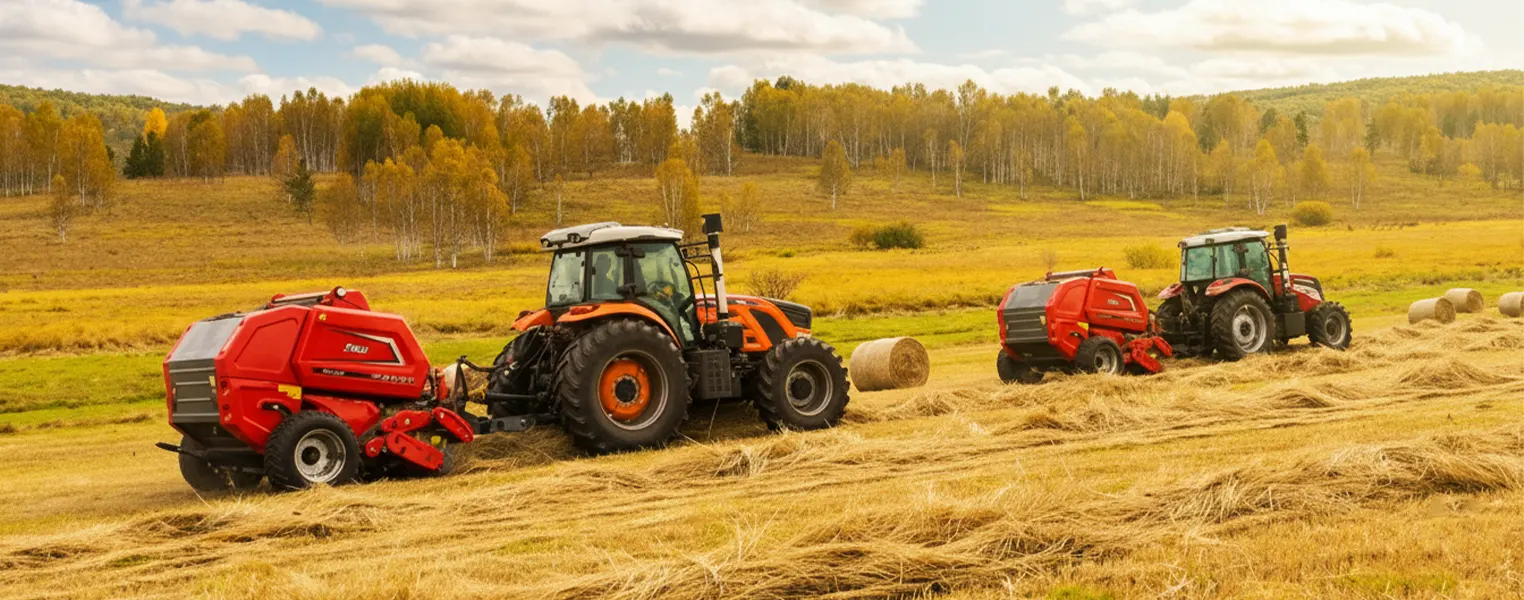
In humid climates where 3-day dry-hay windows are rare (Southeast, Gulf Coast, Appalachia, Pacific NW), the silage baler eliminates weather dependency entirely. The operator mows in the morning, wilts for 4 to 8 hours, rakes and bales in the afternoon, and wraps the same evening — regardless of tomorrow’s forecast. A beef cow-calf operation that loses 2 to 3 cuttings per year to rain damage when making dry hay saves $5,000 to $15,000 annually by switching to baleage for the late-season cuttings where weather risk is highest.
Crop: fescue, bermudagrass, bahiagrass, mixed grass | Moisture: 50 to 60% | Wrap layers: 6
Dry Hay Production: The Same Baler Does Both Jobs
Every silage baler also makes dry hay by reducing the chamber density setting and baling forage at standard 12 to 18 percent moisture. The heavier frame, larger rollers, and stronger drivetrain of a silage baler actually produce a denser, better-shaped dry bale than a standard dry-hay baler because the machine has more compression capacity than the dry crop requires. Operators who produce both dry hay (for the horse market) and baleage (for their own dairy or beef herd) use one silage baler for both products, eliminating the cost and storage footprint of owning two separate machines.
Crop: timothy, orchard grass, alfalfa, bermudagrass | Moisture: 12 to 18% | No wrapping required
Late-Season Rescue Baling
Third and fourth cuttings in September and October face short days, heavy dew, and frequent rain that make dry hay nearly impossible. The forage baler captures these cuttings as baleage that would otherwise be abandoned in the field. On a 100-acre operation, rescuing one late-season cutting that yields 1.0 ton per acre saves $10,000 to $15,000 in feed that would have been purchased to replace the lost production.
Rain-Damaged Hay Recovery
When rain wets a drying hay swath, the forage re-absorbs moisture to 30 to 45 percent and cannot be baled as dry hay. A standard baler must wait 2 to 3 additional days for the hay to re-dry, risking more rain. A silage baler bales the rained-on forage immediately at its elevated moisture, wraps it, and lets fermentation preserve whatever feed value the rain did not wash away. The resulting baleage is lower quality than hay that was never rained on, but it is infinitely better than hay left in the field to rot.
Cover Crop and Green Manure Baling
Cash-crop farmers who plant cover crops (cereal rye, crimson clover, radish blends) for soil health can bale the cover crop as silage before termination, capturing both the soil-health benefit and a marketable feed product from the same planting. The round baler handles the green, high-moisture cover crop that a dry baler cannot process. Revenue from selling the cover crop silage ($40 to $80 per ton) partially offsets the seed cost of the cover crop program.
Drought and Disaster Emergency Feed
During drought years when hay markets spike to $200 to $400 per ton, operators with silage balers can bale salvage forage from failed crop fields (drought-stressed corn, sorghum, or millet) as emergency silage at moisture levels that a dry baler cannot handle. Wrapped bales of drought-stressed sorghum at 50 percent moisture ferment into acceptable maintenance-level feed that keeps the cow herd alive until the drought breaks, at a fraction of the cost of purchased hay at crisis prices.
Biomass and Bioenergy Feedstock
An emerging application: baling high-moisture energy grasses (switchgrass, miscanthus, elephant grass) as silage for anaerobic digester feedstock or cellulosic ethanol production. The forage baler compresses the bulky biomass into transportable bales that can be stored on-farm and delivered to the processing facility on demand. As bioenergy markets expand, this application is expected to grow significantly through the 2030s.
Six Crop Types a Silage Baler Processes
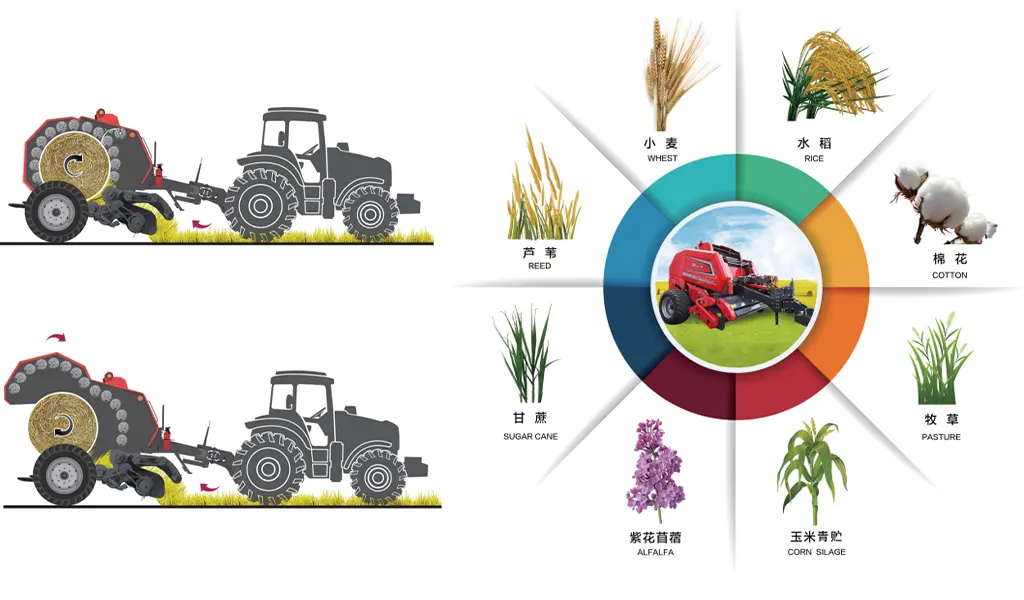
A silage baler is not limited to grass. It handles any forage crop that can be cut, wilted to the target moisture range, and formed into a bale. The following 6 crop categories represent the full range of materials processed by silage balers in commercial US and Canadian operations.
| Crop Category | Common Species | Optimal Baling Moisture (%) |
Primary Market |
|---|---|---|---|
| Cool-season grasses | Orchard, fescue, timothy, ryegrass | 45 to 55 | Beef, dairy, horse |
| Warm-season grasses | Bermuda, bahia, sorghum-sudan | 50 to 60 | Beef, dairy |
| Legumes | Alfalfa, clover, lespedeza | 40 to 50 | Dairy (premium) |
| Cereal forages | Rye, oats, wheat, triticale | 50 to 60 | Beef, sheep, goat |
| Crop residues | Corn stover, rice straw | 45 to 55 | Beef maintenance, bedding |
| Energy grasses | Switchgrass, miscanthus | 50 to 65 | Bioenergy, anaerobic digester |
Why Crop Diversity Matters for Silage Baler Owners
The ability to process 6 different crop categories means the silage baler is never idle due to crop limitation. A grass-only baler runs during the grass growing season and sits unused the rest of the year. A silage baler that also processes cereal cover crops in spring, crop residues in fall, and drought-salvage forage during emergencies operates across 8 to 10 months of the year, which dramatically lowers the per-bale cost of ownership. On a $30,000 machine depreciated over 10 years, an operator producing 600 bales per year pays $5.00 per bale in depreciation. An operator who expands to 1,000 bales per year by adding cover crop and residue applications pays only $3.00 per bale — a 40 percent reduction in the single largest fixed cost of baling.
The crop type also determines how the silage baler’s settings must be adjusted. Legumes like alfalfa require gentler handling because the high-value leaves detach easily under aggressive compression. The knife system should be disengaged for pure alfalfa baleage because the stems are already thin enough to ferment well without chopping, and the knives would shatter additional leaves. Coarse-stemmed crops like sorghum-sudan and corn stover benefit from the full knife bank because the thick stems trap more oxygen per cubic foot when left uncut, and the chopping action reduces stem length to improve both packing density and animal intake when the silage is fed. Bermudagrass falls in between: its fine stems pack naturally well without cutting, but engaging 8 to 12 knives (rather than the full 17 to 25 bank) produces a marginally denser bale that justifies the additional PTO power consumption. Operators who process multiple crop types through the same forage baler learn to adjust the knife engagement and density settings on a per-crop, per-cutting basis, treating the machine as a configurable platform rather than a fixed-setting tool.
Seasonal Application Calendar: When the Silage Baler Runs Through the Year
Unlike a dry-hay baler that operates only during the 3 to 4 months of favorable drying weather, a silage baler operates across an extended season because it does not depend on dry-weather windows. This longer operating season increases the annual utilization hours and reduces the per-bale depreciation cost of the machine.
- March to April: Bale winter rye and triticale cover crops as silage before spring planting of corn or soybeans. First-cut cool-season grass baleage in the South.
- May to June: First and second cut of alfalfa and grass baleage (primary dairy application). Dry hay when weather allows.
- July to August: Third and fourth cuts. Switch to baleage for any cutting where rain threatens the drying window. Bermudagrass baleage in the South.
- September to October: Late-season rescue baling. Rain-damaged hay recovery. Fourth and fifth bermudagrass cuts as baleage.
- November to February: Off-season. Maintenance, winterization, and preparation for the next season. In the Deep South, a sixth bermudagrass cutting is possible in early November.
Three Farm Profiles: How Different Operations Use the Same Silage Baler
The silage baler is not a one-size-fits-one machine. Three fundamentally different farm types use the same equipment for entirely different revenue models.
Profile A: 80-Cow Dairy in Wisconsin
Uses the silage baler to produce 400 to 500 bales of alfalfa and grass-clover baleage per year across 4 cuttings on 120 acres. Every bale is consumed on-farm by the milking herd. The baleage produces 2 to 4 lb more milk per cow per day than the dry hay the operation fed before purchasing the forage baler. At $20 per cwt milk price, the additional production generates $23,000 to $47,000 of incremental milk revenue per year, which paid for the entire baler and wrapper investment within the first season. The baler also makes 200 bales of dry hay from the first cutting when weather permits, which are sold to a local horse stable at $80 per bale for an additional $16,000 of annual income.
Profile B: 200-Head Beef Herd in Alabama
In the humid Southeast, this operation attempted dry hay for 5 years and lost an average of 1.5 cuttings per season to rain damage, costing $12,000 to $18,000 in wasted forage annually. After switching to baleage for the third, fourth, and fifth bermudagrass cuttings, rain-damage losses dropped to near zero. The silage baler’s ability to bale and wrap within hours of cutting eliminated the 48-to-72-hour drying window that was the source of all weather losses. The first two cuttings are still made as dry hay during the driest months. Total annual savings from avoided weather losses plus the additional tonnage captured from rescued cuttings: $20,000 to $30,000 per year.
Profile C: Custom Operator in Missouri
Serves 12 clients across 600 total acres, offering both dry baling and baleage wrapping services. The silage baler handles both products from the same machine, eliminating the need to own two separate balers. Clients pay $18 to $22 per bale for dry hay service and $25 to $30 per bale for the baleage service that includes wrapping. The baleage premium generates $4,200 to $4,800 more revenue per year than if the operator could only offer dry-hay baling. The silage baler’s dual capability is the competitive advantage that wins contracts from operators who can only do one or the other.
The Versatility Advantage: One Machine, Multiple Revenue Streams
The common thread across all 8 applications and all 3 farm profiles is versatility. A dry-hay baler produces one product: dry hay. A silage baler produces dry hay, baleage, rescue-baled forage, cover-crop silage, and emergency drought feed, all from the same machine with nothing more than an adjustment of the hydraulic density setting and a decision about whether to wrap the ejected bale. That versatility transforms the silage baler from a single-purpose implement into a multi-revenue platform that generates value across every weather condition, every crop type, and every market segment the operator chooses to serve.
The practical implication for equipment purchasing is clear: if your operation is currently considering a dry-hay baler and there is any possibility that you will want to make baleage, rescue rained-on cuttings, or serve dairy clients in the future, buy the round baler instead. The 20 to 40 percent price premium over a standard dry-hay baler buys a machine that does everything the dry baler does plus everything the dry baler cannot. The premium pays for itself the first time you bale a cutting that a dry baler would have forced you to leave in the field because the weather did not cooperate.
Economic Value of Each Application
The total annual value of a silage baler is not just the silage it produces — it is the sum of every application the machine enables, including the losses it prevents. The table below estimates the annual economic contribution of each application for a representative 100-cow beef operation on 150 acres in the Southeast US.
| Application | Annual Value | How the Value Is Captured |
|---|---|---|
| Primary baleage production (3 cuttings) | $30,000 to $45,000 | Replaces purchased hay at $130 to $180/ton |
| Late-season rescue (1 cutting saved) | $10,000 to $15,000 | Feed value of cutting that would have been lost |
| Rain-damage avoidance (1 event/year) | $5,000 to $10,000 | Quality preserved by wrapping rained-on forage |
| Dry hay for horse market (1 cutting) | $8,000 to $12,000 | Premium-market revenue at $160 to $220/ton |
| Total annual value | $53,000 to $82,000 | From a machine costing $20,000 to $40,000 |
A silage baler that costs $25,000 to $35,000 and delivers $53,000 to $82,000 of annual value produces a payback period well under one season. Even accounting for wrapper cost, stretch film, net wrap, and consumable expenses, the net return on the silage baler investment exceeds 100 percent per year for most mid-size livestock operations in humid climates. No other single implement in the hay equipment chain generates this ratio of economic value to purchase price.
Find the Silage Baler That Fits All Your Applications
Whether you make dairy baleage, rescue late-season cuttings, or produce dry hay for the horse market, America Ever-Power silage balers handle every application from the same machine. Tell us your herd size, acreage, and primary forage type for a matched recommendation. Dallas, TX parts depot for 3-day delivery.
Editor: Cxm