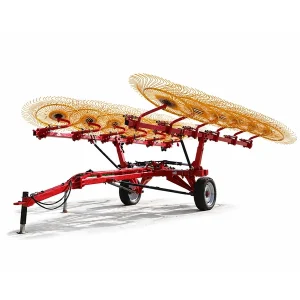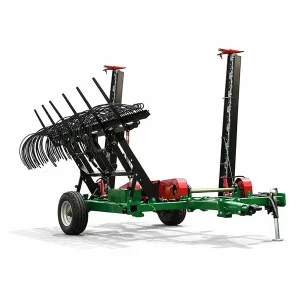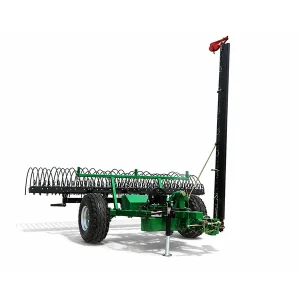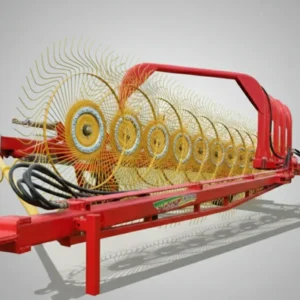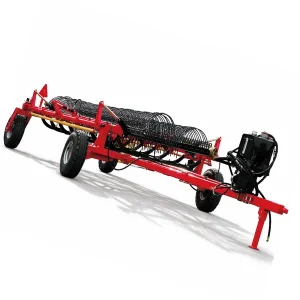
9LZD-9.0 17-Wheel V-Rake | 9 m Finger Wheel Hay Rake
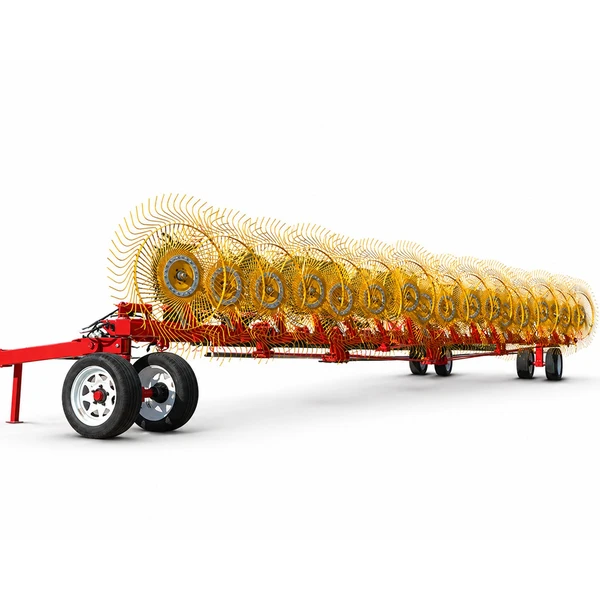
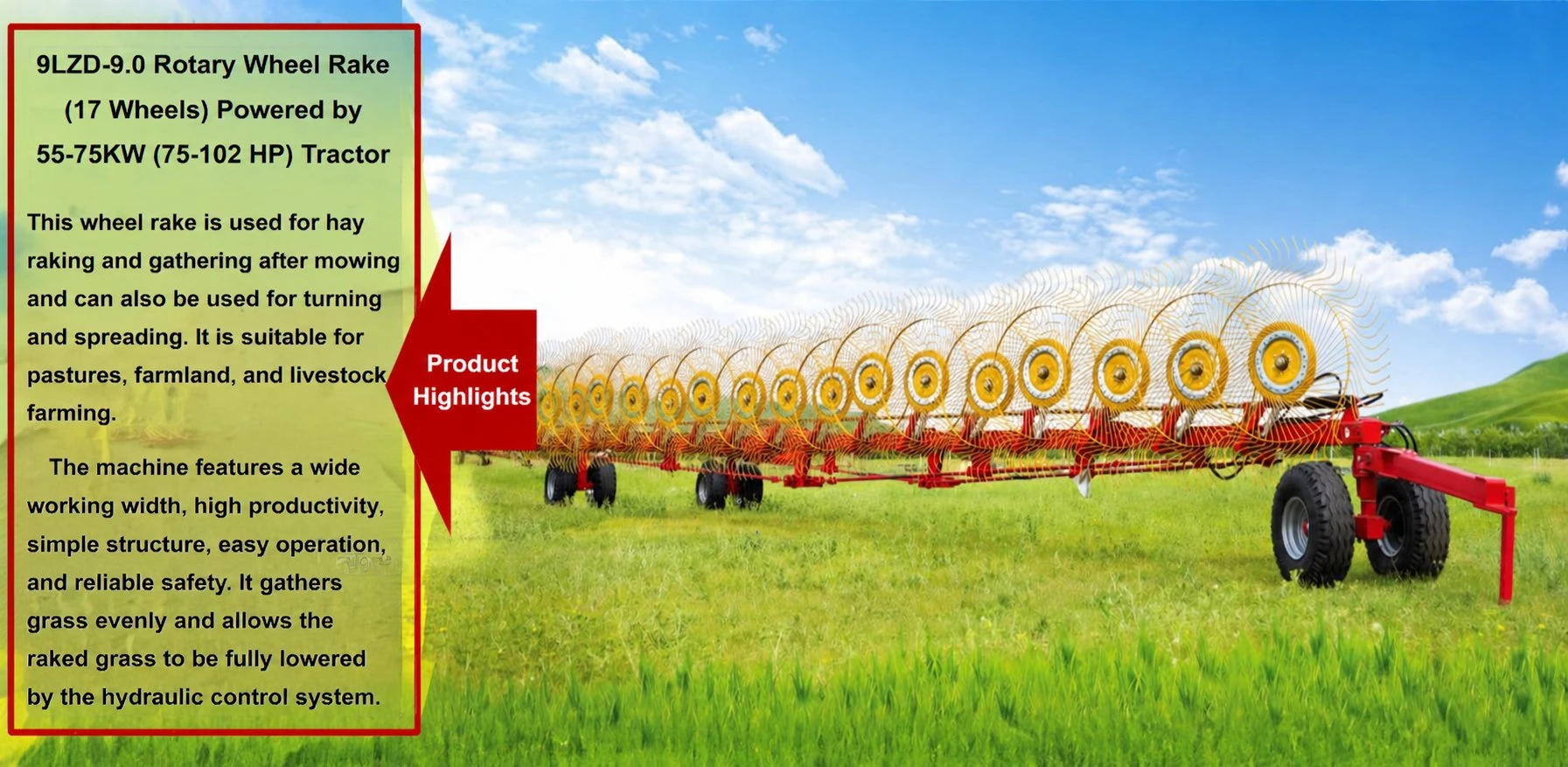
The 9LZD-9.0 finger wheel hay rake is the heavy-duty 17-wheel sister of our 15-wheel 9LZY-9.0 V-rake. Built for high-yield North American hay and stover work, it spans 9 meters of raking width with 1020 spring tines arranged on 17 finger wheels, sweeps the field at 8 to 10 km/h, holds the miss rate at or below 2 percent and pulls cleanly behind a 55 to 75 kW tractor without a PTO connection.
Where the 9LZD-9.0 Sits Inside Our V-Rake Lineup
The 9LZD-9.0 finger wheel hay rake is the densest implement in our trailed V-rake catalog. Where the 12-wheel 9LZ-6.0 covers 6 meters and the 15-wheel 9LZY-9.0 covers a full 9 meters with a lighter wheel count, the 9LZD-9.0 takes that same 9 meter sweep and crowds 17 finger wheels across it. The result is 1020 individual spring tines (17 wheels times 60 tines per wheel) brushing the soil at every pass, which is what gives this rake its sub-2 percent miss rate even on heavy-yielding alfalfa, thick CRP grass and irregular wheat stubble.
For a US producer choosing between the 15-wheel and 17-wheel models, the decision usually comes down to two questions. First, how heavy is your typical tonnage per acre? On a thin native range producing under 1.5 tons per acre, the 9LZY-9.0 will keep up. On second-cut alfalfa, irrigated grass or a heavy stover layer, the additional two wheels and 120 extra tines on the 9LZD-9.0 close the gaps that thinner rake spacing leaves behind. Second, what tractor are you planning to pull it with? The 9LZD-9.0 specifies 55 to 75 kW (75 to 100 horsepower), which positions it slightly above the lighter 50 to 55 kW window of the 9LZY-9.0 to handle its 1240 kg implement weight on rolling ground.
Field operators who run high-volume custom haying contracts across the southern Plains and Texas Panhandle have shifted toward this heavier model, because the difference between 2 percent and 5 percent miss rate adds up to several hundred dollars per cut on a 500 acre wheat-stubble job. The 9LZD-9.0 is also the model we recommend for any operation pulling forage straight into a high-density round baler, since cleaner windrows feed the chamber more evenly and produce better-shaped bales downstream.
Key Technical Specifications
Three numbers anchor the 9LZD-9.0 specification. The 9 meter raking width pairs with a 0.8 to 1.2 meter windrow target, meaning the rake gathers material from a swath nearly thirty feet wide and lays it into a windrow that fits cleanly under a standard 5 foot or 6 foot baler pickup. The 17 finger wheels carry 1020 individual heat-treated spring tines, which is what holds the miss rate at the 2 percent ceiling. And the 55 to 75 kW power window means most American utility tractors in the 75 to 100 horsepower class can run this rake all day without lugging.
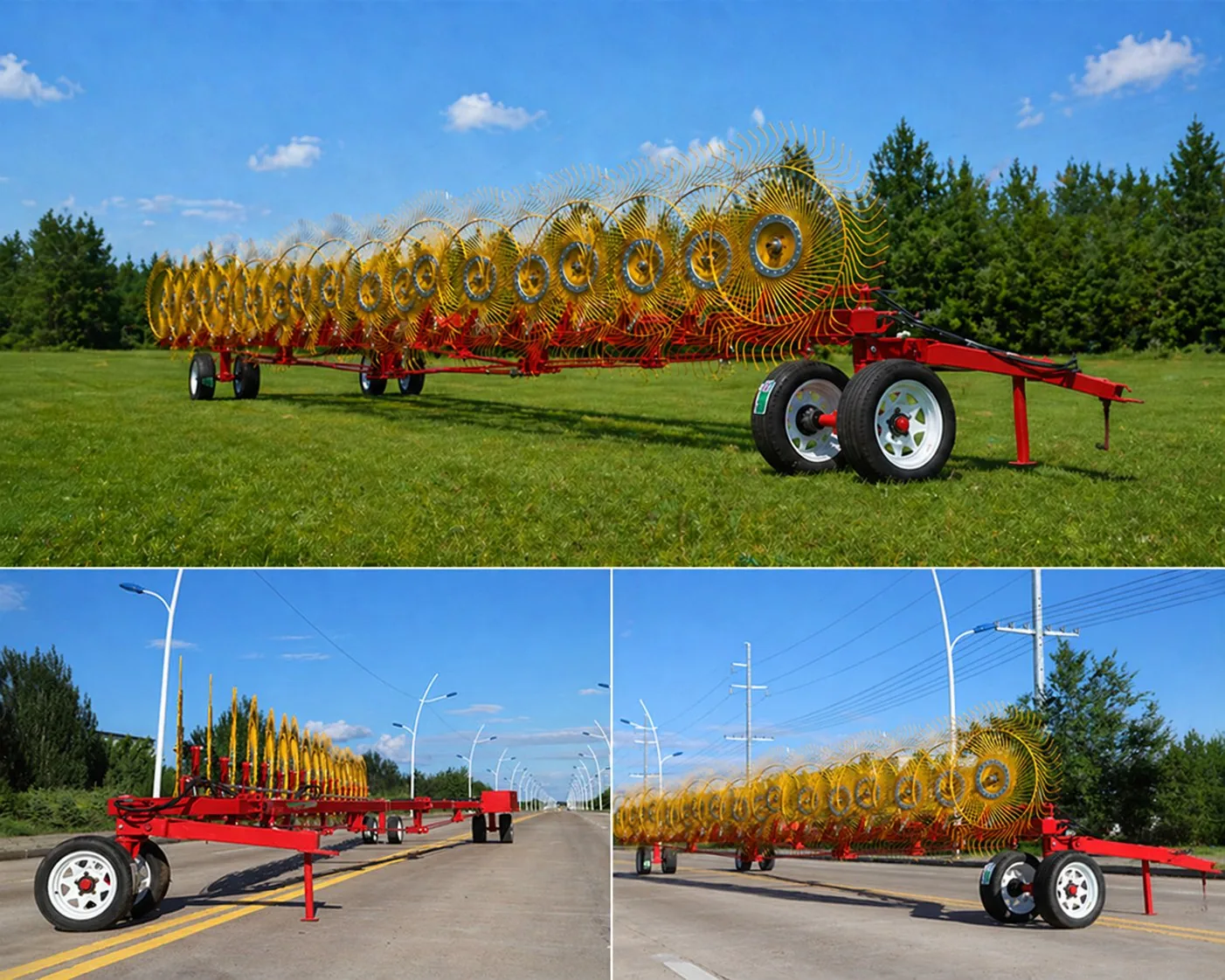
The 16.8 meter long working envelope (folded out of transport) reflects the in-line V-rake configuration: when deployed, the wheel banks angle backward in a wide V shape behind the tractor, which is what creates the lateral sweeping motion. In transport mode the implement folds back to roughly 3.9 meters wide, well within US farm-road and trailer legal limits. Total weight stays at 1240 kg (around 2,733 lb), which is light enough that a 75 horsepower tractor handles it without ballast on flat ground.
| No. | Item | Unit | Specification |
|---|---|---|---|
| 1 | Model | / | 9LZD-9.0 Finger Wheel Hay Rake |
| 2 | Configuration | / | Finger-wheel V-rake |
| 3 | Hitch | / | Trailed |
| 4 | Required tractor power | kW | 55 - 75 (~75 - 100 HP) |
| 5 | Working envelope (L x W x H) | m | 16.8 x 3.9 x 1.6 |
| 6 | Implement weight | kg | 1240 (~2,733 lb) |
| 7 | Working width | m | 9 (~29.5 ft) |
| 8 | Working speed | km/h | 8 - 10 |
| 9 | Transport speed | km/h | 12 |
| 10 | Number of finger wheels | pcs | 17 |
| 11 | Total tines | pcs | 1020 (17 x 60) |
| 12 | Operators | person | 1 |
| 13 | Windrow width | m | 0.8 - 1.2 |
| 14 | Miss rate | / | ≤ 2 % |
| 15 | Productivity | ha/h | 7.2 - 9 |
Imperial conversions are rounded approximations. The metric values are the engineering specification of record.
Working Principle: Ground-Driven, No PTO Required
The 9LZD-9.0 is a passive, ground-driven implement. There is no PTO shaft, no gearbox on the rake itself and no fuel-burning power consumed by the rake's motion. As the tractor pulls the implement forward at 8 to 10 km/h, friction between the cut crop, the angled finger wheels and the soil surface causes the wheels to rotate naturally. Each wheel spins independently, picking up material on its leading edge and casting it inward toward the central windrow zone behind the tractor.
The 17 wheels are arranged in two angled banks behind the tractor, forming a wide V shape. The two outer wheels start the lateral sweep, the next pair pick up what the first set missed and accelerate the crop further toward center, and so on inward through the V. By the time material reaches the inner wheels, it has been folded into a continuous windrow ranging 0.8 to 1.2 meters wide, depending on tractor speed and crop yield. Operators dial the windrow width to match the pickup width of the round baler that will follow.
The advantage of ground-driven operation in modern American hay practice is twofold. First, fuel cost is dramatically lower than running an active rotary rake, because the tractor only has to overcome rolling friction, not also drive a heavy gearbox at 540 r/min. Second, mechanical reliability is far higher. There are no rotating PTO shafts to seize, no oil-bath gearboxes to overheat, and no shear pins that can let go in the middle of a 4 PM rake-out before a thunderstorm arrives. Most operators report the 9LZD-9.0 as a "set it and forget it" implement, with the only daily task being a quick pressure check on the transport tires and a grease shot on the wheel hubs.
For comparison context, the lighter 12-wheel 9LZ-6.0 V-rake uses the same ground-driven principle on a narrower 6 meter footprint, suitable for smaller operations and for paddocks where a 9 meter sweep is overkill.
Core Operational Advantages on US Farms
The four advantages below are the ones our American customers consistently identify as the reason they chose the 9LZD-9.0 over a lighter wheel rake or a heavier active rotary unit. Each is tied to a specific number on the spec table.
◆ 17-Wheel Tine Density
1020 spring tines across a 9 meter sweep is roughly 113 tines per meter, which closes the spacing gaps that a 15-wheel rake leaves behind on heavy crop. The miss rate stays at or below 2 percent, even on second-cut alfalfa producing 4 to 5 tons per acre.
◆ Zero PTO, Zero Driveline Drag
No power take-off connection means no fuel burned driving a gearbox. A 75 horsepower utility tractor pulls the 1240 kg implement at full 10 km/h working speed without ever leaving the upper economy band on the fuel gauge.
◆ Hydraulic Folding Frame
From a 9 meter working span, the V folds inward via tractor hydraulic remotes to a 3.9 meter transport profile, suitable for US rural roads and standard farm gates. Transport speed is rated to 12 km/h, which is more than enough between adjacent paddocks.
◆ 7.2 to 9 Hectares per Hour
At 9 ha/h, that is roughly 22 acres per hour of effective rake coverage. A 220 acre alfalfa cut wraps up in a single 10 hour day, leaving plenty of time for the round baler to follow before the next weather change.
Construction, Materials and Service Life
A 17-wheel V-rake operates under cyclic stress every minute it works. Each finger wheel touches the ground, lifts material, casts it sideways, then rotates back into contact again. Multiply that by 17 wheels and 60 tines per wheel, and the implement endures roughly one million micro-impact events per hour of operation. Build quality is therefore non-negotiable, and the 9LZD-9.0 is engineered to absorb that workload across a service life measured in decades, not seasons.
The main central beam is fabricated from high-yield carbon steel tubing. Every plate and bracket is CNC laser-cut, then assembled on automated welding fixtures so each weld bead reaches the same depth and width. Joint geometry is verified against a master jig before the chassis enters the surface treatment stage. The chassis then passes through abrasive shot-blast cleaning before receiving a multi-stage industrial electrostatic powder coat in our signature deep indigo. That powder finish is the same class used on shipping containers, and it shrugs off UV exposure, fertilizer overspray, and ammonia from manure-rich field margins.
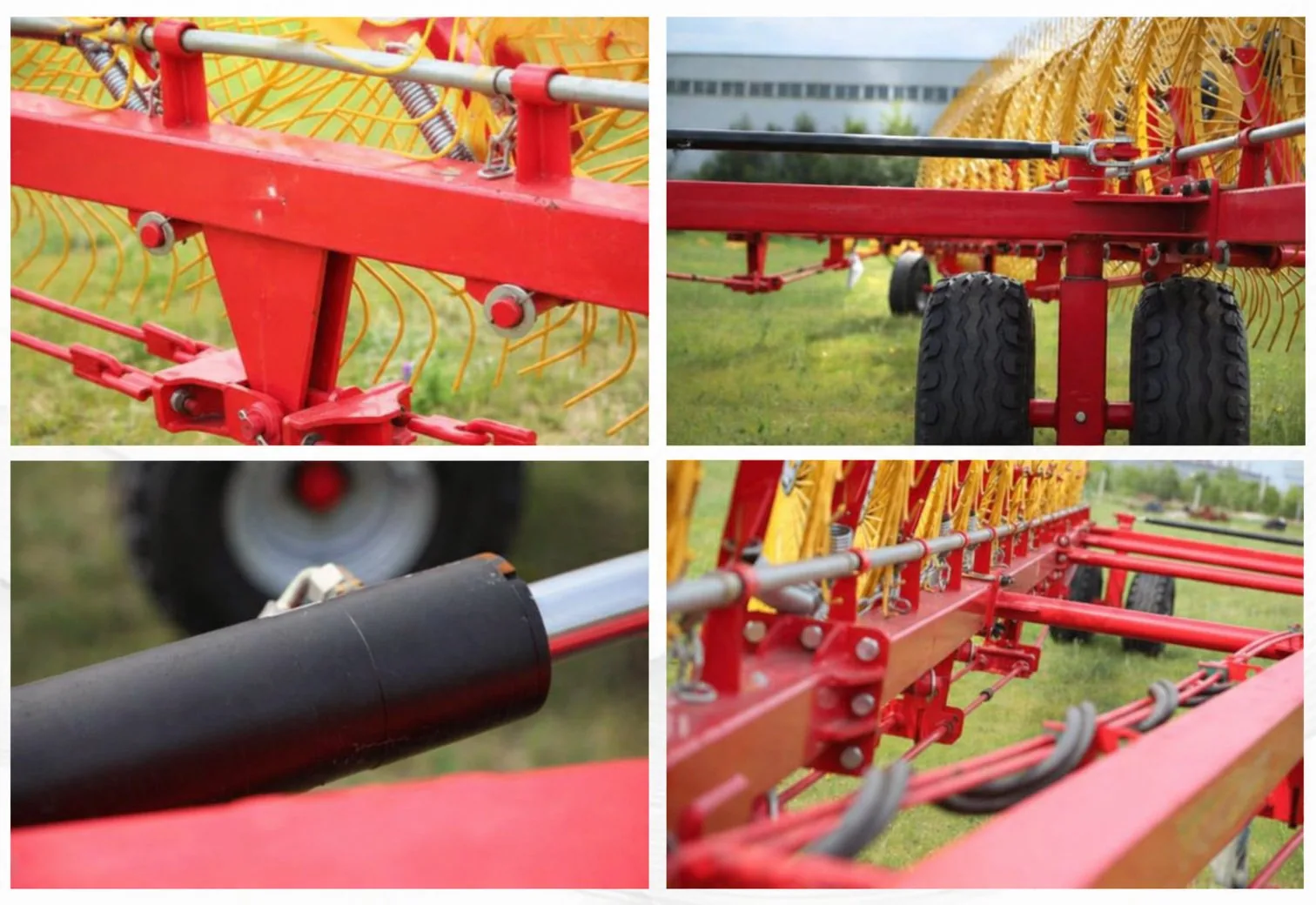
The finger wheels themselves are the primary wear part. Each wheel runs on a sealed, double-row tapered roller bearing rated for 1,500 working hours between greasing intervals. The 60 spring tines per wheel are individually bolted, not welded, meaning a single broken tine costs roughly five dollars and three minutes of field time, not a full wheel replacement. The tine steel is a high-memory carbon spring formulation that flexes without taking permanent set, so a tine that hits a buried rock typically rebounds without damage.
Tires are heavy-duty pneumatic flotation, mounted on an axle group rated to support the 1240 kg implement weight even on soft, recently irrigated ground. Hydraulic cylinders driving the fold-out function use US-standard SAE quick-disconnect couplers compatible with John Deere, Kubota, New Holland, Case IH and Massey Ferguson tractor remotes.
Field-Tested Application Scenarios
The 9LZD-9.0 is engineered for the full spectrum of American hay, forage and crop residue work. The four scenarios below cover the operations where our customers report the highest payback compared to thinner-spaced rakes or active rotary alternatives.
▸ Alfalfa Re-Raking and Tedder Recovery
After a tedder spreads alfalfa for drying, the regathering pass is the most leaf-shatter-sensitive step in the entire hay chain. The 9LZD-9.0 finger wheel hay rake handles re-raking gently because the wheel rotation is driven by the ground, not by an aggressive PTO. Tines roll the crop laterally without the violent percussion that strips protein-rich leaves off stems. Idaho and California growers consistently report higher leaf retention switching from a rotary rake to this V-rake configuration, which translates directly to better RFV grades at the truck scale.
▸ Wheat and Cereal Stubble Consolidation
Modern combines lay sparse, thin stubble swaths that are too low-density for an efficient round baler intake. The 9 meter span of the 9LZD-9.0 takes three combine passes and consolidates them into one full windrow, which is exactly what a 4 ft by 5 ft round baler chamber wants to see. Custom contractors in Kansas, Oklahoma and the Texas Panhandle pair this rake behind a 90 horsepower utility tractor for stubble work, then switch the same tractor onto a round baler in the afternoon.
▸ CRP Hay and Native Range
CRP haying windows are tight and the ground is uneven, often with hidden mounds, abandoned fence wire and shallow erosion gullies. The 17-wheel design floats over irregular terrain because each wheel pivots independently on its mount, maintaining ground contact without forcing the central beam to bottom out. Operators in North and South Dakota use the 9LZD-9.0 as a primary rake on emergency CRP releases, where speed and miss-rate together determine whether a contractor breaks even or loses money on a federal-rate cut.
▸ Corn Stover After Chopping Combines
Behind a chopper-head combine, corn stover lies in heavy, irregular swaths with a mixed moisture profile. Lighter rakes drag and clog. The 9LZD-9.0, with 1020 tines and a strong 75 horsepower power match, lifts and rolls the residue into a uniform windrow ready for the round baler. Bedding sales out of Nebraska and Iowa have grown faster than alfalfa in many local cattle markets, and a 9 meter rake is the practical sweet spot for matching a single chopper-head combine pace.
Sizing Guide and Tractor Compatibility
A V-rake is sized to the tractor and the typical crop yield, not to the bargain price tag. Run through the four-point checklist below before requesting a quote so the 9LZD-9.0 lines up cleanly with what is already in your shed.
- ✔ Tractor power. Rated for 55 to 75 kW (75 to 100 horsepower). On flat ground a 75 hp tractor handles the rake comfortably. On hilly terrain or wet soft conditions, step up to a 90 to 100 hp tractor for safer towing margin and stable braking on the road transit between paddocks.
- ✔ Hydraulic remotes. The fold-and-deploy cycle requires one rear double-acting hydraulic remote with SAE quick-disconnect couplers. Dual remotes are useful but not required. The rake itself does not draw any PTO power.
- ✔ Field topography. The 9 meter wing span performs best on flat to gently rolling ground. Steep cross-slopes above 12 percent grade are workable but reduce raking quality near the downhill wing because the implement weight shifts away from the uphill wheels. For mountainous land, the narrower 9LZ-6.0 is the better fit.
- ✔ Crop and yield profile. Heavy-yield alfalfa, irrigated grass, thick stover and dense CRP grass reward the 17-wheel density. Light-yield native range under 1.5 tons per acre may be served just as well by the lighter 15-wheel 9LZY-9.0 finger wheel hay rake.
Most American customers also pre-spec the round baler that will follow the rake. If you have not already chosen a downstream baler, the 9YG-2.24D S9000 Ultra round baler matches the 9LZD-9.0 in workload class and produces commercial-grade silage and dry hay bales from the windrow this rake creates.
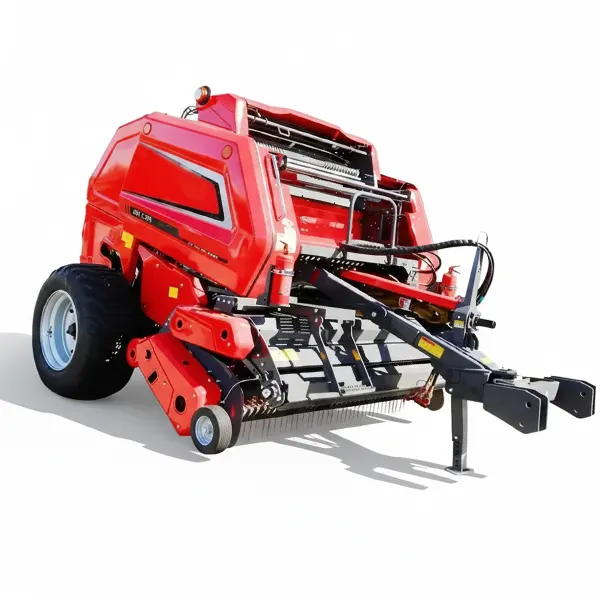
9YG-2.24D S9000 Ultra round baler
Choosing Between the 17, 15 and 12 Wheel Configurations
Our V-rake catalog gives American buyers three points on a single curve. The neutral comparison below uses our own published specifications for all three models so you can place the 9LZD-9.0 against its in-house alternatives at a glance. Bale baler pairing is listed at the bottom for fleet planning.
| Metric | 9LZD-9.0 (this page) | 9LZY-9.0 | 9LZ-6.0 |
|---|---|---|---|
| Working width | 9 m | 9 m | 6 m |
| Finger wheels | 17 | 15 | 12 |
| Total tines | 1020 | 900 | 720 |
| Tractor power | 55 - 75 kW | 50 - 55 kW | ≥ 25.73 kW |
| Implement weight | 1240 kg | 1100 kg | 1200 kg |
| Productivity | 7.2 - 9 ha/h | 7.2 - 9 ha/h | 4.2 - 6 ha/h |
| Best fit | Heavy-yield alfalfa, dense stover, irrigated grass | Mid-yield grass, native range | Small farms, narrow paddocks, hill country |
| Pairs cleanly with | 9YG-2.24D S9000 round baler | 9YG-1.25 round baler | 9YG-1.0 round baler |
If your operation also gathers large windrows behind extra-wide combine swaths, see the horizontal side-delivery 9LH-12 hay rake, which uses a different gathering geometry and reaches a 12 meter sweep.
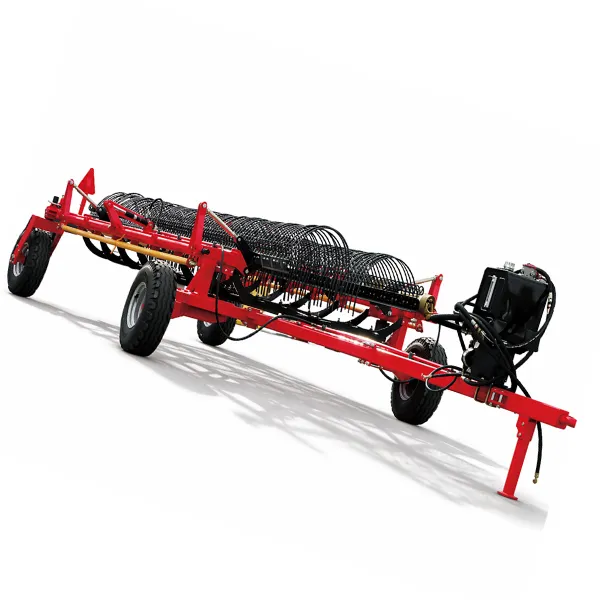
9LH-12 hay rake
Drivetrain Touchpoints and Companion Equipment
The 9LZD-9.0 itself runs entirely on ground-friction drive, so there is no PTO shaft, no input gearbox and no internal lubrication points beyond the wheel hubs. That keeps the implement profile clean and dramatically lowers maintenance overhead. The hydraulic side of the implement uses a single double-acting cylinder per wing for the fold and deploy cycle, plumbed through SAE quick-disconnects compatible with virtually every American utility tractor brand.
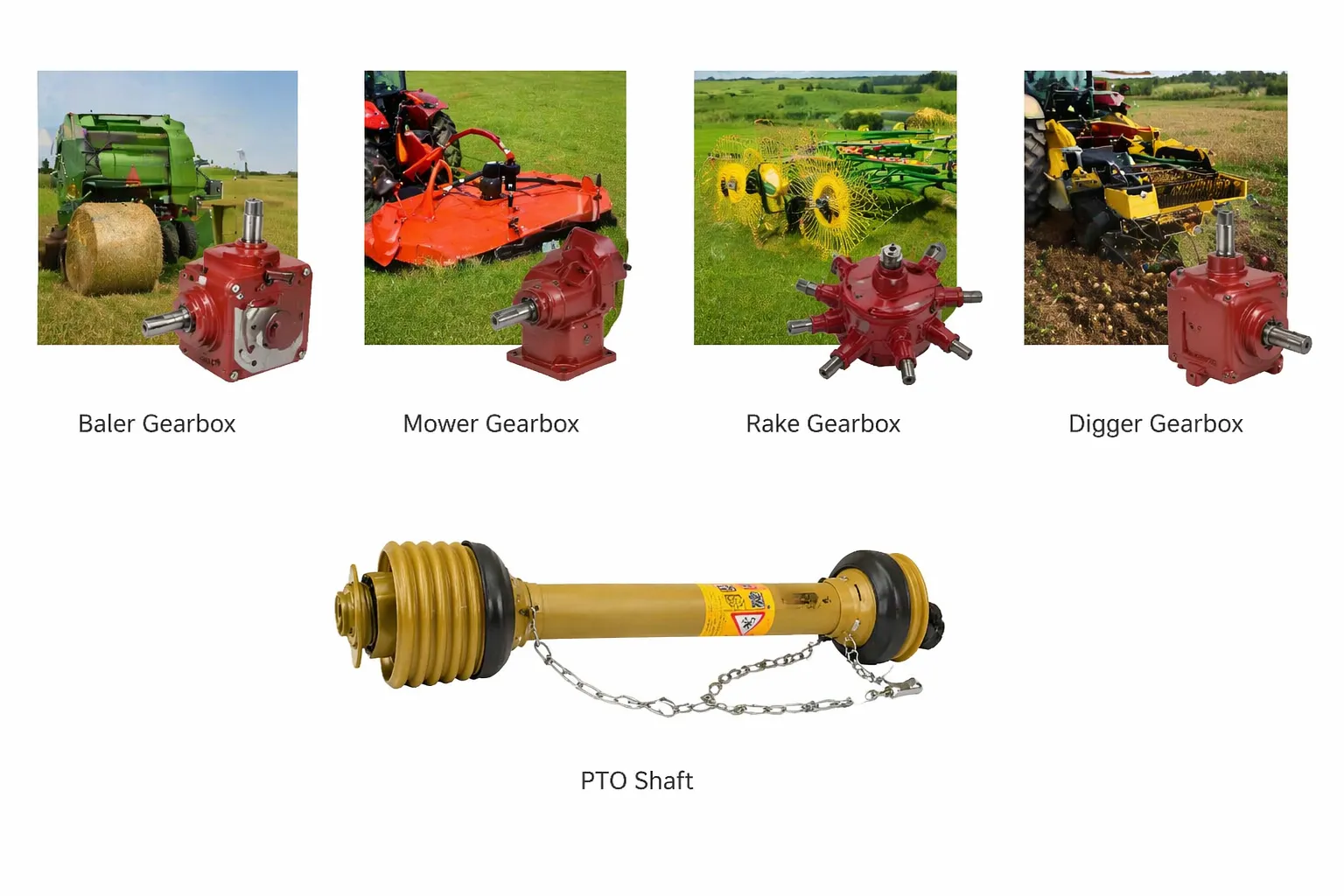
Where drivetrain selection matters is on the equipment that runs alongside this rake. A V-rake on its own is only as productive as the round baler and mower that flank it. Both of those companion machines do require precision-forged input gearboxes to handle peak intake torque. Operators replacing a worn baler bevel reducer, or specifying a new mower-conditioner driveline, should source a purpose-built agricultural right-angle gearbox that is sized for the cyclic shock loads typical of hay and forage work. The right gearbox absorbs the radial impact spikes of slug feeds, prevents premature bearing failure, and keeps the round baler chamber starting cleanly even on heavy windrows.
In a typical American hay workflow, the 9LZD-9.0 sits between the mower and the baler. A mower-conditioner cuts and crimps the crop, the rake gathers the cured material into a 0.8 to 1.2 meter windrow, and a round baler intakes that windrow at about 5 to 7 km/h. Productivity through the chain is set by the slowest link, and at 9 ha/h the rake is rarely the limiter. That is why operators upgrading to the 9LZD-9.0 often pair it with a high-throughput round baler at the same time, since the rake will out-pace any baler running at less than 60 bales per hour.
Maintenance Schedule and Service Calendar
Because the 9LZD-9.0 has no PTO drivetrain, no gearbox and no internal active machinery, daily maintenance is short. Most operators finish the start-of-day check inside ten minutes. The schedule below is the manufacturer recommendation under typical American hay and stover conditions; harsh sandy soils may need more frequent grease intervals.
| Service Item | Interval | Action |
|---|---|---|
| Tire pressure | Daily | Check all transport tires before deployment, inflate to factory spec. |
| Hydraulic hoses and couplers | Daily | Visual check for wear, leaks or chafing at swing points. |
| Spring tine inspection | Every 50 hours | Walk the implement, replace any tines that have lost spring or fractured. |
| Wheel hub grease | Every 500 hours | Pump fresh lithium grease into each finger wheel hub via the zerk fitting. |
| Wheel bearings | Every 1500 hours or annually | Inspect, repack with high-temperature bearing grease, replace seals if dry. |
| Hydraulic cylinder seals | Annually | Inspect rod for pitting, replace seal kit if oil weeping is visible. |
| Frame welds and bolts | Pre-season | Walk-around weld inspection, torque all critical bolts to spec. |
| Powder-coat touch-up | As needed | Spray-touch any chips on chassis to prevent corrosion penetration. |
Frequently Asked Questions
Q: What tractor horsepower do I need for the 9LZD-9.0?
A: The spec calls for 55 to 75 kW, which translates to roughly 75 to 100 horsepower at the drawbar. On flat ground a 75 horsepower utility tractor handles the rake comfortably at full 10 km/h working speed. On hilly terrain or in soft, recently irrigated soil, step up to a 90 to 100 horsepower tractor for better traction and safer braking on the road transit between paddocks.
Q: Does the 9LZD-9.0 require a PTO connection to the tractor?
A: No. The rake is fully ground-driven. The 17 finger wheels rotate purely by friction between the cut crop and the soil surface as the tractor pulls the implement forward. The only tractor-to-rake connection beyond the drawbar is one rear double-acting hydraulic remote that powers the fold-out cylinder.
Q: How does this compare to the lighter 9LZY-9.0 with 15 wheels?
A: Both rakes cover the same 9 meter working width. The 9LZD-9.0 carries 17 wheels with 1020 tines; the 9LZY-9.0 carries 15 wheels with 900 tines. The denser tine matrix on the 9LZD-9.0 closes spacing gaps that a 15-wheel rake leaves on heavy crop, which is why we recommend the 9LZD-9.0 for second-cut alfalfa, irrigated grass and corn stover, and the 9LZY-9.0 for lighter native range.
Q: How wide is the windrow it produces?
A: Windrow width is operator-controlled between 0.8 and 1.2 meters by adjusting tractor speed and the inner-wheel position. Most American round balers in the 4 ft to 5 ft chamber class want a windrow near 1.0 meter (about 39 inches). Slowing the tractor or tightening the inner wheels narrows the windrow; speeding up or widening loosens it.
Q: Can the rake handle wet, recently mowed alfalfa?
A: It can, but standard practice is to ted or air-cure the alfalfa first and use the 9LZD-9.0 only for the final consolidating pass before baling. Raking very wet alfalfa drags moisture into the windrow core and slows final dry-down. The gentle ground-driven motion does help preserve protein-rich leaves better than an aggressive rotary rake regardless of moisture.
Q: How is the implement shipped to the United States?
A: The 9LZD-9.0 is shipped in semi-knocked-down configuration inside a 40 ft High Cube ocean container. Multiple units fit per container, which keeps freight per implement low. Re-assembly is straightforward and uses standard hand tools; a two-person crew typically completes one unit in a long working day. Drive-on roll-on/roll-off shipment is also available for buyers who prefer fully assembled delivery.
Q: What happens if a finger wheel hits a buried rock or fence post?
A: Each wheel is mounted on a sprung pivot that allows it to flex upward over fixed obstacles. Individual spring tines are also designed to flex without taking permanent set, and any tine that does fail is bolted, not welded, so it can be replaced in the field in under three minutes with hand tools. We always include a spare tine bundle in the original delivery toolkit.
Q: How are spare parts sourced after the warranty period?
A: Wear parts are stocked at our Sacramento, California operations base. Spring tines, wheel hub bearings, hydraulic seal kits and quick-disconnect couplers ship same day or next day to most US destinations. Larger structural items can be air-freighted within a week if required during peak harvest. Retail lead time during off-season is typically two to four business days.
What American Operators Say About the 9LZD-9.0
Wade T. Holcomb, Hay Contractor, Amarillo, TX (June 2025)
We pull this rake behind a 95 horsepower utility tractor on contract wheat-stubble jobs. Three combine swaths consolidate into one clean windrow at 9 km/h, and our round baler picks it up without missing a beat. The 17 wheels handle our heavy-yield Texas Panhandle crops better than the 15-wheel rake we ran the previous two seasons. Miss rate on visual inspection is well under 2 percent.
Brett A. Lindstrom, Cattle Operation, Enid, OK (May 2025)
Bought the 9LZD-9.0 specifically to feed our round baler on cured Bermuda hay. Productivity is honest. We measured 8.3 hectares per hour on a clean 200 acre paddock last cut, which is roughly 20.5 acres per hour. The fact that this rake does not need PTO is the biggest day-to-day win, because our older tractor's 540 stub was getting tired and we did not have to fix it before harvest.
Andrea M. Beltran, CRP Hay Operator, Grand Island, NE (August 2024)
CRP releases happen on short notice and we run with whatever weather window FSA gives us. The 9 meter sweep cuts our raking time in half versus our old 6 meter rake, and the 17 wheels float over the rough native range without bottoming the central beam. Hydraulic fold-up to 3.9 meters lets us move between scattered CRP tracts without unbolting anything.
Cole D. Hartmann, Custom Baler, Pierre, SD (September 2024)
I run a custom baling outfit and the rake choice matters because chamber feed quality determines bale shape. The 9LZD-9.0 lays down a windrow that is honest 1.0 meter wide all the way through the field, no clumps, no gaps. My round baler chamber stays loaded evenly, which means square-shouldered bales that stack four high in the customer's barn without falling over.
Tyler J. Knudsen, Alfalfa Producer, Bismarck, ND (July 2025)
Switched off a rotary rake last year because we were losing too many leaves on second-cut alfalfa. The 9LZD-9.0 ground-driven approach is gentle. Our RFV grades came back noticeably higher this season and the dairy buyer paid the premium without negotiation. Worth the implement cost on a single 480 acre cut.
Marisol R. Vargas, Stover Bedding Supplier, Salina, KS (October 2024)
We supply corn-stover bedding to four feedlots inside a 60 mile radius. The 9LZD-9.0 keeps up with our chopper-head combine pace, which is what made it the right choice for us. The 1240 kg implement weight is light enough that our 90 horsepower tractor pulls it without ballast. Service response from the Sacramento parts desk has been fast both times we needed replacement spring tines.
Ready to Quote Your 9LZD-9.0?
Send your tractor model, average acreage and crop mix to our Sacramento operations base. A US-based agronomist will return a tailored quote, freight estimate and delivery window within one business day.
Additional information
| Editor | Cxm |
|---|