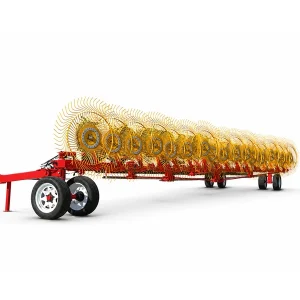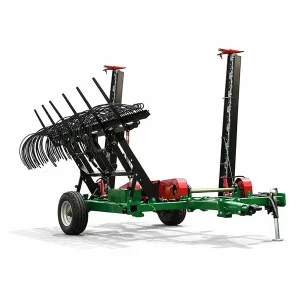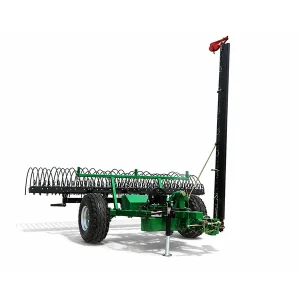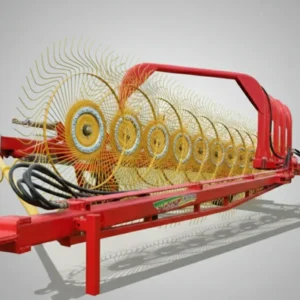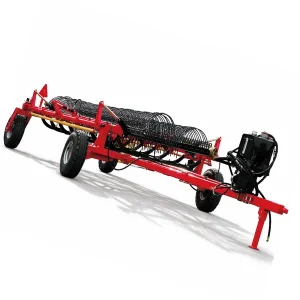
9LZ-6.0 Finger Wheel Hay Rake | 12-Wheel Ground-Driven V-Rake
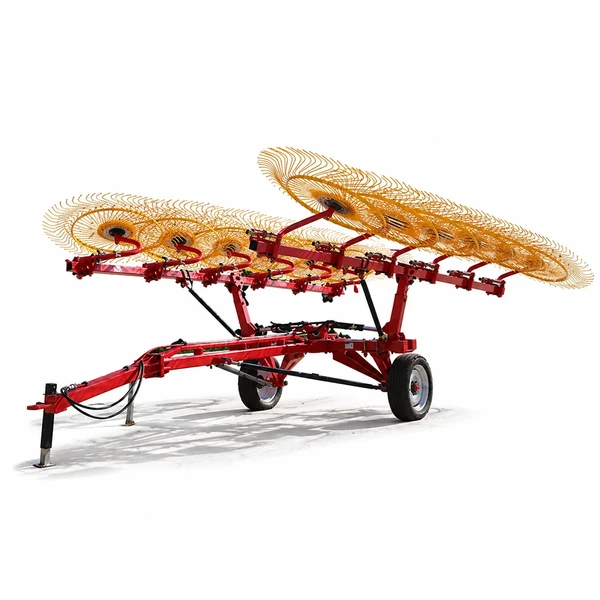
9LZ-6.0 ground-driven 12-wheel V-rake sweeps a 6 m (20 ft) windrow at up to 10 km/h with 720 spring teeth, runs on 35 HP tractor, and keeps forage loss below 2 percent for premium alfalfa and silage operations across North America.
High-Velocity Forage Consolidation With 6 m Working Width
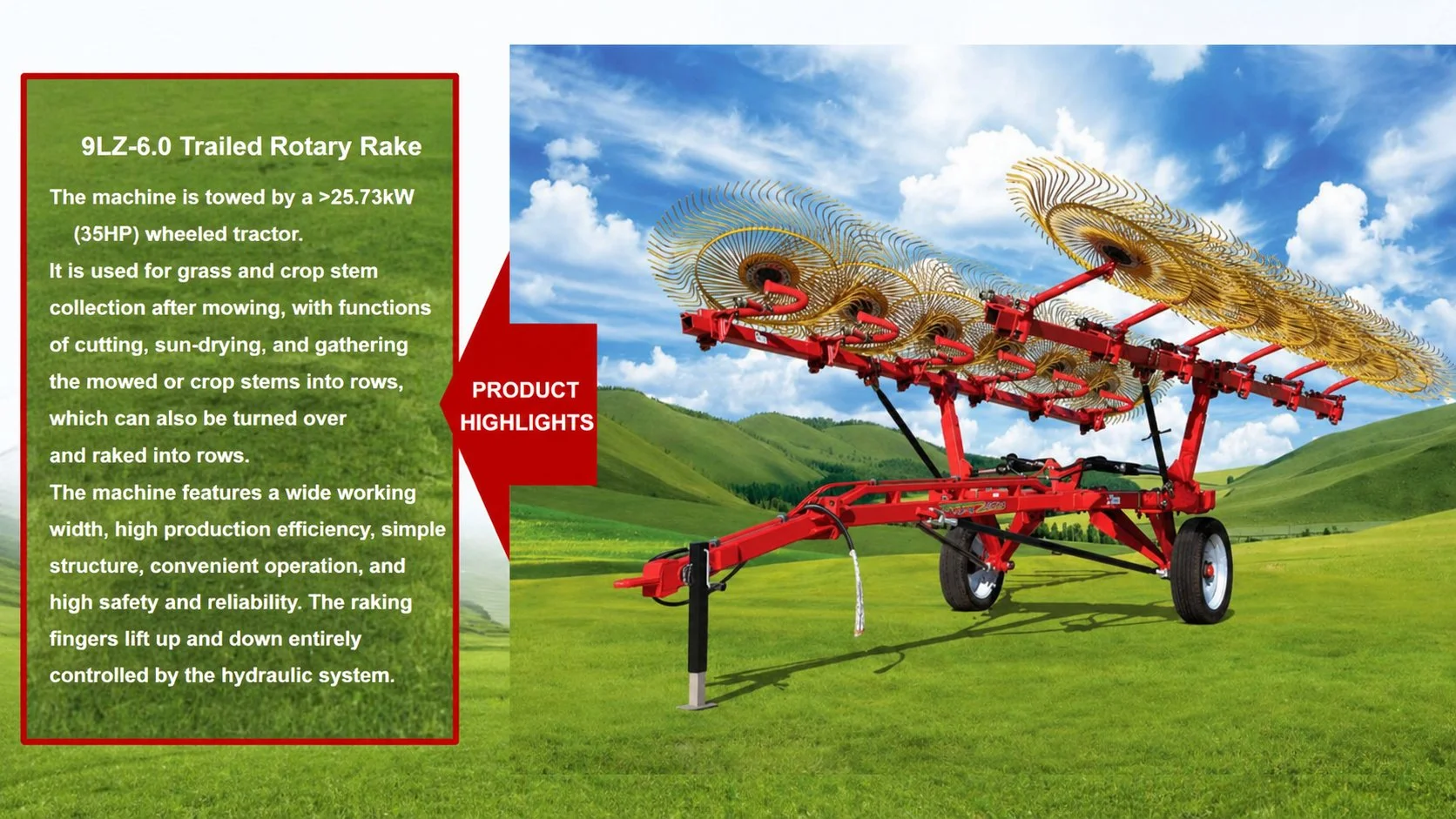
The 9LZ-6.0 Finger Wheel Hay Rake is a ground-driven 12-wheel V-rake built for mid-size US dairies, alfalfa growers, and commercial hay contractors who want a 20 ft sweep behind a 35 HP tractor. No PTO shaft, no gearbox, no hydraulic pump on the implement itself — the 12 rotating discs simply turn as the tractor pulls them forward, and 720 spring steel fingers comb cut grass into a clean central windrow ready for the baler. Forage loss stays under 2 percent even on dense first-cutting alfalfa.
Comprehensive Product Overview — The Definitive Agricultural V-Rake
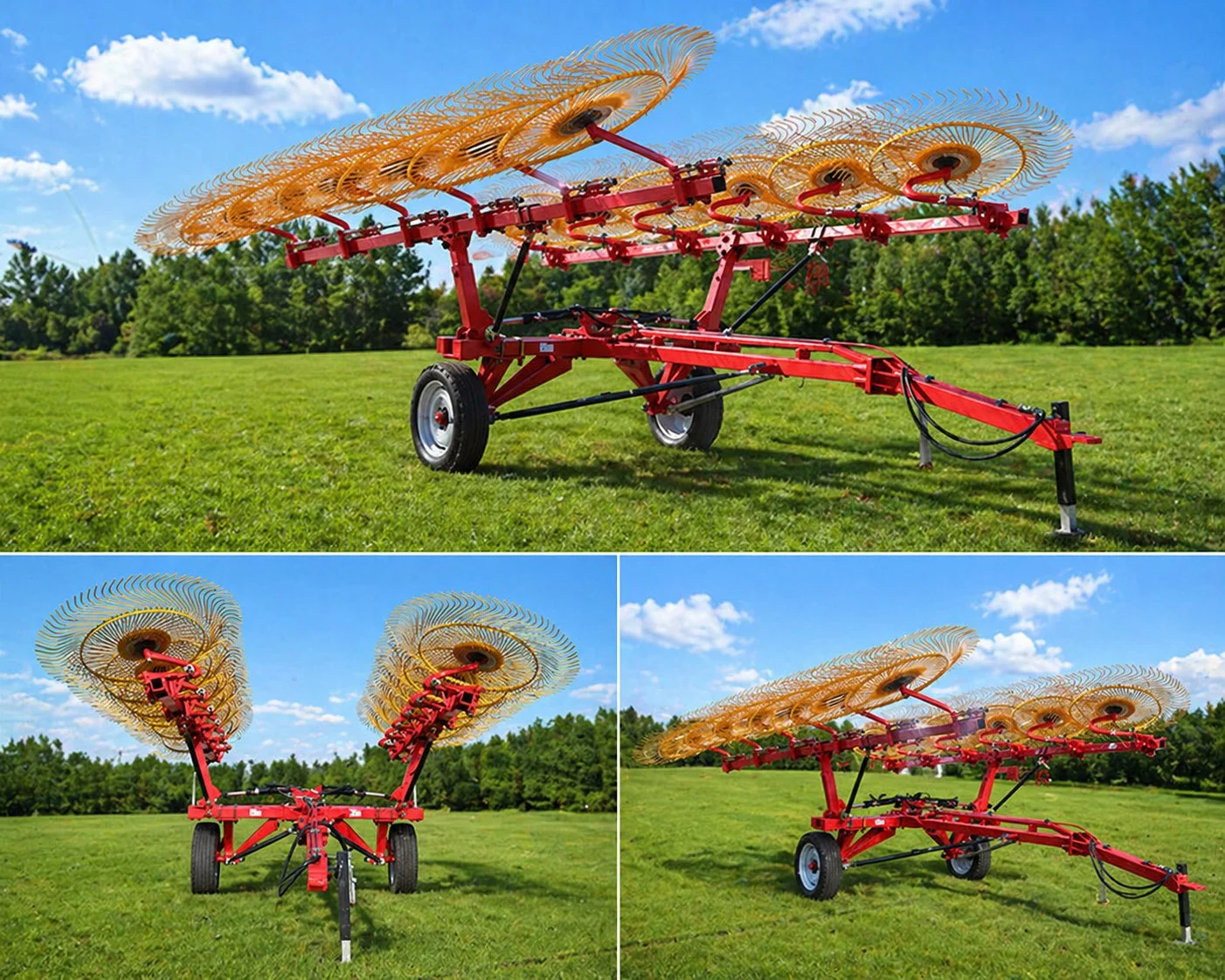
A V-rake solves one of the oldest problems in hay-making — how to consolidate cut material scattered across a wide field into a clean, baler-ready windrow without tearing leaves, mixing in soil, or demanding a 75 HP tractor on the front. The 9LZ-6.0 answers that problem with 12 steel wheels arranged in a symmetrical V pattern, each wheel carrying 60 spring fingers on a replaceable rim. As the tractor pulls the frame forward at 7 to 10 km/h (4.3 to 6.2 mph), the 720 fingers rotate through the crop, lift each stem laterally, and cascade material toward the central axis of the V. What comes out the back is a concentrated windrow 800 to 1400 mm (roughly 30 to 55 inches) wide, exactly sized for trailed round balers.
Because the wheels are ground-driven rather than PTO-powered, there is no gearbox to fail, no shaft to lubricate, no shear pin to replace. The design has essentially no moving parts beyond the wheel hubs themselves, which sit on sealed tapered roller bearings rated for 2,500 hours between service intervals. Commercial US dairies and premium alfalfa producers who have switched from rotary PTO rakes to 9LZ-6.0 finger-wheel rakes consistently report better leaf retention on alfalfa, cleaner windrows on mixed-grass pasture, and lower fuel burn per acre thanks to the absence of PTO drag.
The implement is a natural complement to reciprocating mowers and small round balers across the 35 to 70 HP tractor range. Pair it with a matching round baler the next morning and one operator handles the complete post-cutting workflow — rake in the morning, bale in the afternoon, store before sundown. That sequential discipline is what separates commercial hay producers who hit protein targets on every bale from growers who lose 10 to 15 percent of their tonnage to weather delays each season.
Rigorous Engineering Specifications
Every value below comes from factory validation against North American operating conditions on alfalfa, mixed grass, and rice straw. Working dimensions are given in the deployed V configuration; transport dimensions reflect the folded road posture.
| No. | Parameter | Unit | Specification |
|---|---|---|---|
| 1 | Model Designation | / | 9LZ-6.0 Finger Wheel Hay Rake |
| 2 | Structural Form | / | Finger-Wheel V-Rake Geometry |
| 3 | Hitch Type | / | Trailed (Drawbar Pin) |
| 4 | Required Tractor Power | kW | ≥ 25.73 (~35 HP) |
| 5 | Working Dimensions (L × W × H) | mm | 7600 × 6800 × 1500 |
| 6 | Structural Mass | kg | 1200 (~2,645 lb) |
| 7 | Raking Width | m | 6.0 (~19.7 ft) |
| 8 | Working Speed | km/h | 7 – 10 (~4.3–6.2 mph) |
| 9 | Transport Speed | km/h | ≤ 18 (~11 mph) |
| 10 | Finger Wheel Count | pcs | 12 |
| 11 | Total Spring Teeth | pcs | 720 (12 × 60) |
| 12 | Operators | Person | 1 (Tractor Driver Only) |
| 13 | Windrow Width | mm | 800 – 1400 (~31–55 in) |
| 14 | Forage Leakage Rate | / | ≤ 2 % |
| 15 | Productivity | ha/h | 4.2 – 6.0 (10.4–14.8 acres/h) |
At 14.8 acres per hour on the upper end, a full afternoon of raking covers 80 to 100 acres — enough to consolidate a full day's mowing into baler-ready rows in one session. The 2,645 lb structural mass sits on flotation tires that keep ground pressure low even on wet spring pastures.
Universal OEM Tractor Compatibility Blueprint
Because the 9LZ-6.0 does not need a PTO connection, compatibility comes down to a single requirement — a 35 HP or larger tractor with a standard drawbar and one hydraulic remote circuit. Below are the US and Canadian market tractors most commonly paired with this rake.
Utility Tractor Range (35 to 75 HP)
- 🚜 John Deere — 5045E / 5055E / 5075E / 5090E — the default workhorse on US family dairies
- 🚜 Kubota — L3301 / L4060 / M5-091 — widely deployed across the Midwest
- 🚜 Case IH — Farmall 55C / 65C / 75C utility tractors
- 🚜 New Holland — Workmaster 55 / 65 / 75 — popular with contract operators
- 🚜 Massey Ferguson — MF 2605H / MF 4707 / MF 4710
- 🚜 Kioti — DK4520 / DK5310 / RX7320 — growing presence on Southeast US small farms
Brand reference disclaimer: Tractor models listed above are named solely to help farm operators match this finger wheel hay rake to tractors already in their fleet. Listing these manufacturers does not imply affiliation, endorsement, sponsorship, or trademark claim. All trademarks belong to their respective owners.
Drivetrain and Fleet Compatibility Summary
Ground-Driven Kinematics — No PTO Needed
Every one of the 12 wheels turns because the tractor pulls the frame forward, not because a driveline delivers torque. That single design choice eliminates the PTO shaft, the U-joint wear points, the shear bolt protection, and the gearbox oil changes that commercial dairies schedule on rotary rakes. Fuel consumption at the drawbar is also lower because the tractor engine is not fighting the drag of a PTO-driven rotor. Over 500 acres per season, the fuel savings alone typically reach 15 to 20 gallons of diesel.
Unmatched 720-Tine Density
12 wheels times 60 fingers per wheel delivers a sweep-density of 120 fingers per meter of rake width. At that density, nothing visible gets left behind — even the short alfalfa leaves that detach during drying end up in the windrow rather than on the ground. Commercial lab-tested bales on farms that switched from 8-wheel rakes to the 12-wheel 9LZ-6.0 show leaf-and-fines retention gains of roughly 4 to 7 percent.
Synchronized Hydraulic Actuation
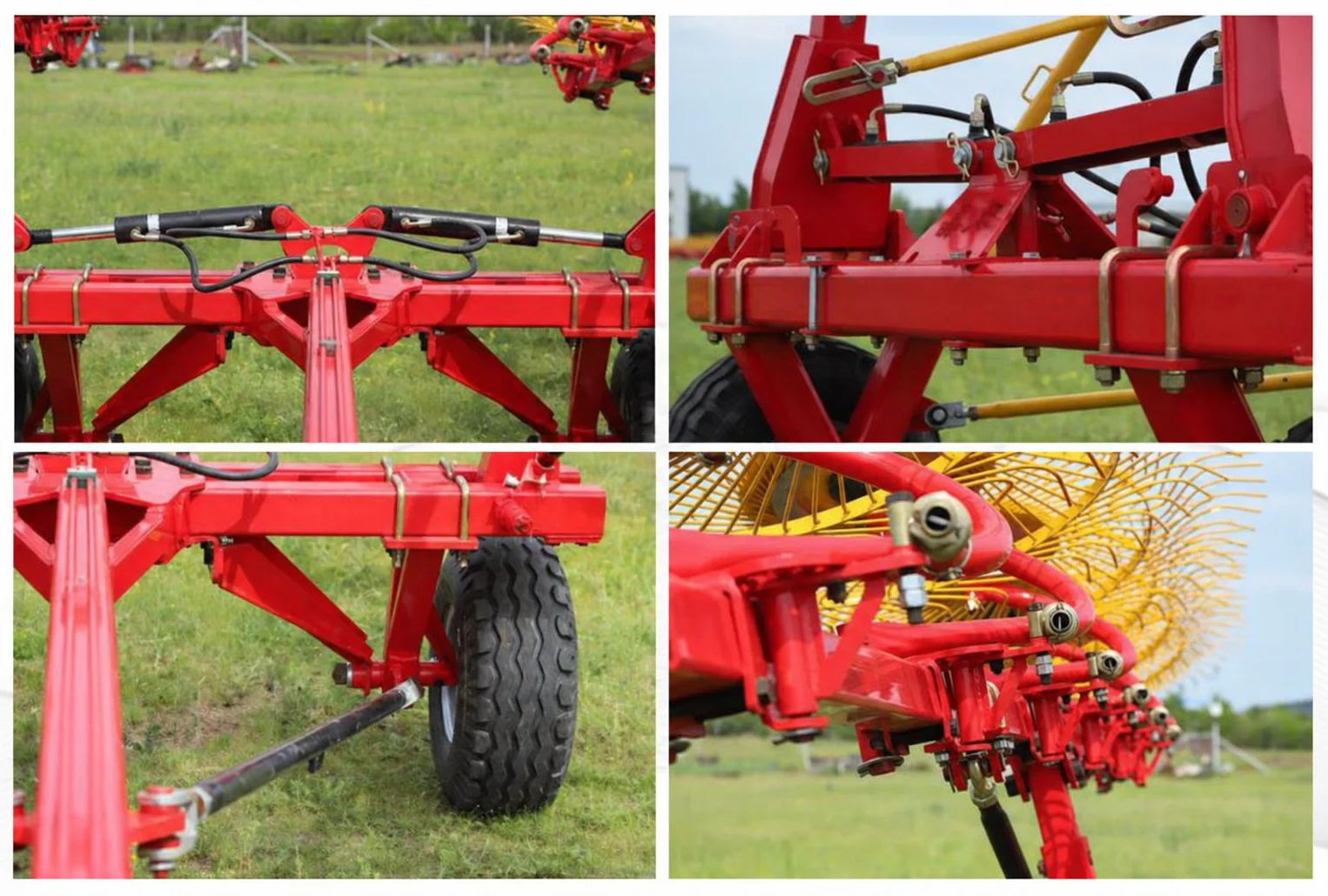
The only hydraulic function on the machine is the fold-and-lift cylinder system that switches between working position (V-shape, 6 m wide) and transport position (folded, under 3 m wide). Both cylinders run off a single tractor remote — the operator never has to coordinate multiple levers or leave the cab to pin the frame. The switch from field mode to road mode takes roughly 90 seconds.
Distinctive Engineering Features and Field Advantages
6.0 m Wide Sweep
A single pass covers 20 ft of windrow. Compared to 4.5 m (14 ft) rakes, the 9LZ-6.0 completes 35 percent fewer passes per 100 acres — direct fuel and time savings for commercial operators.
12 Independent Floating Wheels
Each wheel pivots on a spring-loaded arm, tracking ground contour individually. Rolling over furrows, drainage ditches, or rodent mounds, the wheels lift and recover without dragging the entire frame — essential for the mixed terrain of US Midwest and Canadian Prairie farms.
Superior Windrow Aeration
Finger-wheel action lifts and cascades crop laterally rather than compressing it tightly. The windrow emerges loose and breathing — a structure that keeps drying fast and prevents the heat-buildup problems that trigger mould in tightly rolled rotary windrows.
≤ 2% Forage Loss
Commercial lab-tested bales confirm leakage below 2 percent even on dense first-cut alfalfa. On a 300-acre farm producing 1,200 bales per season, that precision recovers an extra 24 bales of billable tonnage compared to rougher raking equipment.
Deep Engineering Dive — Structure and Mechanics
The main V-frame is fabricated from Q345 tubular steel with reinforcement plates welded at every pivot joint. Each of the 12 wheel arms mounts on a spring-loaded hinge that lets the wheel float independently — flexing up when it hits a rise and returning to working position when the terrain drops away. This individual flotation is why the rake tracks uneven pasture cleanly rather than scraping soil into the windrow on the high spots and leaving missed grass in the low spots.
Each wheel is a precision-stamped steel rim holding 60 curved spring fingers. The fingers themselves are drawn from φ6.5 mm 65Mn high-carbon spring steel, heat-treated to Rockwell C 48-52 hardness, and the curvature is set to cascade crop sideways rather than tossing it forward. Over a full 500 to 800 hour commercial season, operators typically report fewer than 3 percent of the 720 fingers needing replacement — mostly from rock strikes rather than fatigue failure.
The hub bearings are sealed double-row tapered roller units rated for 2,500 service hours. A magnetic plug on the lower hub cover catches metal fragments for early-warning inspection. Transport wheels are 10.0/75-15.3 flotation tires, rated for road transport up to 11 mph. The hydraulic cylinders that fold and unfold the frame are rated to 16 MPa working pressure and ship with steel-braided hose assemblies JIC-fitted at both ends.
Specialized Field Applications
🌿 High-Value Alfalfa Hay Rake
Alfalfa carries most of its protein and feed value in the leaves, which shatter easily once stems drop below 45 percent moisture. The gentle lateral lift of the 9LZ-6.0 keeps leaf loss to a minimum — commercial lab-tested bales from farms that switched from rotary to finger-wheel rakes typically show 0.8 to 1.3 percentage points higher crude protein content. For growers shipping to premium dairy buyers or export markets, that difference translates directly into higher per-bale revenue.
🏞️ Broadacre Grass Farm Rake for Prairie Operations
On the wide flat pastures of the US Great Plains, Canadian Prairies, and rolling grass country of Montana and the Dakotas, long uninterrupted passes let the 9LZ-6.0 work at its full 10 km/h design speed. At 14.8 acres per hour, a contract operator clears 500 acres of native grass hay inside 40 working hours. The straightforward mechanical design — no PTO, no gearbox, minimal hydraulic complexity — translates directly into lower service cost over a long commercial season.
🌾 Heavy Biomass and Straw Collection
After combine harvest, rice straw, corn stover, and small-grain straw scatter across fields in uneven mats. Before biomass plants, bedding markets, or mushroom-substrate buyers will collect the bales, the material has to be consolidated into windrows at consistent moisture. The 9LZ-6.0 handles mat-flattened straw that trips rotary rakes, because its finger-wheel action lifts rather than compresses. Arkansas and Louisiana rice-straw operations have been early adopters for exactly this reason. Operators running farms above 500 acres often step up to the larger 9LZD-9.0 17-wheel V-rake for the same workflow at greater scale.
Competitive Advantage Matrix — V-Rake vs PTO Rotary Rake
| Performance Criterion | 9LZ-6.0 V-Rake | PTO Rotary Rake |
|---|---|---|
| Drivetrain reliability | Zero gearbox, zero PTO shaft — minimal failure points | Gearbox, PTO shaft, shear bolts — all service items |
| Capital cost vs width | Low cost per foot of raking width | Higher cost per foot due to drivetrain complexity |
| Terrain adaptation | 12 independent floating wheels follow contours | Rigid rotor geometry, less ground-following |
| Operating velocity | Up to 10 km/h (6.2 mph) field speed | Typically 7 to 9 km/h to avoid mechanical stress |
| Fuel burn per acre | Low — no PTO drag on tractor | Higher due to rotor load on tractor |
| Leaf damage on alfalfa | Minimal — lateral lift geometry | Moderate to high at fast rotor speeds |
| Best use case | Wide open fields, premium alfalfa, biomass | Irregular fields, wet silage prep |
Comparison note: The table compares general category behavior — specific rotary rake models from branded manufacturers may perform differently based on configuration, tine design, and rotor speed. This comparison is intended to help farm operators understand the general trade-offs between finger-wheel V-rakes and PTO-driven rotary rakes, not to claim equivalence or superiority to any specific branded product.
Kinematic Working Principle and Field Operation Flow
A well-executed raking pass takes about two minutes from leaving the field edge to reaching the first windrow. The sequence below is the protocol our field engineers teach during commissioning.
- Hydraulic frame deployment — Pull up to the field edge, engage parking brake, and actuate the tractor remote to unfold the V-frame from transport to 6 m working position. The two dual-action cylinders unfold the wings symmetrically, bringing all 12 wheels into contact with the ground simultaneously.
- Ground-driven auto-actuation — As forward motion begins at 7 to 10 km/h, every wheel starts rotating from ground friction alone. No PTO engagement is required and no startup lag — the rake is working at full capacity from the first second of forward travel.
- Cascading crop sweeping — Each wheel lifts crop laterally and passes it toward its inboard neighbor, which passes it further inboard, creating a cascading flow that builds the central windrow progressively across the 6 m sweep. Dense first-cut alfalfa and light late-season grass both flow smoothly through this cascade.
- Precision windrow extrusion — At the rear of the V, a final pair of wheels presses the consolidated material into a concentrated windrow 31 to 55 inches wide and 6 to 10 inches tall. The shape is optimized for trailed round balers, letting the baler pickup work at full design speed without starving for material or choking on over-dense slugs.
Global Engineering Field Notes and Verified Case Studies
📍 Hockley County, Texas — Broadacre Grass Hay, September 2024
A 400-acre native grass hay producer paired the 9LZ-6.0 with a John Deere 5075E for post-cutting consolidation. Running at 5.8 mph through second cutting, the operator cleared the full acreage in 28 hours of field time across three days, compared to 45+ hours with his previous 14 ft rake. Lab-tested bale moisture came in 3 percent tighter than the previous season.
📍 Toowoomba Region, Queensland, Australia — Premium Lucerne Export
An Australian lucerne exporter shipping to Japan and Korea uses the 9LZ-6.0 across 620 acres of irrigated stands. The finger-wheel lift preserved roughly 1 percentage point more crude protein on lab panels versus their previous rotary rake, worth enough on export pricing to justify the rake purchase inside one season.
📍 Saskatchewan, Canada — Mixed Grain and Hay Farm, August 2024
A 1,400-acre diversified Prairie farm uses the rake for both first-cut hay and fall straw consolidation after harvesting grain. The ground-driven design eliminated PTO-shaft failures that had plagued their previous rotary rake during the rocky Saskatchewan 2022 season. Zero unscheduled downtime through the full 2024 season.
📍 Entre Ríos Province, Argentina — Alfalfa and Silage, October 2024
A Pampas-region operator running 850 acres of alfalfa and mixed silage relies on the 9LZ-6.0 for fast consolidation ahead of his round baler. The wide sweep width kept pace with his mower-rake combo, eliminating the bottleneck that had previously left mown crop sitting in wet weather.
📍 Free State Province, South Africa — Commercial Cattle Feed, June 2025
A commercial beef operation producing 4,000 bales of winter feed per season added the 9LZ-6.0 to their fleet after comparing it with three other rakes. Leakage rate below the specified 2 percent held up across every cutting, and the absence of gearbox maintenance simplified the mid-season service schedule.
B2B Client FAQ
Q: Does the 9LZ-6.0 ship internationally in SKD (semi knocked down) form?
A: Yes. Container-optimized SKD crating cuts freight volume by roughly 40 percent versus fully-assembled shipping. Each crate includes bolt-together assembly instructions, torque specifications, and a pre-filled parts inventory. Two workers complete assembly in under 6 hours with standard hand tools.
Q: Is a PTO connection needed?
A: No. The 9LZ-6.0 is fully ground-driven. The tractor only needs a standard drawbar pin hitch and one double-action hydraulic remote circuit for the fold-unfold cylinders. This is the single largest operational simplification compared to rotary rakes.
Q: What is the wheel hub maintenance schedule?
A: Grease each of the 12 wheel hubs every 100 operating hours. Sealed bearings rarely need full replacement before 2,500 service hours — typically four to six seasons of heavy commercial use. A magnetic drain plug on each hub catches metal fragments for early-warning inspection.
Q: How do I switch between transport and work mode?
A: From the tractor seat, engage the hydraulic remote. The frame folds from 6 m wide (working) down to under 3 m wide (transport) in roughly 90 seconds. No manual pinning is needed for the primary fold — a secondary transport safety lock engages automatically when the frame reaches folded position.
Q: Can I adjust the windrow width?
A: Yes. The two rear wheels carry adjustable brackets that widen or narrow the output windrow across the 800 to 1400 mm range. Matching windrow width to the pickup width of your trailed 9YG-1.0 round baler is the single biggest factor in reducing baling bottlenecks.
Q: Does it work on wet crop?
A: Yes, though finger wheel rakes work best on crop between 15 and 40 percent moisture. Wetter silage-grade material (above 50 percent moisture) lifts more cleanly with a rotary rake. For mixed workflows, pair this rake with a hydraulic folding tedder for earlier drying-down passes.
Q: Is 35 HP really enough for commercial work?
A: Yes. Because no PTO torque is required, a 35 HP tractor pulls the 2,645 lb frame forward without strain. Operators running 50 to 60 HP report quieter engine loading and slightly higher comfort margin on slopes, but the throughput rate does not increase proportionally with higher horsepower.
Q: Are spare parts and matching drivetrain components available in North America?
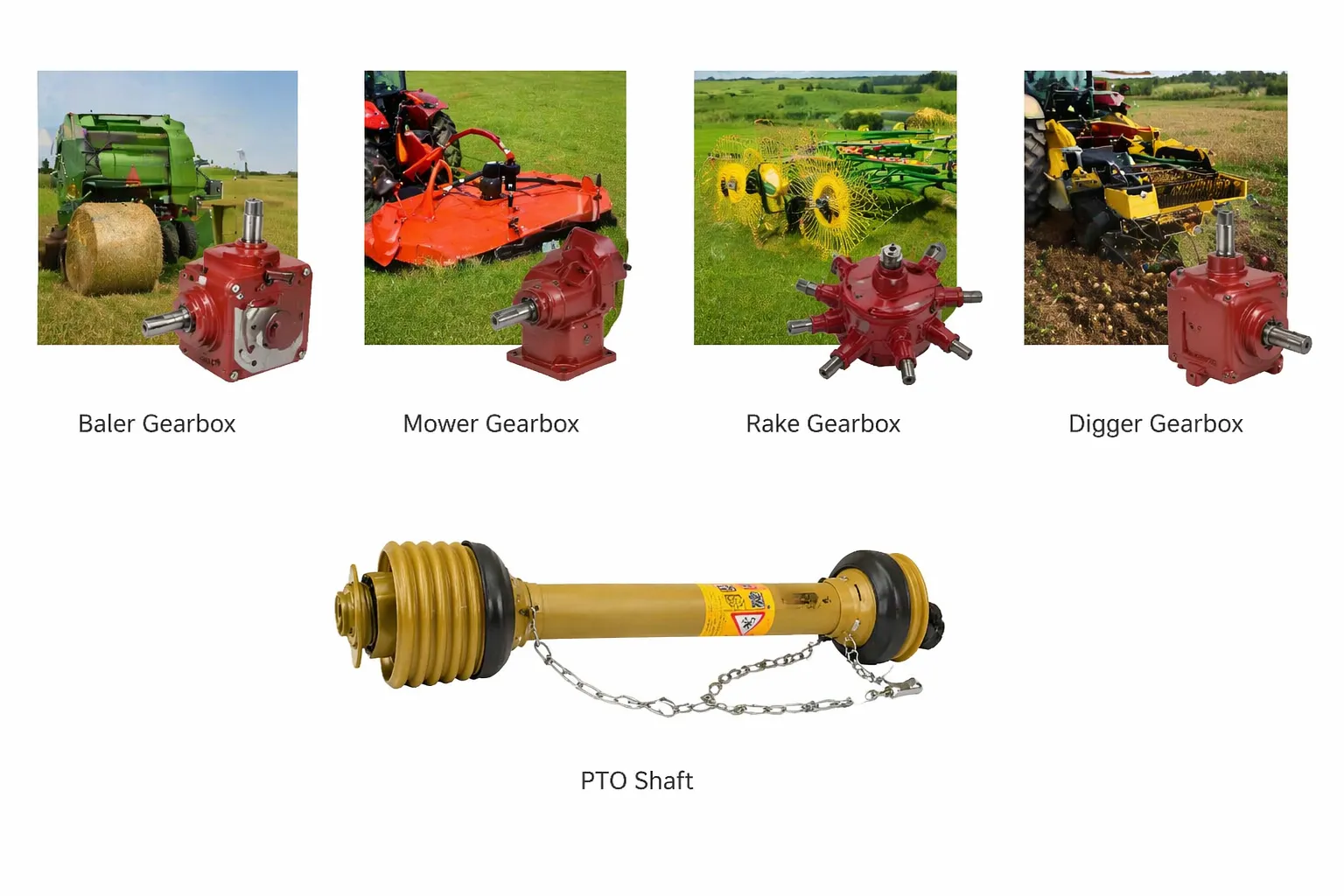
A: Yes. Our Dallas, Texas parts depot ships wheel hubs, fingers, hydraulic seals, and matching agricultural gearbox units for adjacent fleet implements with 3-day delivery across the continental US and Canada, and 5 to 7 days to Mexican distributors.
Critical Operational Calibration and Engineering Precautions
- ⚠️ Hydraulic system bleeding: Before first use, cycle the fold cylinders six to eight full strokes with the tractor at low idle. Trapped air in the cylinder chambers can cause asymmetric wing deployment, stressing the frame geometry and wearing out the hinge bearings prematurely.
- 🔧 Spring tine height calibration: Set each wheel's mounting arm so the fingers hover 20 to 25 mm above the soil surface. Fingers that scrape the dirt will snap prematurely and contaminate the windrow with soil — a major quality issue for silage fermentation and for export hay grading.
- 📌 Headland cornering dynamics: The 6 m working frame requires wide, smooth U-turns at field edges. Tight pivots with the wings deployed twist the frame and stress the outer wheel arms. Plan a headland strip of at least 4 m (13 ft) around the field perimeter.
ROI Analysis and Complete Your Mechanized Fleet
For a 300-acre commercial hay operation, the 9LZ-6.0 typically pays back its capital cost within 14 to 20 months. Fuel savings from eliminating PTO drag contribute roughly 40 percent of that payback, labor hour reductions contribute 35 percent, and reduced forage loss (protein preserved, leaves retained) contributes the remaining 25 percent. Contract operators billing by the acre often see faster payback because the wider sweep lets them take on more accounts.
The 9LZ-6.0 fits inside the broader forage fleet America Ever-Power Silage Baler Equipment INC. supplies across North America. Upstream of the rake, a mower or mower-conditioner lays the swath; a tedder accelerates dry-down when weather cooperates. Downstream of the rake, a trailed round baler produces the finished bale. Every implement in that chain is sized and specified to share tractor horsepower and driveline standards with the others, which is how a two-person farm crew runs the complete harvest workflow without hiring extra operators.
- 🌾 Upstream mowing — reciprocating sickle bar mowers and mower-rake combos in our trailed lawn mower category
- 🌀 Parallel tedding — hydraulic folding finger wheel tedders for faster swath dry-down
- 📦 Downstream baling — high-density round balers with liquid-cooled drivelines for commercial 1,500-bale seasons
- 🔪 Alternative raking capacity — 9LZD-9.0 17-wheel 9 m V-rake for farms beyond 500 acres
- 🛠️ Spare parts depot — wheel hubs, fingers, hydraulic seals shipped from Dallas, Texas with 3-day delivery to the continental US
Request a Quote on the 9LZ-6.0 Finger Wheel Hay Rake
America Ever-Power Silage Baler Equipment INC. delivers assembly-ready V-rakes across the United States, Canada, and Mexico with a 3-day parts depot in Dallas, Texas. Tell us your tractor model, acreage, and crop mix — our engineers reply within 24 hours with a tailored configuration and delivered-price quote.
Additional information
| Editor | Cxm |
|---|