簡単な回答
ベールサイレージ (rhymes with “silage”) is hay that is baled at 40 to 55 percent moisture using a ラウンドベーラー または 飼料ベーラー, then wrapped in 6 to 8 layers of stretch polyethylene film within 2 to 4 hours of baling. The airtight wrapping triggers anaerobic lactic acid fermentation that preserves the forage at a stable pH of 4.0 to 4.5 for 12 to 18 months. Baleage retains 88 to 95 percent of the standing crop’s crude protein compared to 82 to 92 percent for dry hay, requires only 4 to 12 hours of field wilting instead of 2 to 4 days, and stores outdoors without cover or ground preparation.
The Fermentation Science: What Happens Inside a Sealed Bale
Baleage preservation is not drying. It is controlled bacterial fermentation — the same biological process that produces yogurt, sauerkraut, and pickles. Understanding the 4-phase fermentation timeline explains why every production step matters and why shortcuts produce spoiled feed instead of preserved feed.
- Phase 1: Aerobic Respiration (0 to 6 hours after wrapping)
The small amount of oxygen trapped inside the sealed bale is consumed by plant cells and aerobic bacteria. The temperature rises 5 to 15°F above ambient. This phase should be as short as possible because every sugar molecule consumed by aerobic bacteria is a sugar molecule unavailable for the lactic acid bacteria in Phase 2. This is why wrapping within 2 hours of baling is critical — faster wrapping means less trapped oxygen and a shorter aerobic phase. - Phase 2: Active Fermentation (6 hours to 14 days)
Once the oxygen is consumed, anaerobic conditions dominate. Lactic acid bacteria (LAB), primarily Lactobacillus species that are naturally present on the forage surface, begin converting water-soluble carbohydrates (plant sugars) into lactic acid. The pH drops rapidly from 6.0 to 6.5 (fresh forage) toward the target of 4.0 to 4.5. The temperature stabilizes and then slowly declines. The rate of pH drop depends on the sugar content of the forage (higher sugars = faster drop), the moisture level (45 to 55 percent optimal), and the density of the bale (denser = less residual oxygen = faster anaerobic onset). A サイレージベーラー that produces a denser bale at 3,000 PSI hydraulic pressure creates the conditions for faster, more complete fermentation than a standard round baler at 1,500 to 2,000 PSI. - Phase 3: Stable Storage (14 days to 18 months)
Once the pH reaches 4.0 to 4.5, the acid environment inhibits further bacterial activity — including the activity of spoilage organisms like Clostridia, Listeria, and mold fungi. The bale enters a stable state where no significant biological change occurs as long as the film seal remains intact. The forage can remain in this stable state for 12 to 18 months without measurable nutrient loss beyond the 3 to 8 percent of dry matter consumed during the fermentation itself. - Phase 4: Aerobic Spoilage (begins at film puncture or opening)
When the film is removed for feeding (or punctured by wildlife or debris), oxygen floods the anaerobic environment. Aerobic spoilage organisms — primarily yeasts and molds — activate immediately, consuming the lactic acid, raising the pH, and generating heat. Visible mold appears within 48 to 72 hours. The bale must be fed within 3 to 5 days of opening to avoid significant spoilage loss.
The 6-Step Baleage Production Process
Step 1: Mow at Optimal Maturity
Cut the forage with a ディスクモア at the same maturity stage you would for premium dry hay: late bud to 10 percent bloom for alfalfa, boot to early heading for grasses. Fermentation preserves quality — it does not improve it. Cut at peak maturity to lock in maximum protein and energy.
Step 2: Wilt to 40 to 55 Percent Moisture (4 to 12 Hours)
The forage must lose enough moisture to concentrate the sugars for effective fermentation but retain enough water for LAB activity. In hot, dry conditions the target is reached in 3 to 5 hours. In cool, humid conditions, 8 to 12 hours may be required. A tedder pass at 2 to 3 hours accelerates the wilt on slow-drying days. Monitor with a moisture probe. The sweet spot is 45 to 50 percent — the zone where sugar concentration, bacterial activity, and pH drop rate all peak simultaneously.
Step 3: Rake Into Heavy Windrows
Use a フィンガーホイールレーキ to merge 2 to 4 swaths into a single dense windrow. Baleage windrows should be heavier than dry-hay windrows because the wet forage compresses more readily, and the forage baler needs a full-diameter bale to achieve the target density. A thin windrow produces a small, light bale that ferments poorly because the low mass-to-surface-area ratio allows too much oxygen infiltration through the film layers.
Step 4: Bale With a Silage Baler at Maximum Density
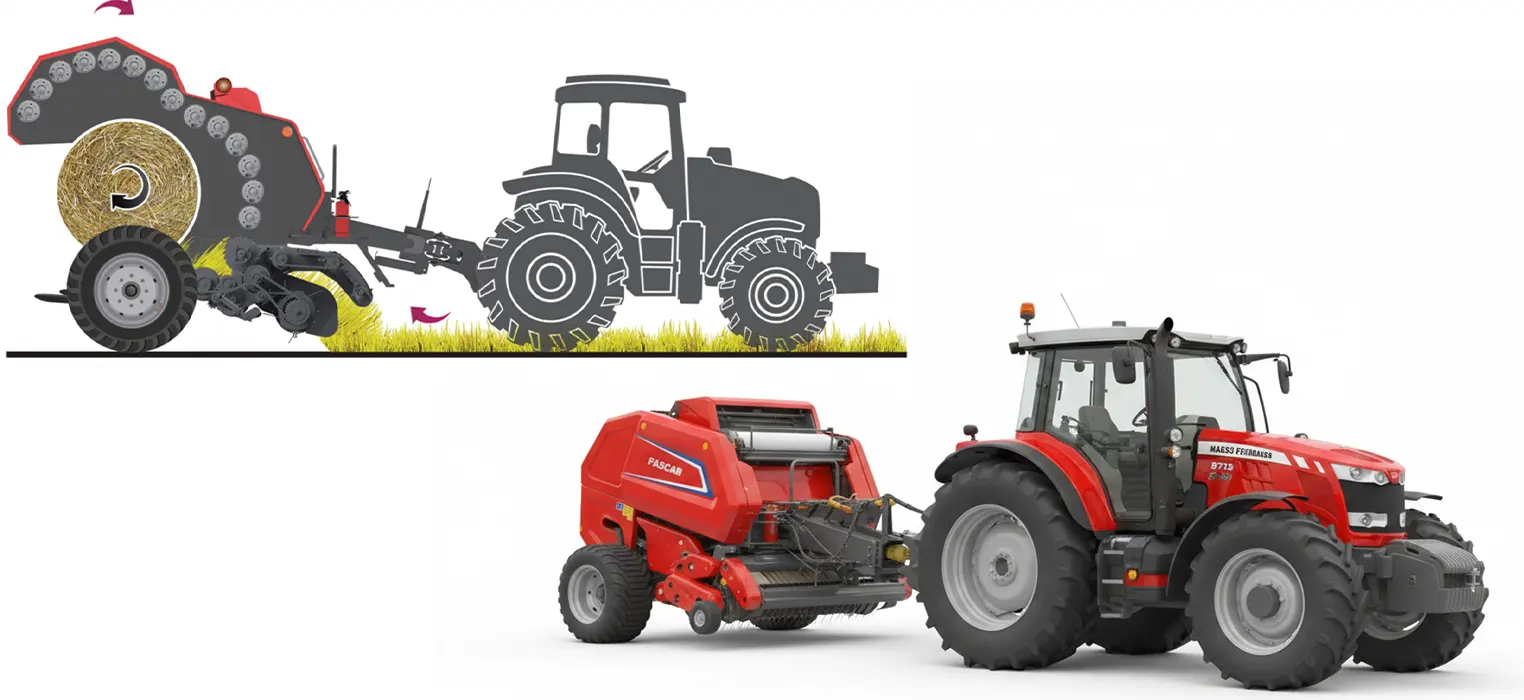
Run the サイレージベーラー at maximum hydraulic pressure (2,500 to 3,500 PSI) to produce the densest bale possible. Density is the single most important baler-controlled variable in baleage quality because denser bales contain less trapped oxygen, ferment faster, reach a lower final pH, and resist film puncture better. Apply net wrap at 3.0 to 3.5 revolutions — heavier than dry hay — because the wet bale is 40 to 80 percent heavier and needs more structural support to maintain its shape during transport and wrapping. A standard dry-hay round baler operating at 1,500 PSI produces adequate baleage in an emergency, but the lower density results in slower fermentation, higher final pH, and a shorter stable storage window.
Step 5: Wrap Within 2 to 4 Hours of Baling
Apply 6 to 8 layers of 1-mil UV-stabilized stretch polyethylene film using a turntable or inline wrapper. The film must overlap by 50 percent on each revolution to ensure a complete oxygen barrier. Every hour of delay between baling and wrapping allows aerobic bacteria to consume 1 to 2 percent of the available sugars, which slows the subsequent fermentation and raises the final pH. Bales wrapped within 2 hours produce baleage with pH below 4.2. Bales wrapped after 8 hours may stabilize at pH 4.8 to 5.2 — a level where Clostridial activity is not fully inhibited and butyric acid can develop.
Step 6: Store, Monitor, and Feed
Place wrapped bales on flat, open ground at least 20 feet from tree lines and fences. Inspect monthly for film punctures from birds, rodents, or debris. Repair any puncture immediately with stretch film tape. Allow 4 to 6 weeks of fermentation before feeding. Once opened, feed within 3 to 5 days to avoid aerobic spoilage. For a 50-cow herd eating one round bale per day, open no more than 3 bales at a time.
Baleage vs Dry Hay vs Pit Silage: The 3-Way Comparison
| 要素 | ベールサイレージ (Silage Baler + Wrapper) |
Dry Hay (Round Baler) |
Pit Silage (Forage Chopper + Bunker) |
|---|---|---|---|
| Target moisture | 40 to 55% | 15 to 18% | 60 to 70% |
| Field wilt time | 4 to 12 hours | 48 to 96 hours | 0 to 4 hours |
| Weather dependency | Low (1-day window) | High (3-day window) | Very low (same-day) |
| CP retention vs standing crop | 88 to 95% | 82 to 92% | 85 to 93% |
| Equipment investment | $28,000 to $58,000 (baler + wrapper) |
$12,000 to $28,000 (baler only) |
$150,000 to $500,000+ (chopper + trucks + bunker) |
| Storage infrastructure | None (wrapped bales outdoor) | Barn or gravel pad | Concrete bunker + walls |
| Minimum herd size to justify | 20 to 30 head | Any size | 200+ head |
| Portability | Fully portable (individual bales) | Fully portable | Fixed location (bunker) |
| 最適 | 20 to 500 head, humid climates, no barn | All sizes, arid climates, barn available | 200+ head dairies, large feedlots |
Baleage occupies the sweet spot between dry hay and pit silage. It preserves feed quality nearly as well as pit silage but at one-fifth to one-tenth the equipment cost and without any permanent storage infrastructure. It requires more investment than dry hay but eliminates the weather dependency that causes 2 to 4 cuttings per year to be lost or degraded in humid climates. For operations with 20 to 500 head of livestock in the eastern US, baleage from a 飼料ベーラー and wrapper is the most cost-effective forage preservation system available — delivering pit-silage quality at dry-hay infrastructure cost.
Which Forage Species Make the Best Baleage?
Not all forages ferment equally well. The key factor is water-soluble carbohydrate (sugar) content at the time of baling, because sugars are the fuel that lactic acid bacteria convert into the lactic acid that drops the pH and preserves the forage. Grasses generally contain higher sugar concentrations (8 to 15 percent of dry matter) than legumes (5 to 10 percent), which is why grass baleage ferments faster and reaches a lower, more stable pH than alfalfa baleage from the same field on the same day.
Orchard grass, ryegrass, and fescue produce excellent baleage because their high sugar content drives rapid, complete fermentation. Alfalfa produces good baleage but benefits from a bacterial inoculant ($1 to $3 per ton) applied at the ラウンドベーラー pickup to supplement the naturally lower LAB population on legume surfaces. Bermudagrass produces acceptable baleage but its low sugar content (6 to 9 percent of DM) means the fermentation is slower and the final pH is higher (4.5 to 5.0) than cooler-season grasses, reducing the stable storage window from 18 months to 9 to 12 months. Mixed grass-legume stands produce the most reliable baleage because the grass component provides the sugars that the legume component lacks, combining the protein advantage of alfalfa with the fermentation advantage of grass in a single product from a single field.
6 Common Baleage Mistakes and How to Avoid Them
- Wrapping too late. Every hour between baling and wrapping costs 1 to 2 percent of available sugars to aerobic respiration. The rule is “wrap within 2 hours, never beyond 4.” Organize the baling and wrapping operations so the wrapper is running continuously within 30 minutes of the first bale hitting the ground. On a large field, a second operator running the wrapper simultaneously with the baler operator is the ideal workflow.
- Too few film layers. Six layers is the minimum for an effective oxygen barrier. Eight layers is the standard recommended by every university extension program. The $0.50 to $1.00 per bale cost of the additional 2 layers buys 6 to 12 months of additional storage stability and provides a safety margin against minor film abrasion during handling and storage. Five layers or fewer do not create a reliable seal and will result in mold pockets within 2 to 4 months.
- Baling too dry (below 35 percent moisture). Insufficient moisture starves the LAB of the water they need for metabolic activity. The pH drops slowly and may stabilize at 5.0 to 5.5 — a level that does not inhibit Clostridial growth. The result is butyric acid production, a foul smell, and feed that cattle eat reluctantly and horses refuse entirely. If the moisture has dropped below 35 percent, bale as dry hay instead of attempting baleage.
- Baling too wet (above 65 percent moisture). Excess moisture dilutes the sugar concentration below the threshold for effective lactic acid fermentation. Clostridial bacteria outcompete LAB and produce butyric acid. The bale also weighs 2 to 3 times more than a properly wilted baleage bale, overloading the round baler’s bearings, belts, and PTO driveline. If the moisture is above 65 percent, wait 2 to 4 more hours for additional wilting.
- Storing wrapped bales near sharp objects. A single puncture in the stretch film allows oxygen to enter the bale and trigger aerobic spoilage at the puncture site. Fence posts, tree branches, wire, rodent teeth, and bird beaks are the most common puncture sources. Store wrapped bales on flat, open ground at least 20 feet from any structure, fence line, or tree canopy. Inspect monthly and repair any puncture immediately with stretch film repair tape.
- Opening too many bales at once. Once the film is removed, aerobic spoilage begins within 24 hours and accelerates through Day 3 to 5. A 50-cow herd consuming one round bale per day should never have more than 3 unwrapped bales exposed at any time. Opening 10 bales on Monday and expecting them to last through the following week results in 5 to 7 days of spoilage exposure on the last bales — enough to produce visible mold and 15 to 25 percent refusal by the animals.
The Economic Case: Why Baleage Pays for the Equipment in 1 to 3 Seasons
The combined cost of a サイレージベーラー ($20,000 to $40,000) and a bale wrapper ($8,000 to $18,000) is $28,000 to $58,000 — a significant investment for a mid-size operation. The payback comes from three revenue and cost-avoidance streams that recur every year.
Stream 1: Rescued Cuttings
In humid climates, 1 to 3 cuttings per year are lost to rain when making dry hay only. Each rescued cutting on 80 acres at 1.0 ton per acre and $130 per ton = $10,400 per year. Over 3 years: $31,200.
Stream 2: Quality Premium
Baleage retains 5 to 10 percent more CP than dry hay from the same field. The higher quality commands $15 to $30 per bale premium if sold, or reduces supplemental feed cost by $10 to $20 per ton if fed on-farm. On 300 bales per year: $4,500 to $9,000 per year.
Stream 3: Eliminated Barn Cost
Wrapped baleage stores outdoors with 3 to 8 percent DM loss — equivalent to indoor barn storage. The avoided barn construction of $15,000 to $30,000 is an immediate capital savings that reduces the effective net cost of the silage baler and wrapper to $0 to $28,000.
Combined, the three streams produce $14,900 to $19,400 of annual value for a typical 80-acre operation producing 300 baleage bales per year. At this rate, the $28,000 to $58,000 silage baler and wrapper investment pays for itself in 1.4 to 3.9 years, after which the annual value stream continues for the remaining 7 to 12 years of the equipment’s useful life — generating a total lifetime return of $100,000 to $230,000 from a $28,000 to $58,000 investment.
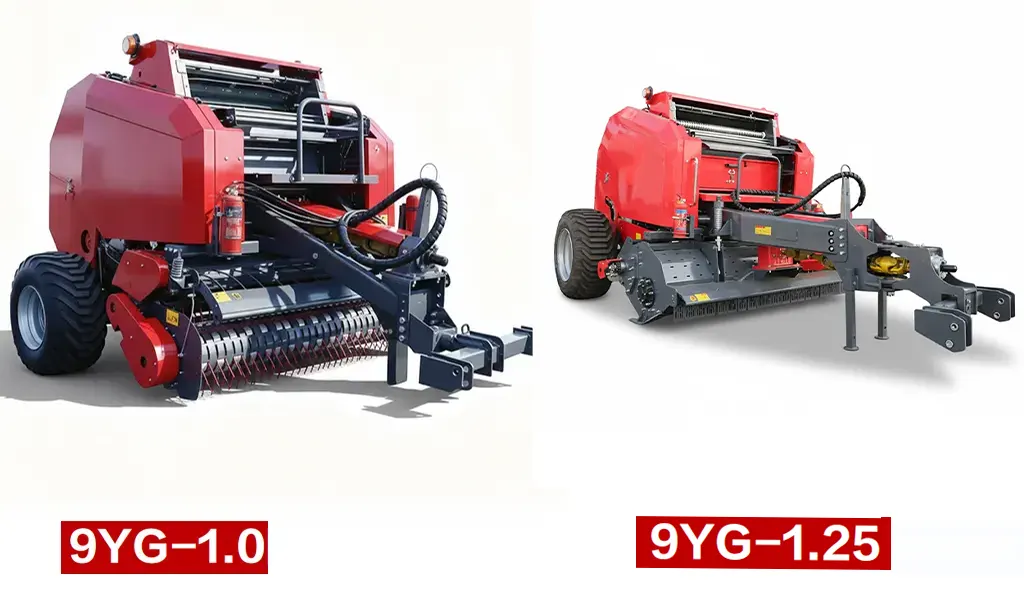
Start Making Baleage With Equipment Built for Fermentation Quality
America Ever-Power silage-grade round balers produce the densest baleage bales in their class at 3,000 PSI hydraulic pressure — the density that drives faster fermentation, lower pH, and longer stable storage. Pair with our matched bale wrapper for a complete baleage system that pays for itself in 1 to 3 seasons. Tell us your herd size and acreage for a custom recommendation. Dallas, TX parts depot for 3-day delivery.
編集者: Cxm