Quick Answer
Large square bale: 12 to 16%
Round bale (dry): 15 to 18%
Baleage (silage baler): 40 to 55%
DANGER ZONE: 20 to 35% — do not bale
Why 2 Percentage Points of Moisture Can Cost You $5,000 or a Barn
Baling moisture is the narrowest quality-control window in all of hay production. The acceptable range for dry round bales is only 3 to 4 percentage points wide: 15 to 18 percent. Below 14 percent, the alfalfa leaves shatter off the stem during compression and are lost as dust blown out the back of the round baler. Each percentage point of excessive drying below 14 percent costs 2 to 3 percent of the total leaf mass, which represents the highest-protein, highest-value fraction of the forage. Above 20 percent, mold begins colonizing the warm, moist bale interior within 7 to 14 days, and at 22 to 28 percent the spontaneous combustion risk escalates with every additional degree of heating. A barn fire from a single lot of over-moisture hay can cause $50,000 to $500,000 in structural damage — a catastrophic loss triggered by a 4-percentage-point measurement error.
This is precisely why a silage baler changes the risk equation so fundamentally. The dry-hay baling window is 3 to 4 points wide (15 to 18 percent). The baleage window is 15 to 20 points wide (40 to 55 percent). A forage baler operator working in the baleage zone has 5 times more moisture tolerance than a dry-hay operator, which means 5 times fewer bales that miss the target and 5 times fewer quality losses from measurement imprecision. The baleage zone is not just a weather-rescue option — it is a quality-control advantage that reduces the precision burden on the operator and the equipment.
Target Moisture by Bale Type and Storage Method
Different bale formats have different target moisture ranges because the internal ventilation characteristics and storage conditions vary. A small square bale stacked in a tight barn has less airflow through the stack than a round bale sitting alone in a field, which means the small square must be drier at baling to prevent mold in the low-airflow storage environment.
| Bale Type | Target Moisture (%) |
Absolute Maximum (%) |
Typical Storage | Why This Range |
|---|---|---|---|---|
| Small square (50 to 60 lb) | 14 to 18 | 20 | Barn, stacked tight | Tight stacking = no airflow = must be driest |
| Large square (800 to 1,200 lb) | 12 to 16 | 18 | Barn or covered | Massive core mass retains heat longer = lower target |
| Round bale — barn storage | 14 to 16 | 18 | Indoor, single-high | Indoor = no re-wetting; lower moisture maximizes shelf life |
| Round bale — outdoor storage | 15 to 18 | 20 | Outdoor on gravel | Slightly higher OK because outer layer re-wets regardless |
| Baleage (silage baler) | 40 to 55 | 60 | Outdoor, wrapped | Fermentation requires moisture for LAB activity |
The baleage row illustrates the operational advantage of owning a forage baler or silage baler. The target moisture zone is 15 to 20 points wide (40 to 55 percent) compared to 3 to 4 points wide for dry-hay formats. This wider window means the operator can start baling earlier in the wilting process and continue later, which translates into a longer daily baling window, less sensitivity to dew and humidity fluctuations, and fewer partial-day shutdowns caused by marginal moisture readings. On a practical level, a forage baler operator producing baleage works comfortably from mid-morning through late afternoon, while a dry-hay operator producing round bales may have a window of only 11 AM to 4 PM — a 5-hour window squeezed by morning dew and evening moisture rise.
What Happens When You Bale Too Wet: 4 Escalating Consequences
Baling dry hay above the target moisture sets off a predictable sequence of biological events inside the bale that escalates from invisible quality loss to visible mold to potentially fatal fire. Understanding the sequence helps operators recognize the warning signs at each stage and respond before the damage compounds.
- Stage 1 — Nutrient loss (20 to 22% moisture). The bale looks fine on the outside, but aerobic bacteria inside are consuming the water-soluble carbohydrates (sugars) that represent the most digestible energy fraction of the forage. TDN drops by 2 to 5 percentage points within the first 2 weeks. The hay still smells acceptable but tests 5 to 10 percent lower in energy value than properly cured hay from the same field. Most operators never know this loss occurred because they do not test the hay after baling.
- Stage 2 — Mold growth (22 to 26% moisture). Aspergillus, Fusarium, and Penicillium fungi colonize the warm, moist bale interior within 7 to 14 days. The bale develops a musty smell and produces visible white, gray, or green mold on the inside when the bale is opened. Horses are extremely sensitive to mold spores and can develop heaves (recurrent airway obstruction) from a single exposure to moldy hay. Cattle tolerate mild mold but reduce intake by 10 to 20 percent, which slows weight gain and milk production. The hay’s market value drops from the tested grade to Utility or bedding price — a $40 to $120 per ton loss.
- Stage 3 — Heating (24 to 30% moisture). Bacterial metabolism generates enough heat to raise the bale’s internal temperature above 120°F. The bale is hot to the touch when you insert your hand into the interior. The forage turns brown, develops a tobacco-like or caramel odor, and loses 15 to 30 percent of its crude protein to the Maillard reaction (heat-induced binding of protein to fiber that makes the protein indigestible). Heat-damaged hay is called “caramelized” hay and is worth 30 to 50 percent less than undamaged hay of the same species and cutting.
- Stage 4 — Spontaneous combustion (26 to 30+% moisture). If the heating continues unchecked past 150°F, the chemical oxidation process becomes self-sustaining and can reach ignition temperature of 170 to 190°F within 2 to 6 weeks. The bale catches fire without any external spark. A single burning bale in a stacked barn can destroy the entire structure and its contents within hours. Prevention is absolute: never bale dry hay above 20 percent moisture. If the moisture is above 20 percent and you cannot wait, bale it with a silage baler as baleage and wrap it — the anaerobic environment prevents the aerobic heating cascade entirely.
What Happens When You Bale Too Dry: 4 Quality Losses You Cannot Recover
Over-drying receives less attention than over-wetting because it does not cause fires, but it quietly destroys feed value in ways that are permanent and impossible to reverse after the bale is formed.
1. Leaf Shatter
Leaves are the highest-protein, highest-energy part of the plant. When moisture drops below 12 to 14 percent, the leaves become brittle and shatter on contact with the rake tines, the baler pickup, and the chamber rollers. The shattered leaf fragments fall through the swath and are left on the ground or blown out the back of the baler as dust. Each percentage point below 14 percent costs 2 to 3 percent of the total leaf mass, which represents a 1 to 2 percentage point reduction in the bale’s crude protein. An alfalfa bale that should have tested 20 percent CP tests 16 to 17 percent after excessive leaf shatter — a grade drop from Premium to Good that costs $30 to $60 per ton.
2. Low Bale Density
Over-dry stems are stiff and springy rather than pliable and compressible. The round baler’s chamber cannot pack the rigid stems as tightly, producing a bale that is 10 to 15 percent lighter than a bale made at 16 to 17 percent moisture from the same windrow. A lighter bale means fewer tons per trailer load (increasing transport cost per ton) and a bale that stores worse outdoors because the loose outer layer absorbs more rain per unit of surface area.
3. Color and Vitamin A Loss
Extended sun exposure that over-dries the hay also bleaches the green chlorophyll pigment and degrades beta-carotene, the vitamin A precursor. A bale that enters the barn yellow instead of green has lost 30 to 60 percent of its vitamin A activity. For breeding livestock, this loss requires supplementation with injectable or feed-additive vitamin A, adding $0.50 to $1.50 per head per month in supplement cost.
4. Increased Dust
Over-dry hay produces excessive dust during handling and feeding. Dust reduces palatability (animals eat less), contaminates respiratory airways (especially in horses and confined cattle), and creates a fire and explosion hazard in enclosed barns where airborne dust particles can ignite from a static spark or an overheated motor. The dust is composed primarily of shattered leaf fragments — the most nutritious part of the forage that should have been inside the bale rather than floating in the air.
3 Ways to Measure Moisture in the Field
The target numbers in the table above are useless if the operator cannot measure the actual moisture in the windrow or the finished bale accurately. Three methods are available, ranging from free but imprecise to $500 but highly accurate. The investment in measurement accuracy pays for itself the first time it prevents a barn fire or saves a cutting from excessive leaf shatter.
- Method 1: Hand-Twist Test (Free, ±4% accuracy)
Grab a fistful of hay from the thickest part of the windrow and twist it tightly for 30 seconds. If moisture squeezes from the cut stem ends, the hay is above 25 percent — far too wet. If the stems feel cool, limp, and rubbery but do not drip, the hay is 20 to 25 percent — still too wet for dry baling. If the stems crackle slightly and feel warm and dry but still have some pliability, the hay is 15 to 20 percent — approaching the target. If the stems snap cleanly and feel papery, the hay is below 14 percent — at risk of leaf shatter if aggressively handled. The hand-twist test is the method every producer should know, but its ±4% accuracy means it cannot reliably distinguish between 16 percent (safe) and 20 percent (dangerous), making it a screening tool rather than a decision tool. - Method 2: Microwave Oven Test ($20, ±1-2% accuracy)
Collect a 100-gram sample from the windrow, weigh it on a kitchen scale, microwave it at 50 percent power in 30-second intervals (with a cup of water beside it to prevent arcing) until the weight stops declining between intervals, and reweigh. Moisture percentage equals original weight minus final weight divided by original weight times 100. This method is accurate to within 1 to 2 percentage points but requires carrying the sample back to a microwave, which takes 10 to 15 minutes per test — an eternity when the mower is running and the weather window is shrinking. - Method 3: Electronic Moisture Probe ($100 to $500, ±1% accuracy)
A handheld probe inserted into the windrow or into the formed bale measures electrical conductivity or capacitance, which correlates directly to moisture content. Results display in 3 to 5 seconds on an LCD screen. Windrow probes (Farmex, Delmhorst, AgraTronix) measure the forage before it enters the baler, allowing the operator to decide whether to bale or wait. Bale probes measure the finished bale after ejection, verifying that the moisture is within the safe storage range. Some premium round balers and forage balers include a baler-mounted moisture sensor that reads continuously during bale formation and displays the real-time moisture on the tractor cab monitor — the ultimate measurement integration that eliminates the need to stop and probe manually. At $200 to $500, an electronic probe is the single best quality-control investment a hay producer can make.
The 24-Hour Moisture Cycle: When the Baling Window Opens and Closes
Hay moisture is not static throughout the day. It follows a predictable daily cycle driven by temperature, humidity, and dew formation that opens and closes the baling window at different times depending on the season and the climate.
Typical Dry-Hay Moisture Curve (Summer, Central US)
- 6 AM to 9 AM: Windrow moisture 22 to 28% from overnight dew absorption. Too wet to bale dry hay. Rake to fluff and speed dew evaporation.
- 9 AM to 11 AM: Moisture drops rapidly as dew evaporates: 18 to 22%. Approaching target. Probe frequently. Begin baling when probe reads 18% or below consistently.
- 11 AM to 5 PM: Moisture at daily minimum: 14 to 17%. Prime baling window. Bale aggressively during this period. Monitor for over-drying below 14% on hot, windy days — slow down or reduce tedding to preserve leaves.
- 5 PM to 8 PM: Moisture begins rising as air cools and humidity increases: 17 to 21%. Still bale-able in the early evening hours on low-humidity days. Stop baling when the probe reads above 19% consistently.
- 8 PM to 6 AM: Dew forms. Moisture rises to 22 to 30%. Do not bale dry hay. However, a silage baler operator making baleage can bale at 40 to 55% moisture at any time of day or night because the baleage window is not affected by the dew cycle.
The practical daily baling window for dry hay in a typical central US summer is approximately 6 hours (11 AM to 5 PM). In humid climates where the dew burns off later and the evening humidity rises earlier, the window narrows to 4 to 5 hours. In arid climates with low humidity, the window expands to 8 to 10 hours. A forage baler producing baleage effectively operates during all daylight hours and, if equipped with lights, can extend into evening and pre-dawn hours when the dew-wetted forage is within the 40 to 55 percent baleage target. This extended operating window is why baleage operations produce 30 to 50 percent more bales per day than dry-hay operations from the same field with the same tractor.
Hay Preservatives: Can They Extend the Safe Baling Moisture?
Propionic acid-based hay preservatives are liquid treatments applied to the forage as it enters the baler chamber. They inhibit mold growth by lowering the pH of the bale surface and suppressing aerobic bacterial activity. When applied at the manufacturer’s recommended rate (2 to 8 lb per ton depending on the moisture level), preservatives extend the safe baling moisture for dry hay from 18 percent up to 25 to 28 percent. This 7 to 10 percentage point extension widens the daily baling window by 2 to 3 hours and allows operators to bale in marginal conditions that would otherwise require waiting another half-day for further drying.
The cost of preservative treatment is $4 to $12 per ton depending on the application rate, which adds $2 to $6 per round bale. This cost is justified when the alternative is losing a cutting to rain or losing a half-day of baling time waiting for the dew to burn off. However, preservatives are not a substitute for proper moisture management — they are a buffer for marginal situations. They do not prevent spontaneous combustion above 30 percent moisture, and they add a chemical input that some buyers (particularly organic operations and horse owners) reject. For operations in humid climates where marginal-moisture baling is a chronic challenge, a silage baler that produces baleage at 40 to 55 percent moisture without any chemical treatment is a cleaner, more permanent solution than relying on preservative application to push dry-hay baling beyond its natural limits.
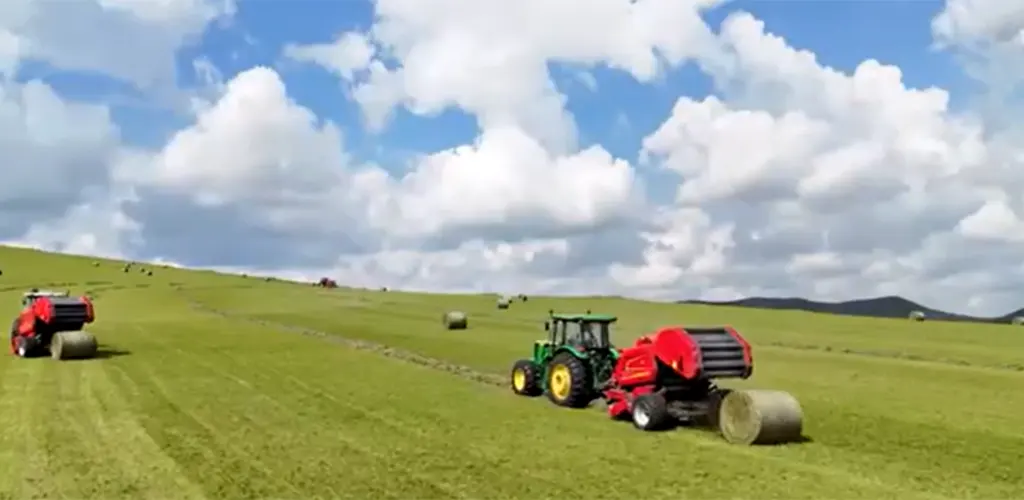
Hit the Target Every Time With Equipment Built for Precision
Dry hay requires a 3-point window. Baleage gives you a 20-point window. America Ever-Power silage-grade round balers handle both — producing dense dry bales at 15 to 18 percent and dense baleage at 40 to 55 percent from the same machine. Stop stressing about 2 percentage points. Start producing premium feed in any moisture condition. Dallas, TX parts depot for 3-day delivery.
Editor: Cxm