9YG-2.2 Large Roll-Drum Round Baler
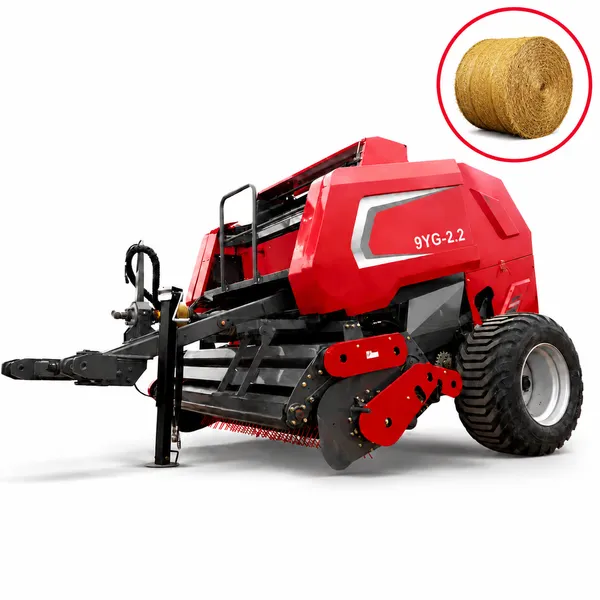
The 9YG-2.2 is a commercial-grade round baler built around an 18-roller fixed-chamber compression system — the architecture that eliminates belt replacement costs and produces bales dense enough to store outdoors for 12 months with less than 10% dry matter loss. With a Φ48-inch (1,220 mm) chamber driven by 110–150 kW (148–201 HP), a 2,200 mm (86.6 in) spring-tooth pickup, automatic net wrapping, and a handheld color touchscreen, this machine brings factory-floor automation to the hayfield.
-
- ▶ 18 hardened-steel rollers — consistent density, no belts to replace
- ▶ Handheld color touchscreen with auto/manual operating modes
- ▶ Fully automatic thin-oil lubrication — 65% less daily maintenance time
- ▶ High-precision sensor controls net-wrap count to the revolution
- ▶ Globally sourced drivetrain — drive shaft, bearings, clutch, chain, electronics
America Ever-Power · Round Baler
Φ48 in Chamber
148 – 201 HP
Auto Net Wrap
8,378 lb · 3,800 kg
What Is a Round Baler — and Why the Chamber Design Changes Everything
A round baler is a PTO-driven implement that collects cut forage from windrows, compresses it into a cylindrical bale, wraps the bale in net wrap or twine for structural integrity, and ejects it onto the field for collection. Every step from pickup to ejection happens in one continuous pass through the field, making the round baler the single implement most responsible for the final quality, density, and storage performance of the hay or baleage crop. The chamber — the enclosed space where forage is compressed into its cylindrical shape — is the defining engineering component, and the two dominant chamber architectures produce meaningfully different results.
Belt-type chambers form the bale against a flexible rubber belt that wraps around the bale's circumference and applies compression through belt tension. Belt-type balers dominate the low-to-mid-price segment because they are mechanically simpler and less expensive to manufacture. Their limitation is consistency: belt tension varies with belt wear and temperature, and a worn or stretched belt produces bales with soft spots, irregular shape, and density variations from center to edge. Belt replacement — the single highest maintenance cost on a belt baler — runs $400 to $1,200 per set every 5,000 to 15,000 bales.
Roll-drum chambers form the bale against a fixed ring of hardened steel rollers that apply uniform radial compression to every point on the bale's surface simultaneously. Because the compression force comes from rigid steel at fixed positions rather than variable belt tension, the resulting bale is denser, more uniform, and more consistent across its diameter and width. The 9YG-2.2 uses an 18-roller roll-drum chamber at Φ1,220 mm (48 in) — the largest and most compression-capable configuration in the America Ever-Power lineup — delivering the bale quality that commercial hay producers, custom operators, and dairy forage contractors depend on for profitable outdoor storage and consistent feed value.
9YG-2.2 Round Baler — Technical Specifications
| Parameter | Specification |
|---|---|
| Model | 9YG-2.2 Round Baler |
| Hitching Method | Trailed (towed-type) |
| Pickup Width | 2,200 mm (86.6 in) |
| Pickup Structure | Spring Tooth Type |
| Feeder Structure | Continuous Screw Feeding Mechanism |
| Chamber Type | Roll Drum — Fixed Chamber |
| Chamber Width | 1,400 mm (55.1 in) |
| Chamber Diameter | Φ1,220 mm (Φ48.0 in) |
| Qty of Press Rollers | 18 pcs |
| Press Roller Diameter | Φ222 mm (8.7 in) |
| Wrapping Method | Automatic Net Wrapping |
| Matching Power Range | 110 – 150 kW (148 – 201 HP) |
| PTO Speed | 540 RPM |
| Overall Dimensions (L×W×H) | 4,100 × 2,900 × 2,400 mm (161 × 114 × 94 in) |
| Machine Weight | 3,800 kg (8,378 lb) |
9YG-2.2 Round Baler — Key Engineering Features
Each feature below is drawn directly from the machine's engineering: the 9YG-2.2 was designed from the ground up for operations that cannot afford unplanned downtime, inconsistent bale quality, or daily maintenance that eats into baling hours.
◆ Handheld Color Touchscreen — Automatic and Manual Modes
The controller operates from the tractor cab via a handheld color display. Two modes are available — fully automatic for steady windrow conditions and manual for situations where the operator wants direct control over each baling step. During automatic mode, the entire process from chamber filling to net wrapping to tailgate opening runs without additional input, letting the operator focus on ground speed and windrow tracking.
- ✓ Full baling-process monitoring — chamber pressure, bale diameter, roller RPM, wrap count
- ✓ Real-time equipment status visible at a glance from the cab
- ✓ Combined with a high-precision displacement sensor: bale diameter tracked to ±5 mm accuracy
◆ Precision Sensor Net-Wrap Control — Accuracy at Lower Cost
A high-precision sensor counts and positions every net-wrap revolution independently of bale rotation speed. This sensor-driven approach ensures that every bale receives exactly the programmed number of wrap passes — not one revolution more, not one less — regardless of bale diameter variation, ground speed change, or crop type.
- ✓ Eliminates over-wrapping that wastes $0.50–$1.00 of net wrap per bale
- ✓ Eliminates under-wrapping that lets bales loosen during transport
- ✓ Net wrap cost per bale stays predictable across the entire season
◆ Fully Automatic Thin-Oil Lubrication — Chains Run Clean All Day
The entire chain drive system — every sprocket, chain link, and bearing surface in the main power train — is continuously bathed in a thin oil film while the machine operates. This is not a timed injection system; it is a continuous splash lubrication that keeps every component wet throughout a 10 to 14-hour baling day. Grease lubrication points that remain are consolidated into a centralized manifold, reducing individual service points from 15–20 down to 3–5.
- ✓ Estimated 65–80% reduction in daily lubrication time vs. conventional round balers
- ✓ Eliminates dry-run damage from missed grease points mid-day
- ✓ Extends chain and bearing service life by an estimated 30–50%
◆ Hydraulic Floating Pickup — Adapts to the Ground, Not the Other Way
The pickup height is hydraulically adjustable from the tractor cab and features spring-loaded floating that follows ground contours automatically. On an uneven field, the tines rise over mounds and drop into depressions, maintaining a consistent 1–2 inch clearance above the soil that collects maximum forage while avoiding the dirt and rock contamination that degrades bale quality.
- ✓ No dismounting to adjust pickup height — done from the seat
- ✓ Floating action also clears blockages more readily, easing cleaning and maintenance
- ✓ Reduces tine-to-rock contact that bends or breaks tines on fixed-height pickups
◆ Globally Sourced Critical Components — No Weak Links in the Chain
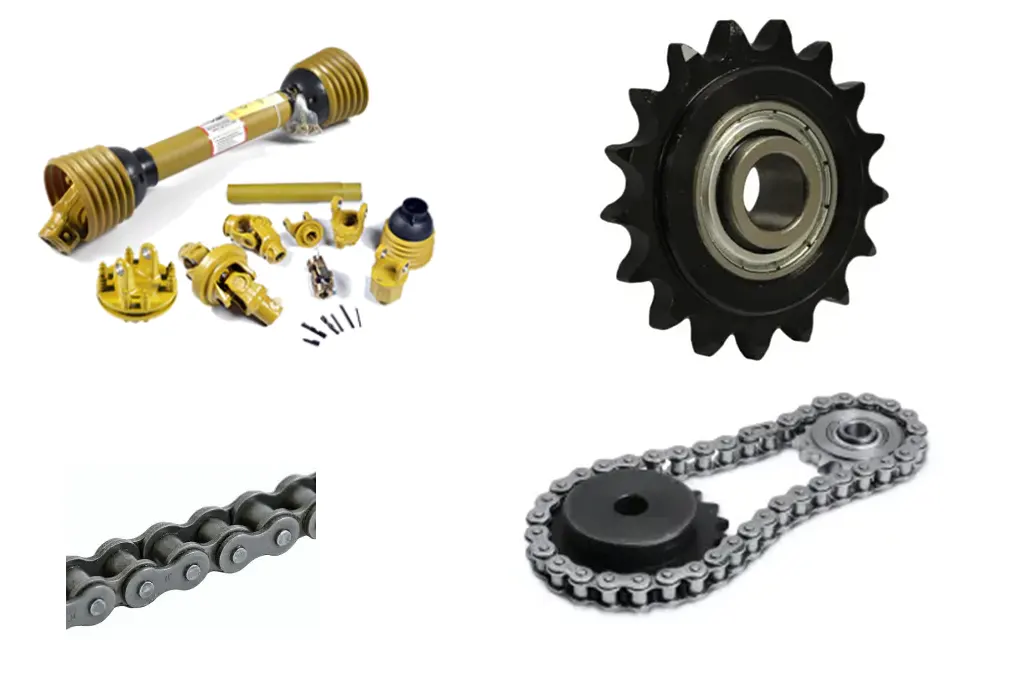
The main drive shaft, bearings, clutch assembly, roller drive chains, and the electronic control module are all specified from internationally recognized suppliers — the same tier of components used by premium European baler manufacturers. The input gearbox is precision-machined from hardened alloy steel with case-hardened gear teeth rated for sustained 150+ HP PTO loads across multi-season commercial use.
- ✓ Drive shaft, bearings, clutch, chain, ECU — all from global-brand supply chains
- ✓ 2-year structural warranty on gearbox and drivetrain
- ✓ All replacement parts stocked at Dallas, TX — 3-day delivery to US and Canada
America Ever-Power Round Baler Lineup — Which Model Is Right for Your Operation?
America Ever-Power manufactures five round baler models ranging from the compact 9YK-870 mini baler at 25 HP to the flagship 9YG-2.2 at 201 HP. All five use roll-drum chamber technology — no belt-type balers in the lineup — so the quality advantage of roller-based compression applies across every model, with the differences coming down to bale size, throughput, and automation level.
| Model | Chamber Ø | Pickup Width | HP Range | Wrapping | Best Match |
|---|---|---|---|---|---|
| 9YK-870 | Φ630 mm / 25" | 800 mm / 31" | 25–50 HP | Rope | Hobby farm · under 20 ac |
| 9YQ-1250 | Φ800 mm / 31" | 1,250 mm / 49" | 54–80 HP | Rope | Small farm · 20–80 ac |
| 9YQ-1950 | Φ1,000 mm / 39" | 1,950 mm / 77" | 49–148 HP | Net | Mid-size · 50–200 ac |
| 9YQ-2300 | Φ1,000 mm / 39" | 2,300 mm / 91" | 79–178 HP | Net | Large acreage · 100–400 ac |
| 9YG-2.2 ★ | Φ1,220 mm / 48" | 2,200 mm / 87" | 148–201 HP | Net Auto | Commercial · 200+ ac · custom ops |
The 9YG-2.2 produces the largest bale in the lineup: a Φ48-inch bale contains roughly 50% more forage than the 9YQ-1950's Φ39-inch bale, which means 30% fewer field stops per acre, 30% fewer bales to move, wrap, and stack, and lower per-bale labor cost across the season. For commercial producers targeting 500 to 3,000+ bales per year, or custom operators billing clients by the bale, these throughput advantages compound into meaningful revenue and cost differences over a full season.
Round Baler vs Square Baler — Choosing the Right Bale Format for Your Market
Many operations run both a round baler and a square baler because the two formats serve different markets, different handling requirements, and different customer types. The choice is not either/or — it is a question of which format your primary revenue stream demands.
● Round Bales — Best For
- ➤ Cow-calf and beef operations feeding outdoors
- ➤ Baleage / silage production (forage baler + wrapper)
- ➤ Large-acreage operations where throughput per hour is the priority
- ➤ Outdoor storage without barn infrastructure
- ➤ Custom baling contractors — fewer consumables, faster cycle
● Square Bales — Best For
- ➤ Horse markets — premium pricing, easy single-flake feeding
- ➤ Retail / bagged hay for farm stores and feed dealers
- ➤ Stacking in standard barn bays and shipping containers
- ➤ Operations with limited tractor HP (small square balers from 40 HP)
- ➤ Export markets that require palletizable bale dimensions
America Ever-Power's square baler lineup — including the 9YFS-2.2 double-chamber model that ejects two finished bales per compression cycle and the 9YF-2200 series for standard single-bale output — is PTO-matched at 540 RPM and hitch-compatible with the same tractor platforms that run the 9YG-2.2 round baler. Many operations run a round baler for the bulk of their acreage and a small square baler for the premium horse-hay cuttings, switching implements between fields based on the intended market for each cutting. The economics of this dual-format approach are straightforward: round bales at $60 to $90 each for cow-calf operations, small square bales at $6 to $12 each for the horse and retail market. A producer who identifies both markets in their area can serve both with two implements on the same tractor, maximizing revenue per acre from the same fields across the season.
Who the 9YG-2.2 Round Baler Is Built For
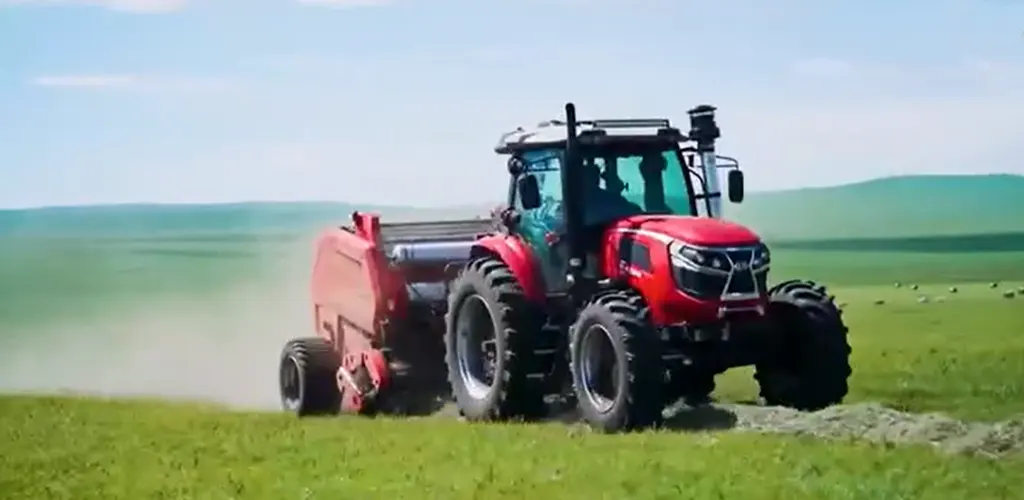
Commercial Hay Producers · 200+ Acres
Operations running 500 to 3,000+ bales per season across multiple cuttings. The 9YG-2.2's 86.6-inch pickup, screw feeder, and automatic lubrication target 25–35 bales per hour sustained — the throughput that clears 100+ acres per cutting day and captures every weather window in a 4 to 6 cutting season.
Custom Baling Operators
Operators billing 5–20 clients per season need a machine that runs 10–14 hour days without overheating or requiring field-side maintenance. The automatic lubrication saves 20–40 minutes of daily greasing. The touchscreen bale counter tracks production by client and field for accurate invoicing.
Dairy Forage Contractors · Baleage
The 9YG-2.2 handles dry hay at 15–18% moisture and high-moisture forage at 40–55% for baleage. The screw feeder prevents plug-ups on wet crop. Pair with a downstream wrapper to complete the silage baler system for dairy-grade baleage that commands a $20–$50 per ton quality premium.
Tractor Requirements and Maintenance Schedule for the 9YG-2.2 Round Baler
The 9YG-2.2 requires a tractor with 148–201 engine HP, a 540 RPM PTO, and a minimum of 3 rear hydraulic remotes. Tractor weight should be at least 11,000 lb (5,000 kg) to maintain stability when towing the 8,378 lb baler with a formed bale inside the chamber. MFWD (four-wheel drive) is strongly recommended on sloped terrain or soft ground.
- ▶ Before each session: Check thin-oil reservoir level · verify net wrap supply · grease 3–5 centralized points (2–3 pumps each)
- ▶ Every 50 hours: Inspect roller surfaces for wear · check pickup tine condition · verify drive chain tension
- ▶ After baleage sessions: Clean roller surfaces of fermented-crop residue · inspect screw auger flights for wear
- ▶ End of season: Drain and replace gearbox oil · inspect clutch plates · store with empty chamber and tailgate open
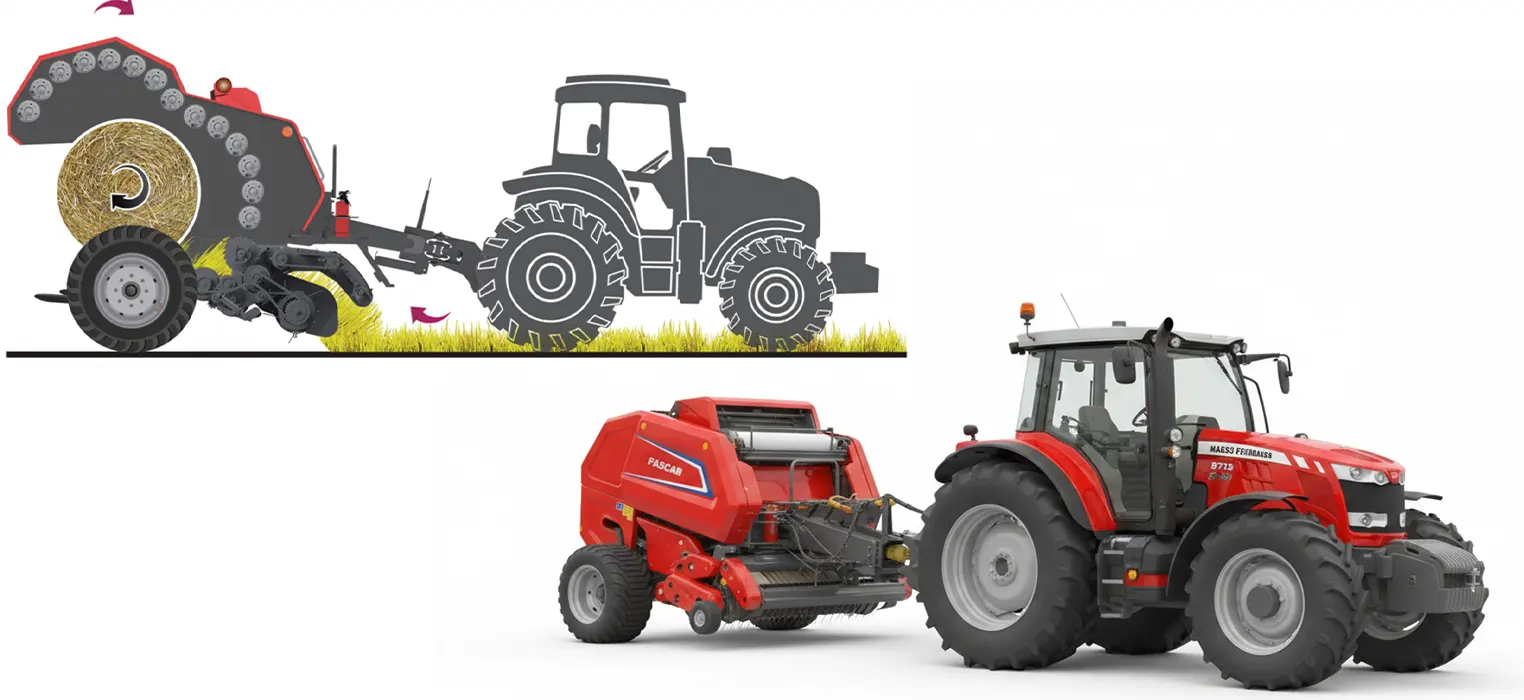
Operating the 9YG-2.2 Round Baler — Ground Speed, Windrow Management, and Bale Quality
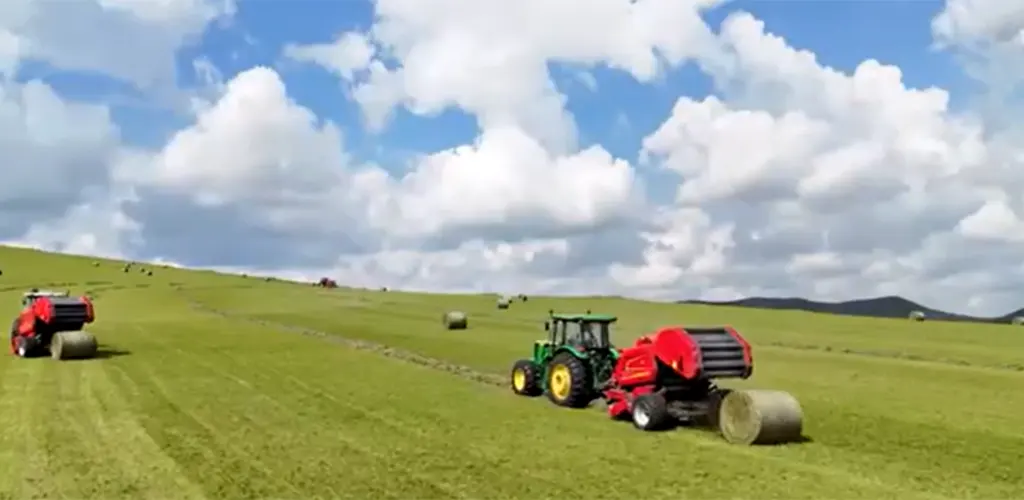
The 9YG-2.2's 86.6-inch pickup and continuous screw feeder give it a wider operating speed window than direct-feed round balers, but ground speed still determines bale density, throughput, and the likelihood of a plug stop. The target range is 4 to 7 mph on dry hay windrows and 3 to 5 mph on high-moisture baleage windrows, with the specific speed governed by windrow weight rather than a fixed number. Heavier windrows demand the lower end of the range; thinner, lighter windrows allow the higher end.
The touchscreen controller's real-time chamber pressure reading is the best live indicator of whether the current speed-to-windrow combination is within the machine's optimal operating range. A steady pressure reading at the mid-scale zone indicates the screw feeder is metering forage into the rollers at the rate they can process it. A rising pressure spike indicates the feed rate is temporarily exceeding the chamber capacity — the correct response is a 0.5 to 1.0 mph speed reduction before the spike becomes a plug. An experienced operator reads the windrow density 50 to 100 feet ahead and adjusts speed proactively, keeping the pressure steady rather than reacting to the warning that the chamber is already overloaded.
Windrow preparation directly affects the 9YG-2.2's productivity and bale uniformity. A windrow that is too narrow produces a bale that builds unevenly across the 55-inch chamber width, creating a barrel-shaped bale that rolls unpredictably and stacks poorly. A hay rake that merges 2 to 3 swaths into a single windrow matching the pickup width produces the most consistent feed rate and the most uniform bale cross-section. For baleage production, the rake should also be used to form heavier windrows than would be used for dry hay, because the higher mass-per-foot of a wet windrow reduces the number of windrow-lengths needed to fill the 48-inch chamber diameter and shortens the cycle time per bale.
Net wrap application is fully automated by the touchscreen controller. Once the bale diameter sensor signals that the target diameter has been reached, the wrap mechanism activates without operator input, applies the programmed number of wrap revolutions (typically 2.5 to 3.5), cuts the net, and sends the "tailgate ready to open" signal to the controller display. The operator ejects the bale, drives forward to clear the drop zone, and the next bale begins forming immediately as the pickup re-engages the windrow. On a flat field with a well-prepared windrow, this cycle produces 28 to 35 bales per hour on the 9YG-2.2 at optimal ground speed — a throughput that clears a 40-acre field in a single 6 to 8 hour baling session and leaves the afternoon available for another field or for the wrapper operator to begin baleage wrapping on the morning's bales before the aerobic respiration window closes.
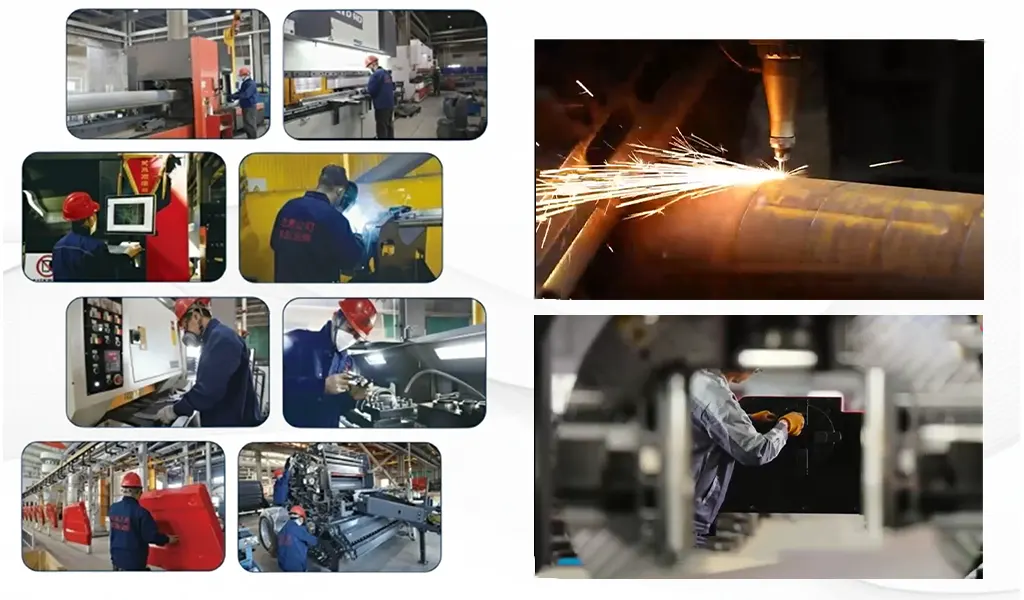
Every replacement part for the 9YG-2.2 — from roller bearings and screw auger flights to net wrap mechanisms and electronic controller modules — is stocked at the America Ever-Power Dallas, TX parts depot for 3-day delivery to any address in the continental United States or Canada. Full equipment chain: disc mowers, hay rakes, round balers, and bale wrappers — all 540 RPM PTO-matched and hitch-compatible.
Get a Quote for the 9YG-2.2 Round Baler
Tell us your tractor model, annual bale target, and whether you need dry-hay only or baleage capability. We confirm PTO compatibility, recommend the right density and net-wrap configuration, and provide a delivered price to your farm. Parts stocked in Dallas, TX — 3-day delivery across the continental US and Canada.
Additional information
| Editor | Cxm |
|---|
Related products
-
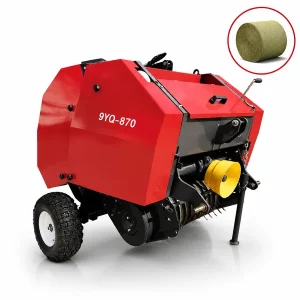
9YK-870 Mini Round Baler — Compact Roll-Drum Baler
-
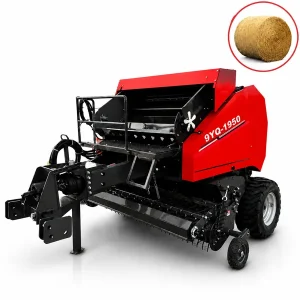
9YQ-1950 Round Baler — Mid-Size Roll-Drum Round Baler
-
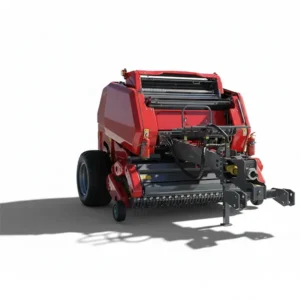
9YG-1.25A Round Baler – Professional 4×5 Silage Baler Built for American Farms
-
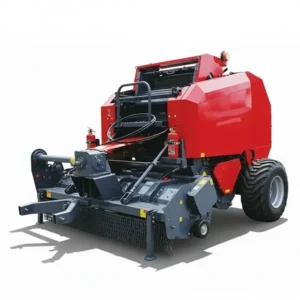
Round Baler – 9YG-1.25 Silage Baler for Efficient Forage Baling
-
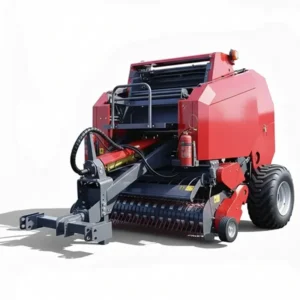
9YG-1.0 Round Baler – Silage Baler for Hay and Forage Harvesting
-
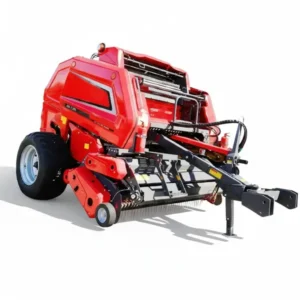
Silage Baler – 9YG-2.24D Round Baler (S9000 Ultra) | Hay and Forage Baling for U.S. Farmers
-
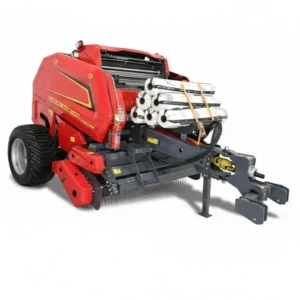
9YG-2.24D S9000 Round Baler (Classic) with Spring Tooth Pickup | High-Density Hay & Silage Baler
-
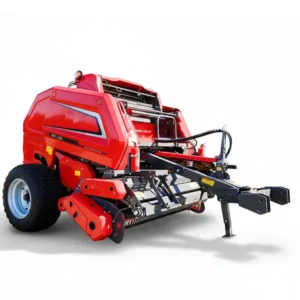
Silage Baler – 9YG-2.24D S9000 Round Baler | Forage Baler with Spring-Tooth Pickup