Common Silage Baler Problems: 12 Diagnostic Patterns
Twelve diagnostic cards covering the silage baler problems that operators actually encounter — symptom, root cause, and fix for each one.
Silage baler problems fall into recognizable patterns once an operator has run enough seasons to see them. The same twelve diagnostic patterns account for roughly 85% of mid-cutting failures and post-storage quality issues across U.S. operations. Some are mechanical — bearings, belts, knives. Some are operational — pressure settings, wilting timing, wrap discipline. Some only show up at feed-out time, weeks or months after the bale was made, when the underlying cause has long passed and only the consequence remains. This article presents these twelve patterns as diagnostic cards organized by where the symptom shows up, with severity tags that indicate how urgent the fix is.
The diagnostic cards below use red severity tags for problems that should stop the cutting and require immediate fix, yellow tags for problems that warrant attention but allow continued operation, and green tags for problems that operators can address between cuttings. The card structure — symptom, root cause, fix — is meant to be scanned quickly during active operation rather than read end-to-end. Operators encountering an unexpected outcome can match the symptom to the appropriate card and work from there.
Watch — fix between cuttings
Post-storage — trace upstream
In-Cutting Mechanical Failures (P01–P06)
The first six diagnostic patterns show up during active baling and require operator response within minutes to hours. P01 (lopsided bales) usually traces to uneven feed across the windrow — one side of the chamber is filling faster than the other because the windrow geometry is asymmetric or the silage baler is running at an angle to the windrow direction. The fix is to check windrow uniformity from the rake step and verify that the operator is centering the pickup head on the windrow rather than tracking offset. Persistent lopsided bales after windrow check usually indicate uneven belt wear in the chamber and warrant inspection between cuttings.
P02 (soft bale cores) is one of the most common silage baler problems and almost always traces to incorrect chamber pressure during the bale-buildup phase. Variable-chamber machines should reach target pressure progressively as the bale grows; if pressure ramps too slowly, the inner layers form before pressure builds, leaving a soft core that the firm outer shell traps. The fix is to verify hydraulic pressure setting and check pressure-curve programming on the cab control. P02 is the most direct cause of poor fermentation outcomes among in-cutting failures because the trapped air in the soft core cannot be eliminated by any later process.
P03 (density variation across bales) typically has multiple contributing causes — moisture variation across the field, knife wear progressing across the cutting day, hydraulic system delivering inconsistent pressure under varying tractor RPM. The fix requires systematic testing: weigh several bales from different field sections, compare against expected weight, and identify whether the variation correlates with field location, time of day, or apparent mechanical wear. P03 is the diagnostic that most often reveals operator-side rather than equipment-side root causes once the systematic testing is complete.
P04 (tailgate sag) is a serious mechanical failure that prevents proper bale ejection. The tailgate hydraulic cylinders should hold the gate firmly closed during chamber pressurization and open cleanly for ejection. Tailgate sag means the cylinders are not holding adequate pressure — usually due to internal seal wear, occasionally due to hydraulic line damage. Continuing to bale with tailgate sag produces incomplete bales and potentially damages the chamber when the tailgate fails to close fully on the next cycle. P04 demands immediate stop and dealer service rather than field-level fix.
P05 (knife shear) is gradual rather than sudden — knives wear progressively across the cutting season, and the symptom (forage tearing rather than slicing) develops over hours of accumulated wear. The fix is knife sharpening or replacement at scheduled intervals (30–50 baling hours) rather than waiting for the symptom to develop. Operations that try to maximize hours per knife sharpening invariably end up with P05 symptoms in the second half of the cutting season. P06 (hydraulic seal weep) is a more urgent variant — visible oil seepage from chamber-pressure cylinders or tailgate cylinders signals seal failure that will worsen quickly without intervention. Stop baling and inspect.
Wrap-System Failures (P07–P09)
Three diagnostic patterns relate to the wrap and net-wrap systems that convert chamber-formed bales into properly-protected silage. P07 (net wrap trailing) means the net wrap dispenser is feeding properly but the cutter is not severing the net cleanly at cycle end. The trailing net catches on field debris and tears, leaving partial wrap on the bale and exposing the silage surface to oxygen. The fix is to inspect the net-cutter blade for nicks or wear; replacement is usually a 15-minute operation that restores proper performance.
P08 (wrap punctures) at storage placement usually traces to handling damage between baling and storage. Forks driven into wrap surface, dropped bales, scraping against fence posts or other bales during transport — all produce small punctures that compromise gas-barrier integrity. The fix is upstream of the symptom: switch to squeeze-clamp handling, verify bale transporter ramp angles, eliminate impact handling at storage placement. Operations that consistently see P08 after handling discipline upgrades should investigate wrap film quality — some lower-grade films puncture more readily than premium films at the same handling stress.
P09 (chamber slip on wet forage) means belts cannot grip the forage to drive the rotation that builds bale density. The symptom shows up at moisture above 65% — belts spin against the windrow material without effective compression. The fix is to stop baling and let the field continue wilting; pushing through with chamber slip produces under-formed bales that fail downstream fermentation. Operations encountering frequent P09 should also check belt condition — worn belts develop polished surfaces that lose grip on forage even at acceptable moisture content.
Silage Baler Replacement Parts
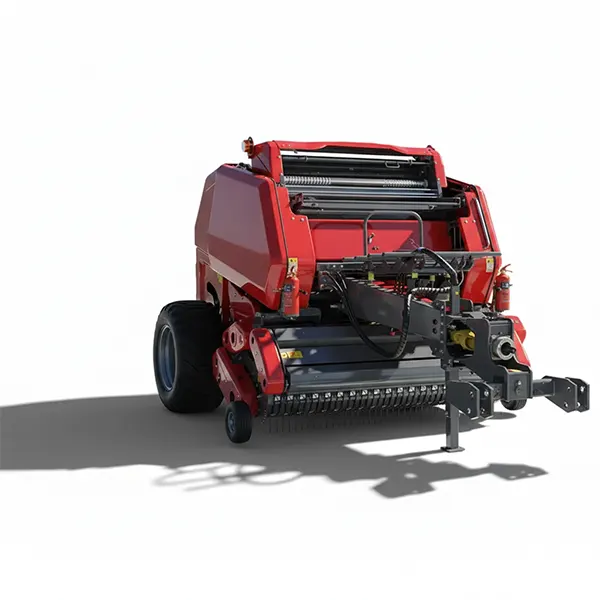
Wear parts including knives, belts, hydraulic seals, net-wrap cutters, and chamber components. Maintaining a basic spare-parts inventory on-farm shortens the diagnostic-to-fix cycle for the patterns described in this article.
Post-Storage Quality Failures (P10–P12)
The final three patterns show up weeks or months after baling, when the bale opens for feed-out or inspection reveals a problem. These are the hardest patterns to diagnose because the upstream causes happened at baling time and the operator has to reconstruct the conditions retrospectively. P10 (visible mold under wrap at 30 days) almost always traces to oxygen ingress during the early storage phase — wrap punctures (the P08 pattern not caught at the time), inadequate wrap layer count, or under-density bales that took too long to reach anaerobic conditions. The fix for P10 is upstream: improve handling discipline, increase wrap layers, increase chamber pressure for higher density. The bale itself with visible mold is unsalvageable.
P11 (butyric smell at feed-out) traces to clostridia bacteria that outcompeted lactic-acid bacteria during fermentation. The dominant cause is forage moisture above 65% at baling — wet forage favors clostridia, dry forage favors lactic-acid bacteria. P11 occasionally also traces to soil contamination in the windrow (clostridia spores live in soil), which means raking that scrapes the ground introduces the bacteria. The fix is moisture targeting (don’t bale above 65%) and rake-height discipline (don’t scrape soil into the windrow). P11 silage is generally not feedable — livestock reject it — and the bale becomes a loss.
P12 (wrapper dispenser failure across a batch) shows up as systematic under-wrapping affecting many bales rather than individual bales. The cause is usually wrapper-machine issue rather than silage baler issue — film tension miscalibration, dispenser arm timing, table rotation speed off-spec. The fix is to inspect the wrapper as a separate unit; the silage baler may be operating correctly while the wrapper is failing. P12 is most common on stand-alone wrapper setups (versus combo machines) because the two machines are maintained separately and a wrapper-side problem can develop without the silage baler operator noticing. Bales that arrive at storage with under-target wrap layers should be re-wrapped with supplemental layers if discovered within the first 48 hours; later than 48 hours the fermentation has typically progressed too far for re-wrap to help.
Diagnostic Quick-Reference Matrix
All twelve patterns in side-by-side reference form. Use this matrix to match a symptom to its diagnostic card during active operation.
| Pattern | Severity | Root Cause Category | Fix Location |
|---|---|---|---|
| P01 Lopsided bales | Stop | Windrow asymmetry / belt wear | Windrow then chamber |
| P02 Soft bale cores | Stop | Pressure-ramp programming | Hydraulic settings |
| P03 Density variation | Watch | Multi-cause (test required) | Field / settings / wear |
| P04 Tailgate sag | Stop | Hydraulic seal failure | Dealer service |
| P05 Knife shear | Watch | Knife wear | Sharpen / replace |
| P06 Hydraulic seal weep | Stop | Cylinder seal failure | Dealer service |
| P07 Net wrap trail | Watch | Net cutter blade wear | Replace cutter blade |
| P08 Wrap punctures | Watch | Handling damage | Transporter / storage |
| P09 Chamber slip | Watch | Moisture too high / belt wear | Wait / replace belts |
| P10 30-day mold | Post-storage | Oxygen ingress | Wrap / handling / density |
| P11 Butyric smell | Post-storage | Moisture above 65% / soil contamination | Moisture targeting / rake height |
| P12 Wrapper dispenser failure | Post-storage | Wrapper-side calibration | Wrapper inspection |
The matrix shows that fixes distribute across four categories: field-level (windrow geometry, moisture timing), operator-side settings (chamber pressure, rake height), wear-part replacement (knives, belts, cutter blades), and dealer service (hydraulic seals, complex calibration). Operations with disciplined preventive maintenance — knife sharpening at 30–50 baling hours, belt inspection between cuttings, hydraulic system inspection at season start — encounter the three serious-stop patterns (P02, P04, P06) far less frequently than operations that run equipment to failure.
Equipment Around the Silage Baler
Several diagnostic patterns trace to upstream equipment rather than the silage baler itself. P11 (butyric smell from soil contamination) often traces to hay rake settings — rakes set too low scrape soil into the windrow and introduce clostridia spores. P09 (chamber slip on wet forage) traces partly to mower-conditioner conditioning intensity that affects wilting trajectory. P08 (wrap punctures) traces to bale transporter handling discipline. The full equipment chain has to be evaluated when diagnostic patterns appear consistently.
Spare parts inventory on the farm shortens the diagnostic-to-fix cycle dramatically. Most operations stock at minimum: a complete set of replacement rotor knives, two spare chamber belts, net wrap cutter blades, and basic hydraulic seal kits. The capital cost of this inventory ($1,500–3,500 depending on machine model) pays back the first time a P05 (knife shear) symptom appears mid-cutting and a same-day fix is possible rather than a 1–2 day dealer-service delay. Operations that run far from dealer locations (PNW, Mountain West) often stock more comprehensive spare-parts inventories than operations in dealer-dense regions.
Diagnostic logging also helps operators connect symptoms to root causes over multiple seasons. A simple notebook entry — date, field, symptom, presumed cause, fix applied, outcome — accumulates pattern data that becomes valuable when the same symptom appears years later. Operations that run dedicated maintenance logs catch upstream-cause patterns (knife wear curves, hydraulic system aging trajectories, seasonal moisture-management issues) far faster than operations relying on operator memory alone. The notebook discipline costs minutes per diagnostic event and pays back across multi-year ownership cycles.
Editor: Cxm