Silage Baler ROI: When the Investment Pays Back
Four worked ROI calculations covering the operation profiles in the series — small farm, dairy, custom operator, beef finishing — with payback periods that match each one’s economic reality.
This article concludes the 20-part silage baler reference series with the question that operators face after working through every other consideration: does the math actually work? The earlier articles cover the equipment in depth — what it does, how it operates, what fits each application, what climates and crops change the discipline. None of that matters if the operation cannot afford the equipment in the first place. ROI calculations are how operations move from “this would be useful” to “this will pay back” — and the four worked examples below show how the same equipment investment produces very different payback profiles depending on the operation’s specific economics.
The four reference operations here map back to operations described in earlier articles in the series: a 75-acre New Hampshire small farm (Article 12), a 600-cow Central Valley California dairy (Article 4), a Pennsylvania custom hay operator (Article 13), and a 600-cow beef finishing operation in Nebraska. The numbers shown are realistic for 2026 economic conditions; specific dollar values vary 10–20% across regions and over time. The calculation framework is consistent across all four examples to enable direct comparison.
EXAMPLE 1Small Farm — 75 Acres, 200 Bales Annual
The New Hampshire reference operation from Article 12 lands on the Path D outcome — own a compact stand-alone silage baler. The economic case requires comparing owned-equipment costs against the realistic alternative (custom-hire) over a 7-year ownership window. The calculation isolates the incremental costs of owning versus the alternative, plus the operational benefits that owned equipment provides (timing flexibility, marketing options to horse-barn customers).
Capital cost (compact silage baler + wrapper)….. $40,000
Annual depreciation (straight-line 7yr)……….. $5,714
Annual fuel + film + parts (200 bales)………… $4,200
Annual labor (50 hr × $20/hr)………………… $1,000
Annual maintenance + repair………………….. $1,800
Tractor allocation………………………….. $1,300
TOTAL ANNUAL COST……………………………$14,014
Custom-hire alternative (200 bales × $26)……… $5,200
Custom-hire scheduling-loss bales (15% × $40)….. $1,200
CUSTOM-HIRE ANNUAL TOTAL……………………… $6,400
Owned-vs-custom-hire annual gap…………… $7,614 MORE
Marketing-side revenue gain (horse customers)……$8,400
NET ANNUAL ADVANTAGE……………………… $786 better
Payback period: marginal — see narrative below
The small farm calculation produces a marginal advantage for ownership rather than a clear win. The owned-equipment annual cost is $7,614 higher than custom-hire; the marketing-side revenue gain from horse-barn customers is $8,400 — making owned equipment $786 per year better. Over the 7-year window, this accumulates to roughly $5,500 in net advantage versus custom-hire — meaningful but not overwhelming. The sensitivity analysis matters: if horse-barn revenue capture drops below $7,614 per year, custom-hire becomes the better choice.
For the New Hampshire operation, the realistic horse-barn revenue is the deciding factor. The operator reports current discussions with two area horse barns at premium pricing ($65–80 per bale versus $40 for cattle-grade). If those relationships develop, ownership is justified; if not, the operation should stay on custom-hire. This is the typical small-farm reality — owned baler equipment makes sense only when there is a specific marketing or operational reason that custom-hire cannot satisfy. The default answer for under-100-acre operations remains custom-hire; ownership is the exception that requires specific justification.
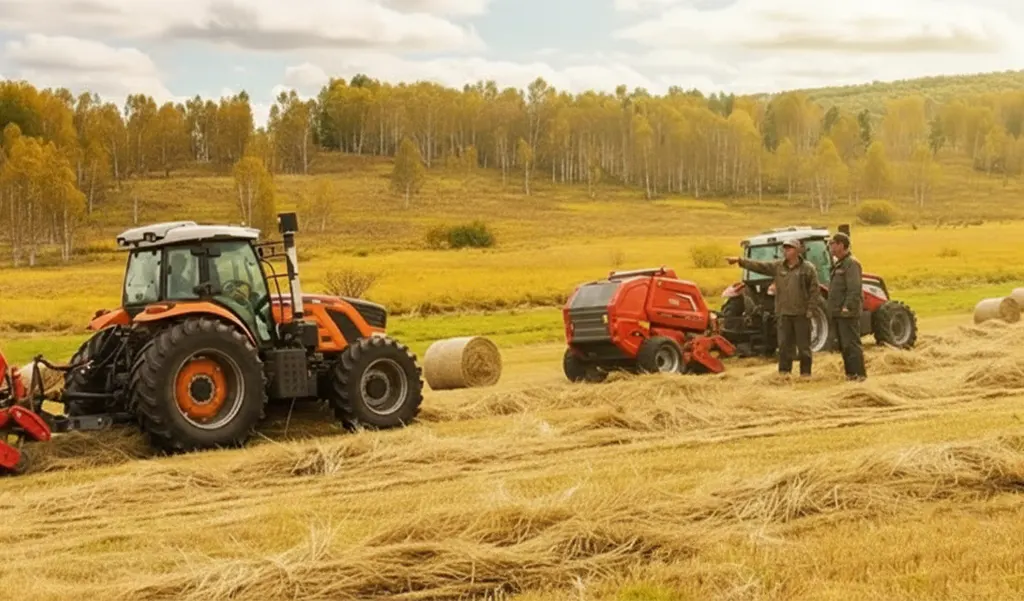
EXAMPLE 2Dairy — 600 Cows, 4,500 Bales Annual
The Central Valley California reference dairy from Article 4 produces enough silage volume that owned equipment is an obvious choice rather than a marginal call. The calculation shifts to comparing equipment configurations rather than ownership-versus-custom-hire — at this scale, every operation owns equipment, and the question is which silage baler tier delivers the best payback.
Mid-tier silage baler + wrapper…………….. $115,000
Annual depreciation (straight-line 8yr)……….. $14,375
Annual fuel + film + parts (4,500 bales)………. $54,000
Annual labor (180 hr × $25/hr)……………….. $4,500
Annual maintenance + repair………………….. $7,500
Tractor allocation………………………….. $5,200
TOTAL ANNUAL COST……………………………$85,575
Cost per bale produced………………………. $19.02
Custom-hire equivalent (4,500 × $35)………….. $157,500
OWN-VS-CUSTOM-HIRE SAVINGS………………. $71,925/year
Payback period: 1.6 years (capital ÷ savings)
8-year cumulative net advantage…………….. $460,000+
The dairy calculation produces a 1.6-year payback against custom-hire alternative — a strong result that holds up against significant assumption variations. Even if custom-hire rates were 30% lower than assumed ($25 instead of $35), payback would still complete in roughly 2.5 years. Even if the dairy produced only 60% of projected bale volume (2,700 instead of 4,500), payback would complete in roughly 2.8 years. The volume threshold above which owned equipment beats custom-hire decisively is roughly 1,500–2,000 bales annually; the 600-cow dairy is well above this threshold.
The 8-year cumulative net advantage of $460,000+ represents the financial weight of the owned-equipment decision. The dairy can use that advantage in many ways — additional capital reserve, parlor upgrades, herd expansion, or simply lower per-cow operating cost that improves competitiveness against other dairies. The calculation also does not capture some real but harder-to-quantify benefits: scheduling control during weather windows, ability to bale at exactly the right moisture without contractor scheduling, and the management efficiency of running an integrated operation rather than coordinating with external service providers.
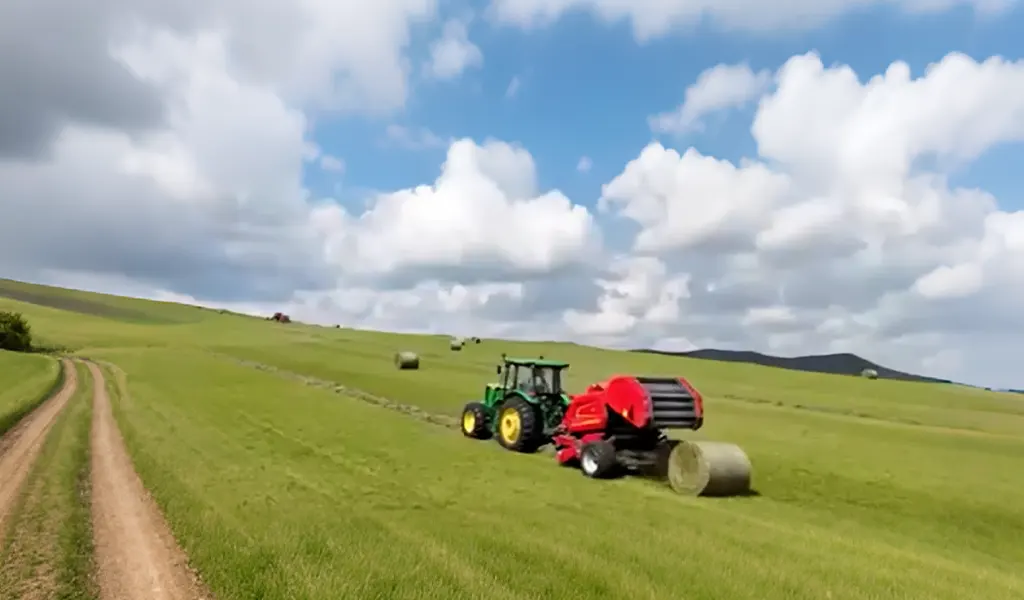
EXAMPLE 3Custom Hay Operator — 12,000 Bales Annual
The Pennsylvania custom hay operator from Article 13 has a different ROI calculation than internal-use operations. The custom operator’s question is not “is this equipment cheaper than the alternative” but “does the revenue stream from customers justify the equipment investment.” The calculation works through the three-tier pricing structure described in Article 13, with revenue from each tier minus the per-bale costs.
Commercial silage baler + wrapper + transporter . $185,000
Equipment yard / storage capital allocation……. $25,000
Total capital invested……………………….$210,000
Annual revenue:
Tier 1 (6,800 × $25)……………………… $170,000
Tier 2 (3,800 × $37)……………………… $140,600
Tier 3 (1,400 × $56)……………………… $78,400
TOTAL ANNUAL REVENUE…………………………$389,000
Annual costs:
Per-bale costs (12,000 × $24)……………… $288,000
Equipment depreciation……………………. $42,000
Insurance + admin overhead………………… $18,000
TOTAL ANNUAL COSTS…………………………..$348,000
Annual operating profit…………………… $41,000
Payback period: 5.1 years (capital ÷ profit)
5-year cumulative profit…………………… $205,000+
The custom operator calculation produces a 5.1-year payback — slower than internal-use operations but appropriate given the higher capital investment and more variable revenue streams. The 5-year payback also assumes consistent customer volume across the period; new custom operators in their first 1–2 seasons typically run at 60–70% of mature-business volume while customer relationships develop, extending the effective payback by 1–2 years. Established custom operators acquiring a replacement silage baler face shorter effective payback (3.5–4 years) because customer volume transfers immediately.
The Tier 3 contribution to the profit calculation is disproportionately important. Tier 3 produces 17% of bale volume but roughly 38% of the operating profit because of the premium pricing. Custom operators who attempt to specialize in only Tier 1 typically produce thinner margins than the calculation above shows; operators who develop strong Tier 3 customer relationships produce substantially better margins. The portfolio-pricing approach described in Article 13 is what makes the 5-year payback realistic rather than aspirational.
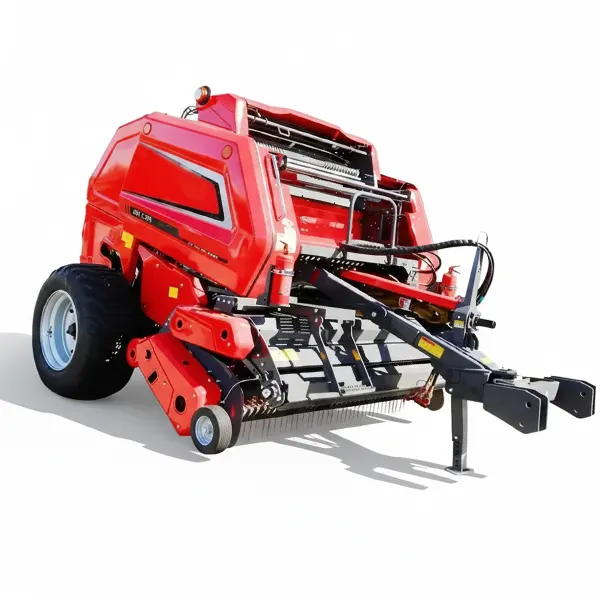
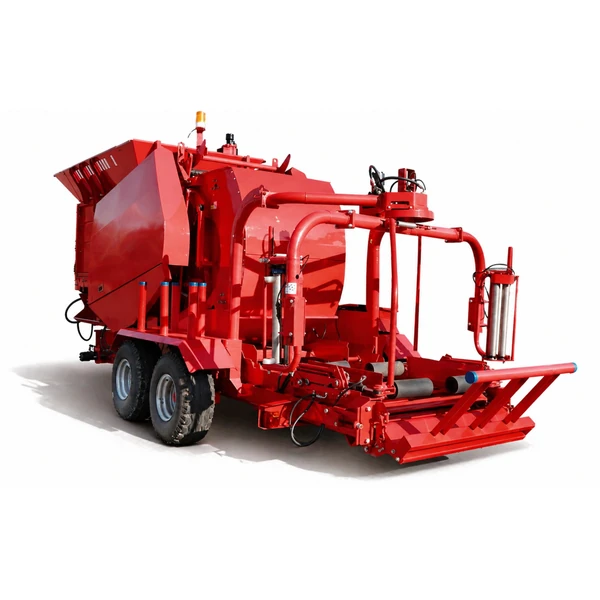
9YG-2.24D S9000 Ultra Silage Baler
Commercial-grade variable-chamber silage baler suited to operations producing 4,000+ bales annually. The throughput and bale-quality consistency support the ROI profiles in Examples 2, 3, and 4 of this article.
EXAMPLE 4Beef Finishing — 600 Head, 3,200 Bales Annual
The Nebraska beef finishing reference operation from Article 5 produces silage primarily for internal feeding rather than for sale. The ROI calculation has to capture the per-head feeding-cost savings that owned silage baler equipment delivers versus the alternative of purchased forage or higher-cost dry hay rations. The calculation framework differs from the dairy example because the value driver is feed-cost reduction rather than revenue generation.
Mid-tier silage baler + wrapper……………… $95,000
Annual depreciation (straight-line 8yr)……….. $11,875
Annual fuel + film + parts (3,200 bales)………. $38,400
Annual labor (140 hr × $22/hr)……………….. $3,080
Annual maintenance + repair………………….. $5,500
Tractor allocation………………………….. $4,400
TOTAL ANNUAL COST……………………………$63,255
Per-bale internal cost………………………. $19.77
Purchased hay equivalent (3,200 × $145/ton)…. $221,000
Owned silage feed-cost equivalent (3,200 × $87)…$278,400
FEED-COST ADVANTAGE……………………… $98,000/year*
*Beef finishing per-head feed cost reduction
Payback period: 1.0 years (capital ÷ savings)
8-year cumulative net advantage…………….. $700,000+
The beef finishing calculation produces an even faster payback than the dairy example because the per-head feed-cost reduction compounds across the 600-head operation. The math: each finishing animal consumes roughly 5 tons of forage equivalent during the finishing phase, and silage delivers that nutrition at roughly 60% of dry-hay equivalent cost when produced internally. Across 600 head per year, the per-head savings accumulate to $98,000 annually — paying back the $95,000 capital cost in approximately 1.0 years.
The beef calculation also captures something the other examples do not: feed-cost is a competitive variable in beef finishing. Operations with $98,000/year lower feed costs than equivalent operations can either price-compete more aggressively at sale time or maintain pricing while capturing higher margins. Both routes produce sustained competitive advantage that compounds across multiple years. Beef finishing operations transitioning from purchased hay to owned baler operations frequently report that the financial impact extends well beyond the per-bale cost calculation — the operational independence and quality control affect almost every financial dimension of the business.
Four-Example ROI Comparison
The four examples in side-by-side summary, with payback periods and key economic drivers for each operation profile.
| Example | Capital | Bales/yr | Payback | Decision |
|---|---|---|---|---|
| 1. Small farm | $40K | 200 | Marginal | Custom-hire usually better |
| 2. Dairy | $115K | 4,500 | 1.6 yr | Own immediately |
| 3. Custom operator | $210K | 12,000 | 5.1 yr | Service business model works |
| 4. Beef finishing | $95K | 3,200 | 1.0 yr | Own immediately |
The pattern across the four examples is that scale drives payback period dramatically. Operations producing under 500 bales annually face marginal economics that depend on specific marketing or operational factors; operations producing 1,500+ bales annually have strong cases for owned equipment regardless of other variables; custom-operator businesses occupy a different ROI structure where customer-revenue rather than cost-savings drives the calculation. The right answer is not “everyone should buy a silage baler” — it is “do the math for your specific operation profile, and act on the result.” This series has provided the operational and technical context to make those calculations realistic.
The 20-Article Series in One Map
This article concludes a 20-part reference series on silage baler operations. The series moved through four major content areas — fundamentals (Articles 1–3), application by livestock species (Articles 4–7), forage species and crops (Articles 8–11), operational models (Articles 12–14), climate and technical depth (Articles 15–17), and operating discipline plus financial economics (Articles 18–20). Operators new to baling operations can read the series in sequence; experienced operators can jump to specific articles addressing their current questions.
The themes that recur across the series are worth restating. First, density is the central operating variable — chamber pressure, forage moisture, cut length all feed into density, and density determines fermentation outcomes. Second, climate-zone discipline matters — humid and arid operations face different challenges that the standard playbook does not fully address. Third, the right ownership model depends on scale — small farms should usually use custom-hire, mid-size operations benefit from owned equipment, custom operators run a service business with portfolio pricing. Fourth, operational discipline pays back more reliably than equipment upgrades — a well-operated mid-tier baler usually produces better outcomes than a poorly-operated commercial machine.
For operations finishing the series and ready to evaluate specific equipment, the application desk in Sacramento can walk through scale-appropriate configurations against your operation profile. The full round baler and silage baler catalog covers compact through commercial machines, and the supporting equipment catalog covers mowers, hay rakes, and bale transporters matched to the silage baler models. The about-us page covers the engineering and field-service team that supports operations through equipment lifecycle.
Series Conclusion
A silage baler is one piece of a larger forage-production system that includes mowing, raking, baling, wrapping, transporting, and storing. Operations that succeed long-term run all the pieces well — equipment that fits their scale, operating discipline that fits their climate, and financial frameworks that confirm the math actually works for their specific situation. This series has covered each piece systematically, with realistic examples across the U.S. forage operation spectrum. Operations applying this material should end up with better-informed equipment decisions, better-executed daily operations, and better-quantified financial outcomes than they would otherwise.
For specific questions on any topic covered in the series — equipment selection, operating discipline, climate-zone adjustments, financial modeling — the Sacramento application desk responds to direct inquiries within 24 hours during the cutting season and 48 hours otherwise. Long-term operator relationships are how this team has accumulated the field experience that informs the series; new operators are welcome to start that relationship from any starting point.
Editor: Cxm