Silage Baler Bale Density: Why It Decides Fermentation
Five causal chains traced from chamber pressure to feed-out outcomes — how density is the lever that quietly decides every other quality dimension.
Bale density is the most-discussed and least-understood variable in silage baler operations. Operators know that denser bales tend to ferment better, but the underlying causal chain — chamber pressure to bale density to oxygen exclusion to fermentation kinetics to feed-out palatability — is rarely walked through in detail. The result is that operators frequently target density as an end goal rather than as a lever, missing opportunities to adjust upstream conditions (chamber pressure, forage moisture, knife sharpness) that produce better density outcomes than tweaking density alone. This article traces five causal chains that connect bale density to fermentation success, with the practical operator-side implications at each link.
The reference framework here applies to wrapped round bales at typical silage moisture (50–60%) using variable-chamber silage baler equipment. Fixed-chamber machines produce different density profiles (denser shell, softer core) and need slightly different chain analysis. Corn-byproduct bales (earlage, snaplage) follow similar logic but with different optimal density targets because of the kernel-and-cob density baseline. The leafy-forage variable-chamber case described below covers the majority of U.S. silage baler operations.
CHAIN 01Chamber Pressure → Bale Density → Oxygen Exclusion
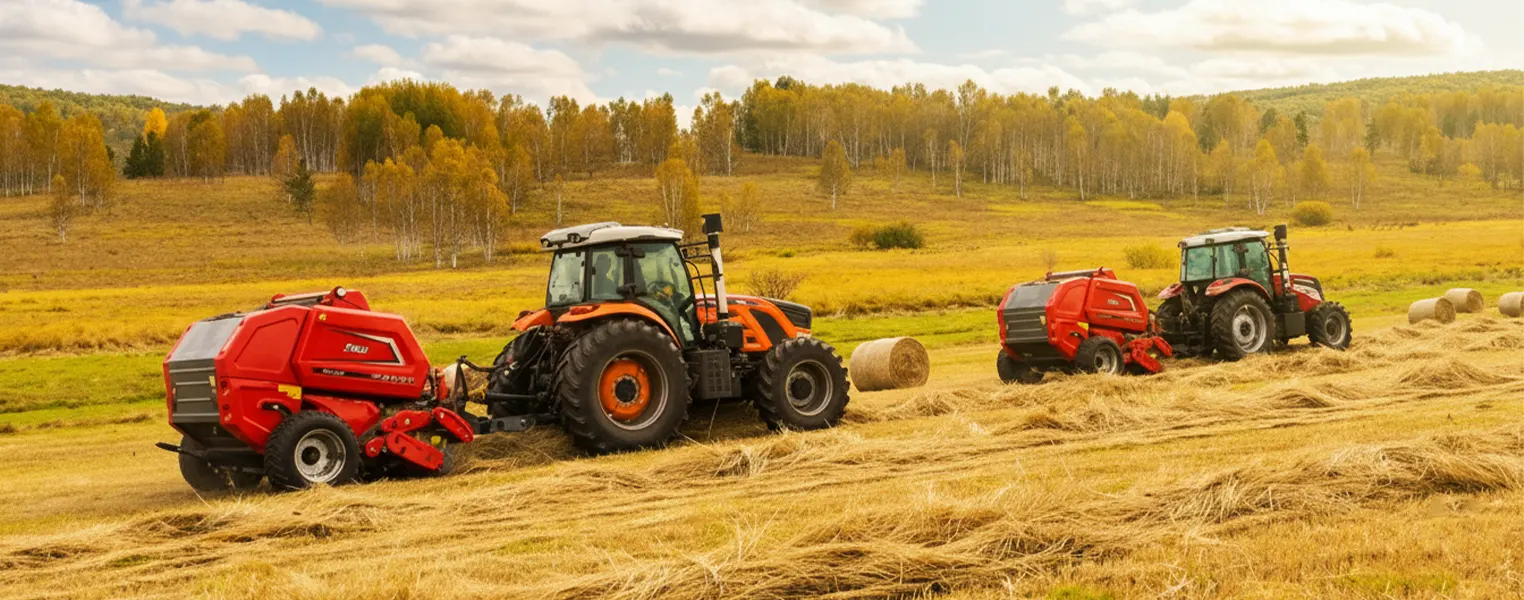
The first causal chain is the most direct one. Chamber pressure forces forage to compress into smaller volume per unit weight, which is the operational definition of higher density. The hydraulic system on a variable-chamber silage baler applies typically 180–230 bar of pressure during the bale-buildup phase, holding the chamber belts tight against the expanding bale surface. Higher pressure means tighter compression; tighter compression means higher density (typically 220–280 kg per cubic meter for properly-baled silage); higher density means less air space between forage particles within the bale.
The “less air space” outcome is what matters for fermentation. A loosely-packed bale at 180 kg per cubic meter contains roughly 30% air by volume; a properly-packed bale at 250 kg per cubic meter contains roughly 18% air. The 12-percentage-point difference in trapped air is what subsequently determines fermentation kinetics — more air means more oxygen for aerobic spoilage organisms to consume during the early days of storage, and longer time required for the lactic-acid bacteria to deplete that oxygen and establish anaerobic conditions.
The practical implication for operators is that chamber pressure adjustments deliver outsized fermentation benefits relative to other interventions. Increasing pressure from 200 bar to 215 bar (a 7.5% adjustment) produces roughly 5% higher density and 15–20% lower trapped-air volume — the chain amplifies through compression geometry. Operators trying to improve fermentation outcomes through wrap-layer increases or moisture-targeting adjustments often miss the simpler chamber-pressure lever that produces larger effects with less operational complexity. Chamber-pressure adjustment is also the lowest-cost intervention — it requires no additional film consumption, no additional baling time, and no upstream-equipment changes.
CHAIN 02Forage Moisture → Compressibility → Density Achievable
The second chain runs upstream of chamber pressure to the forage moisture content itself. Wetter forage compresses more readily because the cellular water in the leaves and stems acts as a hydraulic medium that lets cells deform under pressure rather than spring back. Forage at 60% moisture compresses 12–18% more readily than the same forage at 50% moisture under identical chamber pressure — and the compressibility difference shows up as higher achievable density at the same pressure setting.
The implication is that operators baling drier forage have to dial chamber pressure higher to achieve equivalent density. The standard 200-bar setting that produces 250 kg/m³ density on 60%-moisture forage produces only 220 kg/m³ density on 50%-moisture forage from the same field. The 30 kg/m³ density gap means the drier bales contain 12% more trapped air — and consequently more aerobic spoilage risk during early storage. Operators who maintain a fixed chamber pressure across moisture variations end up with bales that vary in fermentation outcome even when the same machine settings are nominally applied.
The compensating adjustment is straightforward. Operators baling drier forage should increase chamber pressure proportionally — typical adjustment is 5 bar pressure increase for every 2 percentage points of moisture decrease. A field section at 52% moisture would get 215 bar; a section at 56% would get 205 bar; a section at 60% would get standard 200 bar. Most modern machines allow cab-control pressure adjustment fast enough to make this adjustment within the cutting itself rather than waiting until the next field.
CHAIN 03Cut Length → Particle Packing → Density Uniformity
The third chain runs through the silage baler’s rotor cutting system. Forage cut to short uniform lengths (60–90 mm typical for 14-knife rotors) packs more uniformly into the chamber than long uncut material. The shorter pieces fill voids between larger pieces, producing fewer trapped air pockets per cubic meter even at the same chamber pressure. Density uniformity across the bale cross-section also improves — the dense outer shell and slightly less-dense core become more similar in density when the constituent forage is short-cut rather than long-cut.
The cut-length effect is significant in absolute terms. A 14-knife rotor running on sharp knives produces forage at 60–90 mm length and bales at 245 kg/m³ density on standard alfalfa silage. The same rotor running with dull knives produces forage at 100–150 mm length (because the knives tear rather than slice cleanly) and bales at 215 kg/m³ density at the same chamber pressure. The 30 kg/m³ density loss is purely from cut-length deterioration — no other variable changed. This is why the operation manuals on most baler models recommend knife sharpening at 30–50 baling hours; the cut-length quality directly affects fermentation outcomes through the density chain.
Operators who hit fermentation problems on bales from late-season cuttings often trace the cause back to knife wear that accumulated through the season without intervention. The knives that produced excellent first-cutting bales in May produced borderline second-cutting bales in July and inadequate third-cutting bales in August because no mid-season sharpening occurred. The chain from rotor knife condition through cut length through density through fermentation is one of the longest and most underappreciated in silage operations.
CHAIN 04Density → Fermentation Kinetics → Final pH
The fourth chain runs from achieved density through to fermentation chemistry. Higher-density bales reach the anaerobic conditions that lactic-acid bacteria need much faster than lower-density bales. A bale at 250 kg/m³ density typically reaches oxygen-depletion (under 1% O2 in the trapped air) within 36–48 hours after wrapping. A bale at 200 kg/m³ density takes 72–96 hours to reach the same anaerobic state. The 24–48 hour difference is critical because aerobic spoilage organisms are actively reproducing during that whole period — every additional hour of oxygen availability produces measurably more spoilage organism populations that the subsequent lactic-acid fermentation has to outcompete.
Once anaerobic conditions establish, the lactic-acid bacteria multiply rapidly and produce the lactic acid that drops bale pH. Higher-density bales reach pH 4.2 (the fermentation-stable target) within 14–18 days; lower-density bales take 21–35 days. The faster pH drop matters because once below 4.2, virtually all aerobic spoilage organisms cannot multiply — the bale is biologically locked. Bales that take longer to reach pH 4.2 spend more time vulnerable to spoilage organism growth, and frequently arrive at feed-out time with measurably different composition than the fast-fermenting equivalents.
The compounding effect across this chain is significant. A bale that is 20% denser than the comparison bale reaches anaerobic conditions 50% faster, drops to fermentation-stable pH 30% faster, and contains roughly 15% less spoilage-organism residual at the time of feed-out. The downstream feeding-side outcomes — palatability, intake rate, milk yield in dairy applications, daily gain in beef applications — all trace back to this density-driven fermentation kinetics chain. Operators tracking feed-out outcomes who attribute differences to “weather variation” or “forage species variation” often find on careful analysis that density variation is the dominant explanation.
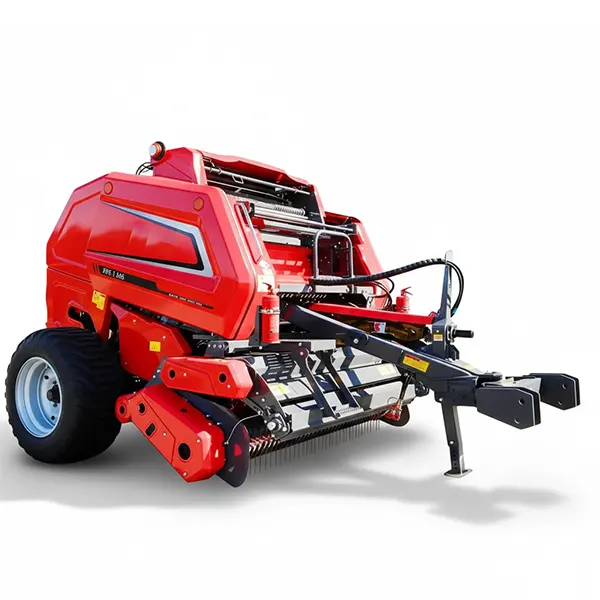
9YG-2.24D S9000 Silage Baler
Variable-chamber design with hydraulic density control rated to 230 bar. Chamber-pressure setting accessible from cab control during active baling, supporting the field-by-field adjustments that the causal chains in this article describe.
CHAIN 05Density → Wrap Performance → Long-Term Storage
The fifth chain connects bale density to long-term storage outcomes through the wrap film performance. Higher-density bales hold their cylindrical shape better than lower-density bales — the internal forage structure is rigid enough to resist deformation under stack pressure, transport handling, and weather-driven stress. A 250 kg/m³ density bale can sit at the bottom of a 3-bale stack for 12 months without deforming; a 200 kg/m³ bale at the bottom of the same stack will visibly deform within 6 months, with the wrap stretching at the deformation points and risking seal integrity.
Wrap film performance also depends on density at a more subtle level. The wrap film cling against itself relies on the static pressure between successive layers — denser bales push the wrap layers tighter against each other, improving the cling-based gas barrier. Looser bales let wrap layers slip slightly relative to each other under temperature changes, opening tiny gas paths that compromise the oxygen-exclusion advantage that wrapping is supposed to provide. The visible wrap may look identical between dense and loose bales, but the gas-barrier integrity differs measurably across the storage life.
The combined storage-life effect is significant. Dense bales (250+ kg/m³) routinely store for 18+ months with under 3% spoilage; loose bales (under 200 kg/m³) typically show 8–12% spoilage at 12 months and unacceptable rates beyond 14 months. Operations producing bales for extended storage — horse-haylage operations, dairy operations storing across multiple seasons, beef operations holding hedge inventory — depend on the density chain even more than operations with shorter storage cycles. The density that an operator might consider “acceptable” for 6-month storage becomes “inadequate” for 18-month storage through this same chain.
All Five Chains in One View
Bale density connects upstream causes to downstream outcomes through five distinct chains. The summary below shows how an operator-controllable upstream variable becomes a feed-out outcome through the density link.
| Chain | Upstream Cause | Density Link | Downstream Outcome |
|---|---|---|---|
| 01 | Chamber pressure | Compression force | Trapped air % |
| 02 | Forage moisture | Compressibility | Density at same pressure |
| 03 | Cut length | Particle packing | Density uniformity |
| 04 | Density (achieved) | Fermentation kinetics | Final pH, palatability |
| 05 | Density (achieved) | Wrap-film performance | Long-term storage life |
The matrix shows that density is both a downstream outcome (chains 01–03) and an upstream cause (chains 04–05). This dual role is what makes density the central variable in silage operations — operators who control density through the upstream chains automatically capture the downstream advantages, and operators who try to fix downstream problems without addressing upstream causes typically fail. The right operating discipline is to manage chamber pressure, forage moisture, and cut length proactively, then verify density outcomes against expectations rather than treating density as the lever to pull when problems appear.
Operations new to active density management often start by focusing on the most easily controlled upstream variable — chamber pressure — and verifying that adjustments produce the expected density outcomes. Once that calibration is established, attention shifts to the moisture-side and cut-length-side chains. Most operations reach acceptable density discipline within 1–2 cutting seasons of focused attention, with measurable feed-out improvements showing up by the second-year evaluation. The discipline does not require new equipment in most cases — just systematic attention to the existing equipment’s density-related settings.
Measuring Density in the Field
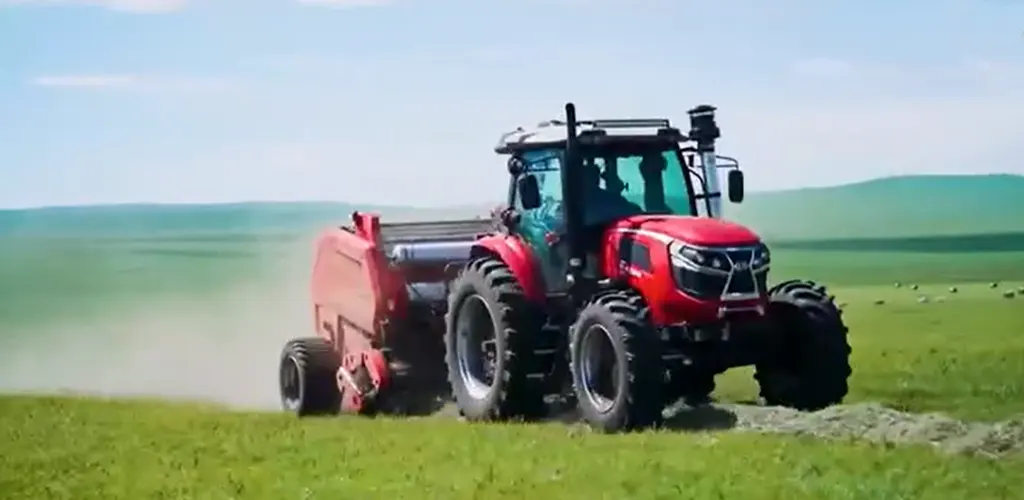
Most operators do not actively measure bale density during the cutting season. The cab-displayed indicator on modern silage baler models shows a percentage-fill reading that correlates with density but is not a direct density measurement. Direct measurement requires weighing a sample bale and calculating bale volume from the chamber dimensions — a 1.2 m diameter × 1.2 m wide bale has 1.36 cubic meters volume, so a 350 kg bale at this dimension is 257 kg/m³ density. Most operators do this calculation occasionally (maybe once per cutting) to calibrate their cab indicator against actual measured density.
A simpler practical method is to track bale weight as a proxy for density. If the silage baler is producing bales of consistent dimensions (chamber diameter and width are fixed once the cycle ends), weight differences between bales reflect density differences directly. Operations with on-farm scales can weigh bales as they move from field to storage, capturing density-equivalent data without the volume calculation. Operations without scales can ride along with a custom transporter operator at scale-out time to spot-check weights periodically. This back-end measurement does not catch in-cutting variations but does identify systematic shifts that warrant chamber-pressure investigation.
The visual indicator that operators learn to read is bale shape uniformity at ejection. Properly-dense bales come out of the chamber as nearly perfect cylinders with smooth surfaces and clean edges. Lower-density bales come out with slight surface irregularity — small bulges where the chamber belt couldn’t fully compress incoming forage, or surface waviness reflecting density variations across the bale’s circumference. Operators who pay attention to these visual cues can identify density problems at the moment of bale formation rather than waiting until storage or feed-out reveals the consequences.
Equipment Around the Silage Baler
Density management starts upstream of the silage baler itself. The mower-conditioner conditioning intensity affects forage moisture trajectory, which feeds chain 02 directly. The hay rake windrow geometry affects feed-rate uniformity into the chamber, which influences density consistency across the bale. Both pieces of upstream equipment can be tuned to support density goals rather than treated as separate from the silage baler operation.
Downstream, the bale transporter handling protects the density advantage that the silage baler created. Dropping a high-density bale from a fork loader can damage the wrap and partially undo the density-driven oxygen-exclusion benefit. Squeeze-clamp transporters preserve the wrap integrity that density depends on for the chain 05 storage outcomes. The full equipment chain has to support density management — the silage baler producing 250 kg/m³ bales is undermined if downstream handling drops effective fermentation outcomes by 30% through wrap damage.
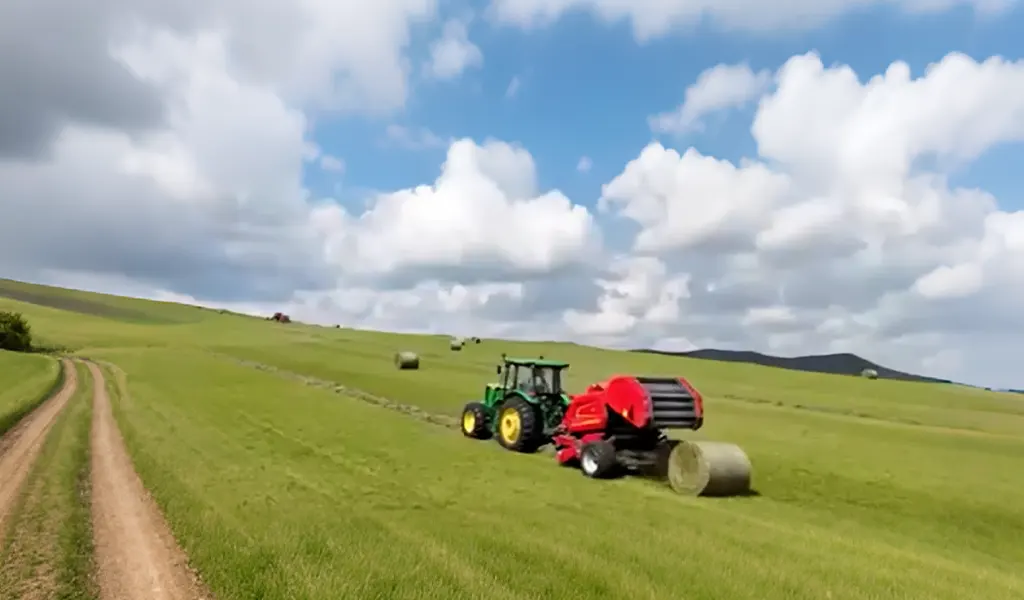
Tractor specification also affects density outcomes indirectly. A tractor with adequate hydraulic flow rate can maintain target chamber pressure even on heavy-flow first-cutting alfalfa; a marginal tractor may deliver lower effective pressure under load conditions, producing softer bales than the cab indicator suggests. Most silage baler manufacturers specify minimum tractor hydraulic flow rates in their operator manuals; operations that mismatch tractor capability with silage baler hydraulic demand routinely produce density variations that no amount of pressure-setting adjustment can compensate for. The hydraulic flow specification is one of the few baler specs that should be checked before purchase rather than discovered during operation.
Editor: Cxm