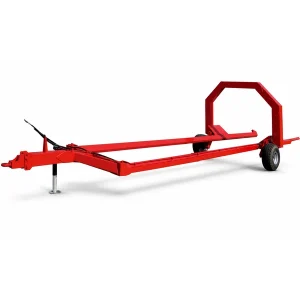
9JYY-4.5 Round Bale Pickup & Transporter Trailer
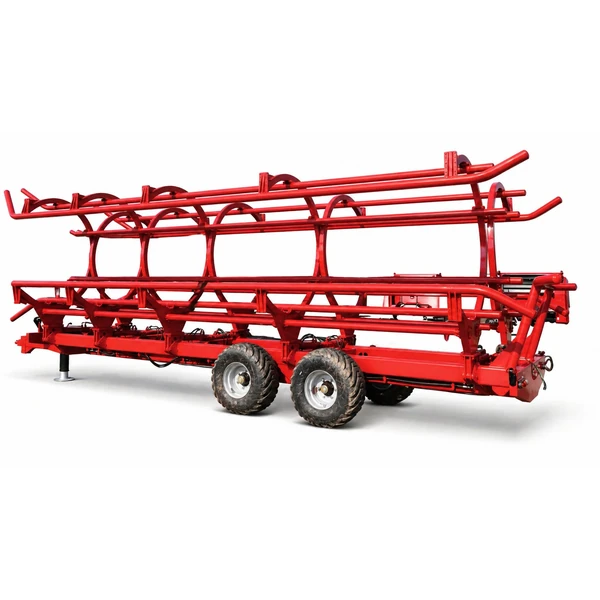
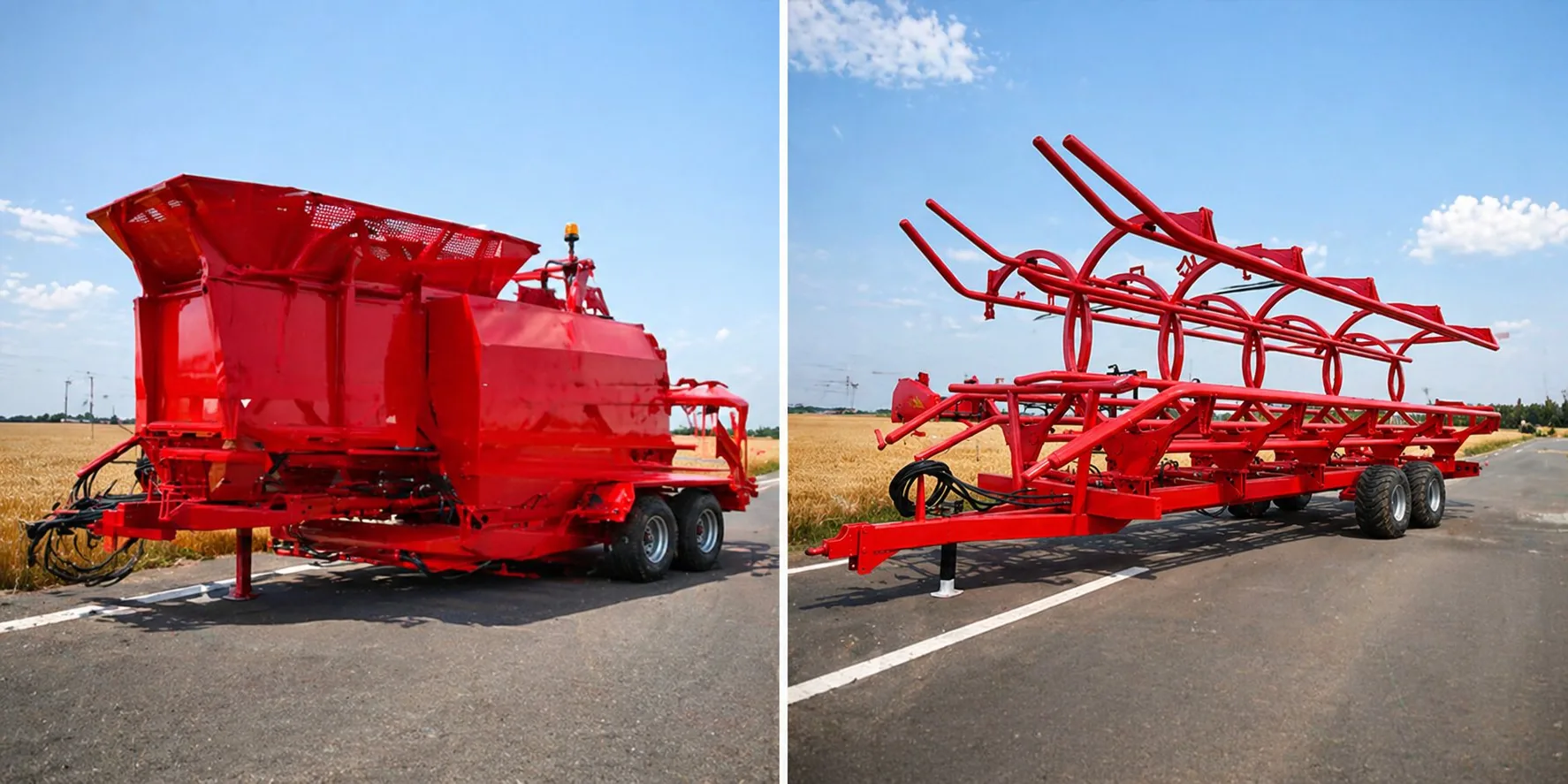
The 9JYY-4.5 round bale transporter is a hydraulic self-loading hay wagon engineered for U.S. operations that move large volumes of round bales between the field and the stack-yard. With a 4,500 kg (≈ 9,920 lb) payload rating, twin-axle 4-wheel chassis, and two independent hydraulic circuits at ≥ 16 MPa, the trailer eliminates the slow loader-and-flatbed shuttle that otherwise costs custom hay haulers and beef ranchers their best harvest hours. The trailer is drawbar-towed and runs on any utility tractor with ≥ 50 kW (≈ 67 HP) at the drawbar — most modern Deere 5R, Kubota M7, Case Maxxum, and New Holland T6 tractors meet that requirement comfortably.
9JYY-4.5 Round Bale Transporter: 4,500 kg Self-Loading Hay Wagon
In field mode the chassis opens to 6.75 m wide for direct ground pickup of round bales standing on their ends. Once loaded, the wings fold to a 2.9 m transport width — DOT-friendly for highway runs at up to 40 km/h on most U.S. state routes. The trailer accepts bales from Ø 1,000 mm × 1,000 mm length up to Ø 1,400 mm × 1,500 mm length, which covers every common North American round-bale standard from compact 4×4 dairy bales through 5×6 commercial hay bales. America Ever-Power Silage Baler Equipment INC. supplies the 9JYY-4.5 from the Sacramento warehouse with parts on the shelf, English-language operator manuals, and freight quoted to your county within 48 hours.
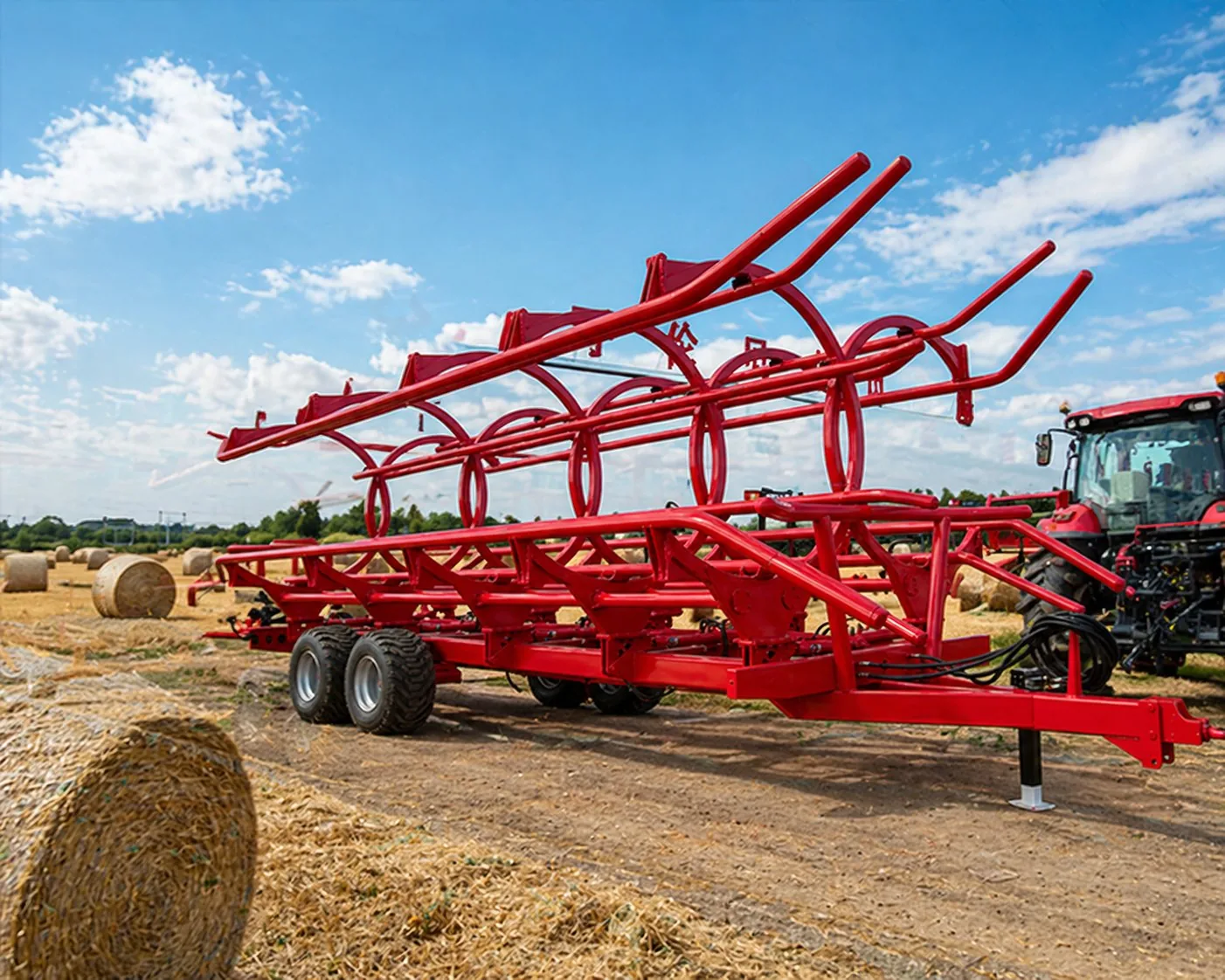
The 9JYY-4.5 was specified at the request of California alfalfa exporters and Pacific Northwest timothy producers who needed a single trailer that could clear a 200-bale field in two loads, then immediately fold for the road run to a 53-foot flatbed loading dock. The same trailer is now in service across Oregon, Washington, Idaho, Montana, Wyoming, and the Mountain States for cow-calf operations stockpiling winter feed.
Technical Specifications
The specification sheet below is reproduced verbatim from the manufacturer drawing set for the 2026 production batch, with imperial conversions added in a second column for the U.S. and Canadian market. All dimensions are confirmed against the factory weld jig and the trailer's transport-mode envelope; the 2.9 m folded width is measured at the widest external point of the chassis.
If your operation routinely handles bales outside the listed Ø 1,000-1,400 mm range — for example, oversized 6×6 export bales or sub-1,000 mm dairy bales — contact the Sacramento application desk before placing the order so the pickup geometry can be sized at the factory. Field retrofits to widen the bale cradle are available but require six weeks of lead time.
| # | Item | Unit | Specification | Imperial / U.S. Reference |
|---|---|---|---|---|
| 1 | Product | / | Round Bale Pickup & Transporter | — |
| 2 | Model | / | 9JYY-4.5 | — |
| 3 | Hitch | / | Drawbar (towed) | Cat. II / Cat. III pin |
| 4 | Loading | / | Hydraulic | cab-controlled |
| 5 | Max payload | kg | 4,500 | ≈ 9,920 lb |
| 6 | Tractor power | kW | ≥ 50 | ≥ 67 HP |
| 7 | Hydraulic working pressure | MPa | ≥ 16 (two independent circuits) | ≈ 2,320 PSI, 2 SCVs |
| 8 | Transport speed | km/h | ≤ 40 | ≤ 25 mph |
| 9 | Tire size | / | 400/60-15.5 (twin-axle, 4-wheel) | flotation tread |
| 10 | Compatible bale size | mm | Ø 1,000 – 1,400 × L 1,000 – 1,500 | ≈ Ø 39-55 in × L 39-59 in |
| 11 | Working dimensions (L×W×H) | mm | 9,400 × 6,750 × 1,750 | ≈ 30.8 × 22.1 × 5.7 ft |
| 12 | Transport dimensions (L×W×H) | mm | 9,400 × 2,900 × 3,300 | ≈ 30.8 × 9.5 × 10.8 ft |
| 13 | Net weight | kg | 3,240 | ≈ 7,143 lb |
How the 9JYY-4.5 Round Bale Transporter Works
The 9JYY-4.5 round bale transporter runs a four-stage cycle from field-side pickup to stack-yard discharge. The whole sequence is controlled from the tractor cab through two SCV remote levers — one for the pickup arms, one for the chassis fold. There is no PTO drive on the trailer itself, so the only mechanical input from the tractor is hydraulic flow at ≥ 16 MPa across two independent circuits. Below is the stage-by-stage workflow.
Stage 1 — Field-to-Trailer Pickup
With the trailer in field mode (chassis open to 6.75 m), the operator drives alongside a row of standing round bales. Hydraulic pickup arms swing outward and slide under each bale, lifting it onto the cradle deck. The geometry is sized so the operator can pick from either side without repositioning the tractor — useful in narrow field-end turn rows.
Stage 2 — Hydraulic Locking
Once the bale is on the deck, hydraulic clamps engage automatically when the second SCV circuit reaches working pressure. The clamps grip the bale shoulders rather than the wrap, so net-wrap and stretch-film integrity is preserved during transport. A check valve holds clamp pressure even if the tractor SCV is reset between bales.
Stage 3 — Road Transport Mode (Folds to 2.9 m Wide)
When the load is full, the operator engages the chassis-fold circuit. The two outer wings rotate inward and lock at a 2,900 mm transport envelope — within the 9 ft 6 in width legal-without-permit threshold in most U.S. states. Transport-mode height rises to 3,300 mm to accommodate the stacked bales; operators should confirm bridge clearances on the planned route. The chassis runs on twin-axle 400/60-15.5 flotation tires with leaf-spring suspension for stable handling at the 40 km/h ceiling.
Stage 4 — Stack-Yard Discharge
At the stack-yard, the wings unfold back to field mode and the deck tilts to roll bales off in sequence. The whole unload cycle takes 90-120 seconds depending on bale count. For commercial flatbed loading, the operator stages the trailer parallel to a 53-foot flatbed and discharges directly onto the bed via a forklift or telehandler — typical at hay-export terminals in Stockton, Long Beach, and Tacoma.
Core Advantages of the 9JYY-4.5 Bale Transporter
Five engineering choices set this trailer apart from older single-axle bale wagons and from front-loader-plus-flatbed shuttles. Each card below maps to a specific operational pain point we hear from American custom haulers and ranch managers: under-rated payloads on light wagons, slow shuttle cycles, hydraulic-flow conflicts on tractors with shared pumps, road-handling issues at U.S. highway speeds, and bale-format mismatches between dairy and beef supply chains.
4,500 kg Payload
A single load moves 8-10 typical 5×5 dry hay bales (≈ 450-560 kg each) or 6-7 wrapped silage bales at 700 kg each. For a 200-bale field, that is two round trips instead of the eight required by a 1,500 kg single-axle wagon.
Folds to 2.9 m for Road Transport
The 2,900 mm transport width sits inside the 9 ft 6 in legal threshold in most U.S. states without an oversize permit. Operators move directly from field gate to highway without staging.
Twin-Circuit Hydraulics
Two independent SCV circuits — one for the pickup arms, one for the chassis fold — eliminate the flow conflicts that plague single-circuit wagons. Pickup speed stays consistent even when the operator simultaneously cycles the fold.
Twin-Axle 4-Wheel Ride
Four 400/60-15.5 flotation tires with leaf-spring suspension keep the trailer stable at the 40 km/h transport ceiling. Tongue weight stays low and predictable across the load range.
Bale-Format Flexible
Compatible with Ø 1,000-1,400 mm × 1,000-1,500 mm bales — the full North American round-bale envelope from compact 4×4 dairy formats through 5×6 commercial hay. No reconfiguration between sizes.
Structure, Materials and Build Quality
The 9JYY-4.5 round bale transporter chassis is welded from Q345B structural steel — the Chinese equivalent of ASTM A572 Gr. 50 — at the partner plant outside Sacramento. The two main longitudinal rails are 200 × 100 × 8 mm rectangular hollow section, more than adequate for the 4,500 kg dynamic payload at 40 km/h. Welds at the wing-pivot joints are CO₂ shielded and inspected by ultrasonic testing on every fifth chassis pulled from the line. Pickup arms are fabricated from 12 mm wear-grade plate with hardened bushings at every pivot, sized for a 15-year service life under typical custom-hauler duty (180-220 days per year).
Surface protection is a four-stage process: phosphate pre-treatment, electrostatic primer, polyurethane top-coat, and oven cure. Salt-spray test results out of the in-house QC lab show > 600 hours before red rust appears at scribe edges — the threshold for ASTM B117 marine-grade certification, which matters for operations along the Pacific Coast and the Gulf hay-export corridors. Hydraulic cylinders are SKF or comparable EU-spec units rated for 21 MPa burst pressure (well above the 16 MPa working pressure). Cylinder rods are chrome-plated and protected by elastomer wipers at both ends. Hydraulic hoses route through chassis pass-through points fitted with abrasion sleeves at every contact edge.
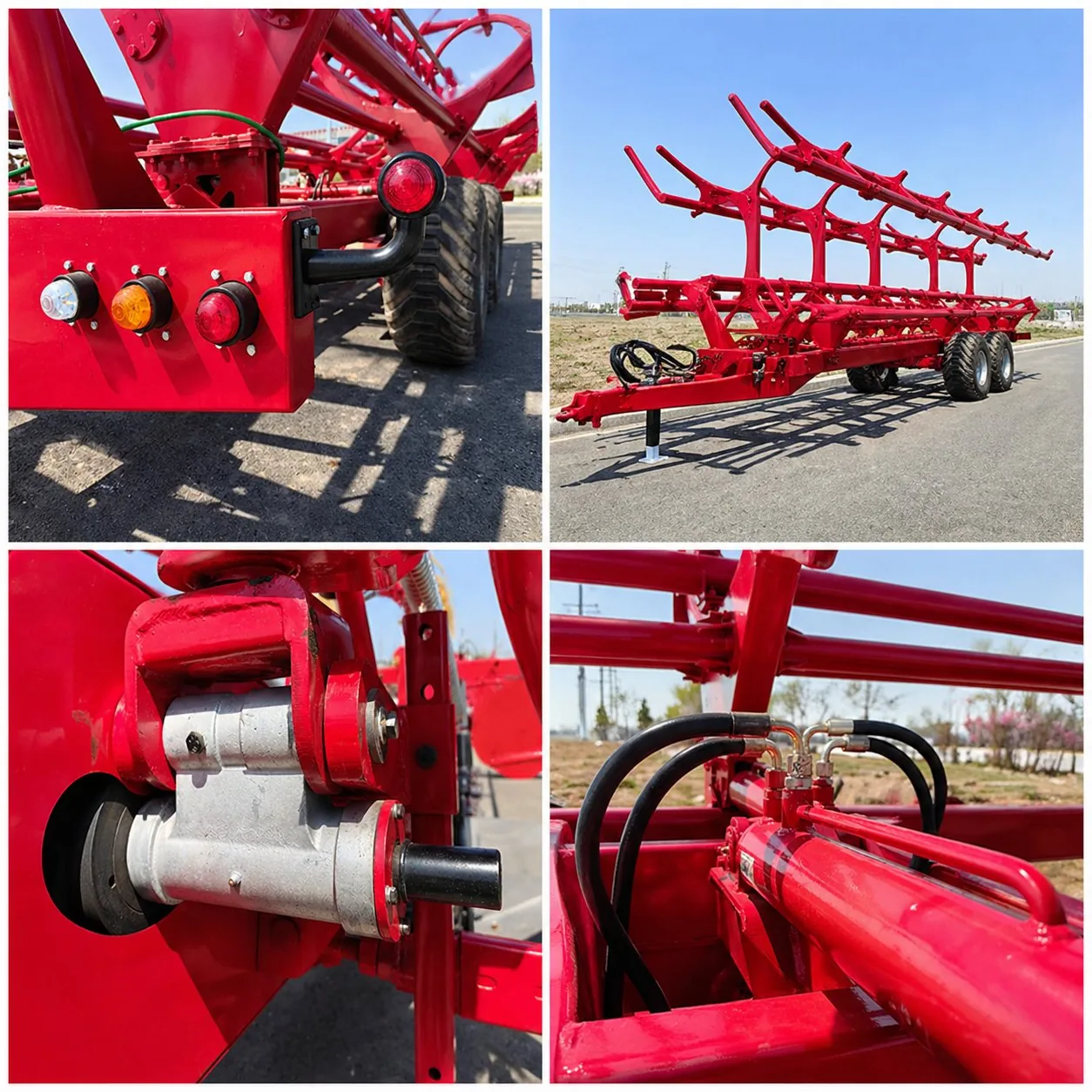
Suspension is a four-leaf parabolic spring assembly on each axle, with greaseable shackle bushings rated for 50,000 km between rebuilds. Tires are 400/60-15.5 flotation pattern, the standard agricultural trailer size carried by every U.S. ag-tire jobber — no proprietary fitments to source overseas. Wheel hubs are sealed taper-roller bearings with grease-fitting access. The whole chassis is field-serviceable with a basic mechanic's tool kit; the only specialty tool is a 75 mm socket for the wheel-hub nut. Most ranch shops complete a full annual service — grease, hose inspection, cylinder pressure check, and tire rotation — in a single afternoon with two technicians. The factory ships a printed maintenance schedule and a torque-spec poster with every trailer.
Application Scenarios for U.S. Hay and Ranch Operations
The three application categories below cover roughly 90 % of 9JYY-4.5 orders from American operators. If your operation does not fit cleanly into one of these — for example, a sod-farm round-bale shuttle or a forestry mulch-bale collection program — call the Sacramento application desk so the chassis spec can be confirmed before the order ships.
Custom Hay-Hauling Contractors
Custom haulers in California's Imperial Valley, Eastern Oregon, and the Snake River Valley typically charge $4-8 per bale moved (rates checked spring 2026 — verify locally). At 8-10 bales per load and a 30-minute round-trip cycle from field to stack-yard, gross revenue per machine reaches $400-$640 per hour during peak season. The 4,500 kg payload and the twin-circuit hydraulic system make the 9JYY-4.5 a fit for this duty cycle: pickup-to-load-secured time runs about 40 seconds per bale, which is faster than any front-loader-plus-flatbed combination at the same labor count.
Large-Scale Beef Ranch Operations
Cow-calf and backgrounder operations in Montana, Wyoming, Nevada, and Eastern Oregon use the 9JYY-4.5 to consolidate winter hay from leased and owned hay ground into a central feed-yard. A typical 1,500-head operation needs 800-1,200 round bales of grass hay per winter; the 9JYY-4.5 clears that volume in roughly 110-150 trailer loads, finished inside two weeks with one operator. Many ranches buy the 9JYY-4.5 alongside a stand-alone high-capacity round baler so the same crew handles baling and transport.
Hay-Export Buyers Loading onto Flatbeds
Timothy, alfalfa, and orchardgrass exporters in Washington, Oregon, and California stage bales from grower fields to consolidation yards near the Ports of Stockton, Tacoma, and Long Beach. The 9JYY-4.5 fits this workflow because the trailer can pull straight up alongside a 53-foot flatbed and discharge bales directly onto the bed at the stack height needed for export-bale loading. Containerized hay shipments to Japan, South Korea, and the United Arab Emirates depend on this kind of dock-side handling speed.
Sizing and Selection Guide
Before placing an order for the 9JYY-4.5 round bale transporter, work through this five-point checklist. Most order returns we see come from a tractor mismatch — typically hydraulic flow or SCV count — and every one of those is preventable in the pre-sale conversation with the Sacramento application desk.
- Bale dimensions. Confirm your typical bale falls inside Ø 1,000-1,400 mm × L 1,000-1,500 mm (≈ 39-55 in diameter × 39-59 in length). Most 4×5, 5×5, and 5×6 round-bale standards fit; oversized 6×6 export bales need a factory-modified cradle.
- Tractor power at the drawbar. ≥ 50 kW (≈ 67 HP). Lighter tractors will pull the empty trailer comfortably but will struggle on grades with a full 4,500 kg load. Most modern Deere 5R, Kubota M7, Case Maxxum 115, NH T6.155, and Massey 5713 tractors meet this requirement.
- Hydraulic outlets. Two SCV remotes — one for pickup arms, one for chassis fold. Confirm flow ≥ 30 L/min at 16 MPa per circuit. Older tractors with single-pump shared hydraulics may need a flow divider — talk to the application desk before ordering.
- Drawbar height. Standard cat. II / cat. III pin, drawbar height adjustable from 38 to 46 cm. The trailer ships with a pin-extension kit for tractors outside the standard range.
- Road-route survey. Confirm your typical highway route has ≥ 3.5 m vertical clearance (transport mode is 3.3 m tall) and ≥ 3.0 m lane width on bridges.
How the 9JYY-4.5 Compares to Anderson, ProAG and Bale Baron
We are not affiliated with Anderson Group, ProAG / Bridgeview, or Marcrest Manufacturing (Bale Baron), and the 9JYY-4.5 round bale transporter is not a counterfeit of any of their products. The comparison below is offered to help American buyers spec the right trailer for their operation. Each of the benchmark machines is a fine piece of equipment; the question is whether the price-to-performance gap justifies the premium for your bale volume.
| Spec | 9JYY-4.5 | Anderson TRB-2000 | ProAG 2014 | Bale Baron 5250 |
|---|---|---|---|---|
| Max payload | 4,500 kg | ~5,400 kg (12 bales) | ~6,300 kg (14 bales) | small-square bundles |
| Loading mechanism | Hydraulic self-loading | Hydraulic self-loading | Hydraulic self-loading | Bundles small squares only |
| Tractor HP needed | ≥ 67 HP | ≥ 100 HP | ≥ 130 HP | ≥ 100 HP |
| Transport width | 2.9 m (folded) | 2.95 m | 3.05 m | 2.5 m |
| Bale compatibility | Ø 1.0-1.4 m round | Round, 4×4 to 5×6 | Round, 5×5 to 6×6 | 3-tie small squares only |
| Approx. price tier | $ — entry to mid | $$$ premium | $$$ premium | $$$$ premium-plus |
| Best fit | Mid-volume hay & ranch ops | High-volume custom haulers | Large round-bale fleets | Small-square horse-hay markets |
Where the brand-name machines win: payload ceiling (the Anderson TRB-2000 and ProAG 2014 carry 12-14 bales per load to the 9JYY-4.5's 8-10), Canadian-prairie dealer density (Anderson and Bale Baron are based in Ontario and have strong dealer networks across the Northern Plains), and resale value (Anderson and ProAG hold residual value better in the U.S. used-equipment market).
Where the 9JYY-4.5 wins: purchase price (typically 35-45 % below comparable Anderson or ProAG list); lower tractor-HP threshold (≥ 67 HP versus ≥ 100 HP for the bigger Canadian-built wagons, which lets smaller operations buy the trailer without an additional tractor purchase); and freight from Sacramento (West Coast and Mountain State buyers receive their machine 4-7 days faster than from Ontario or Manitoba OEM warehouses).
For a buyer running a 5-year total-cost-of-ownership calculation, the answer depends on annual bale volume. Above 15,000 bales per year, the higher-payload Canadian-built wagons usually come out ahead on labor cost per bale moved. Between 4,000 and 12,000 bales per year, the Ever-Power option typically wins by a wide margin on acquisition cost.
Quality Certifications and Service Commitment

Every 9JYY-4.5 round bale transporter leaving the partner plant is built under an ISO 9001:2015 quality system, audited annually by a third-party registrar. Each chassis goes through a 60-minute hydraulic hot-test on the production line: pickup arms cycled 50 times under load, chassis fold cycled 30 times, every cylinder pressure-tested to 21 MPa, and every weld at the wing-pivot joints inspected with dye-penetrant. Results are logged with the unit serial number and shipped with the operator manual.
Warranty terms for U.S. and Canadian buyers: two-year limited warranty on the welded chassis and pivot joints, one-year warranty on hydraulic cylinders and the wheel-hub bearings, six-month warranty on wear parts (clamp pads, bushings, hose abrasion sleeves). Parts ship from the Sacramento warehouse via UPS Ground or LTL freight to commercial addresses inside the lower 48 states; orders placed before 11 AM Pacific ship same day for in-stock items, which covers about 90 % of the wear-part SKUs.
For fleet customers (3+ trailers), a Sacramento-based field engineer is dispatched for the first commissioning, walks the operator and shop foreman through the hydraulic schematic, and leaves a torque-spec poster in the shop. Phone support is available in English Monday-Friday 7 AM-6 PM Pacific. Service contracts are offered in three tiers: Bronze (parts only, 90-day phone advisory), Silver (parts plus annual on-site inspection at the customer's stack-yard), and Gold (parts, on-site inspection, and 24-hour breakdown response inside California, Oregon, Nevada, and Idaho). Most custom haulers running multiple machines settle on Silver after the first season.
Companion Equipment for Hay and Forage Operations
The 9JYY-4.5 sits at the back end of a wider hay-and-forage workflow that we equip end-to-end. The trailer is most often paired with a stand-alone round baler upstream — many fleet customers order both at once for staged delivery. Browse the full round balers lineup to match the 9JYY-4.5 to the right baler size for your operation: the S9000 Ultra series for high-density alfalfa and timothy bales, the 9YG-1.0 for compact dairy bales on smaller tractors, and the 9YCM-850 baler-wrapper combo for silage-bale workflows.
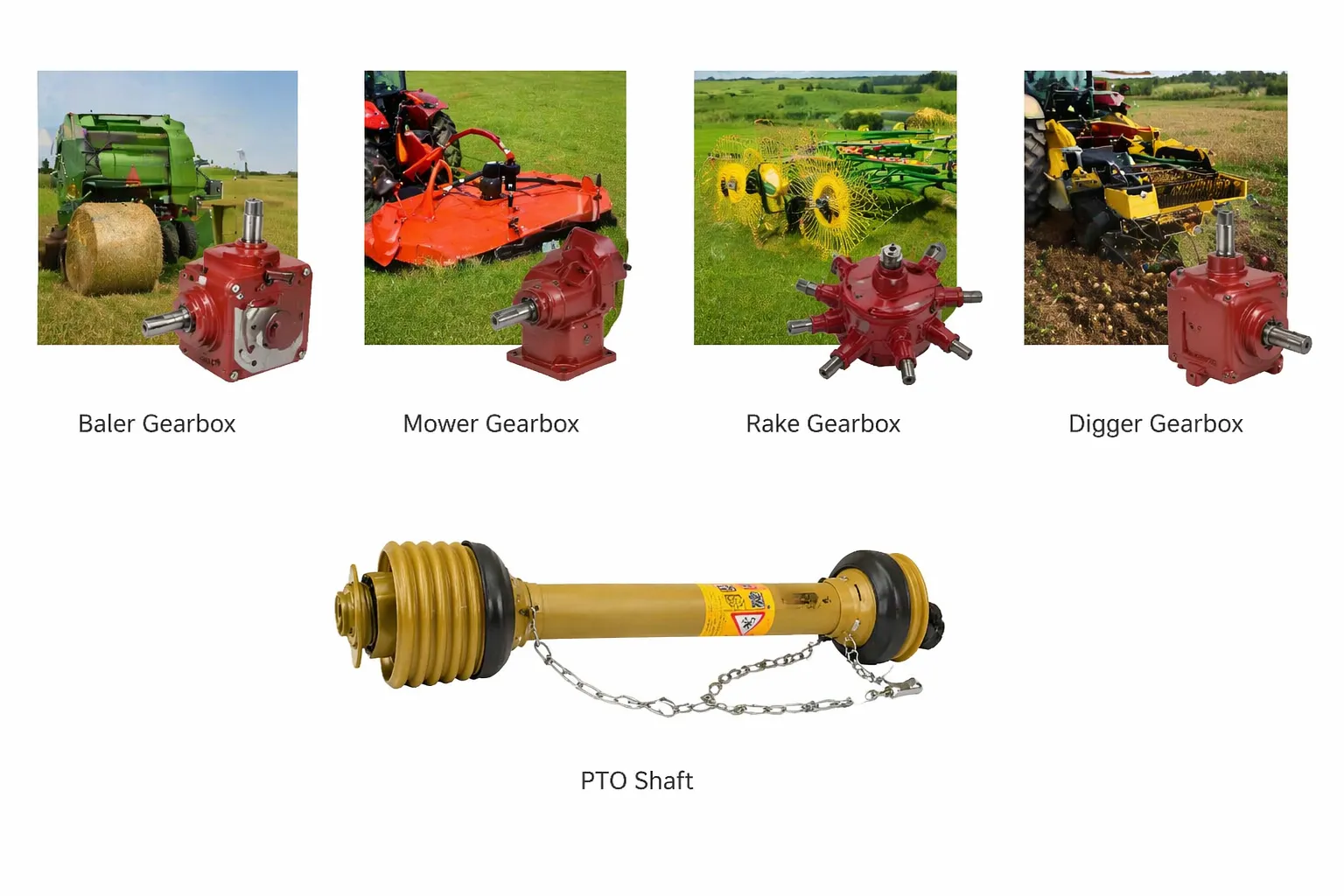
For the upstream PTO-driven equipment in a typical hay program — round balers, mower-conditioners, and finger-wheel rakes — driveline reliability matters as much as the trailer itself. Operators retrofitting older 1000-RPM-only tractors or running unusual splined shaft configurations can specify a matched agricultural drive gearbox from our partner foundry, with reduction ratios from 1:1.46 down to 1:1.93 sized for 540 RPM output on the implement side. Spare gearboxes ship together with the round baler or mower order on request and add roughly 18 kg to the crate weight.
Other companion items frequently spec'd alongside the trailer include replacement clamp-pad kits ($165 per set, shelf stock at Sacramento), hydraulic-hose service kits (12-month supply for one trailer at roughly $290), and a spare-cylinder kit covering the most common rebuild items. The kit is priced at roughly 5 % of the trailer list price and is recommended for any operator more than 200 miles from a hydraulic service shop.
Why Choose America Ever-Power Silage Baler Equipment INC.
There are several import-spec bale wagons in the U.S. market. Here is what makes the 9JYY-4.5 round bale transporter from Ever-Power different in practice:
- ✔ Address: 1401 21st ST, STE R, Sacramento, CA 95811. Same-week parts shipping inside the continental U.S., 7-12 business days to Canada and Mexico.
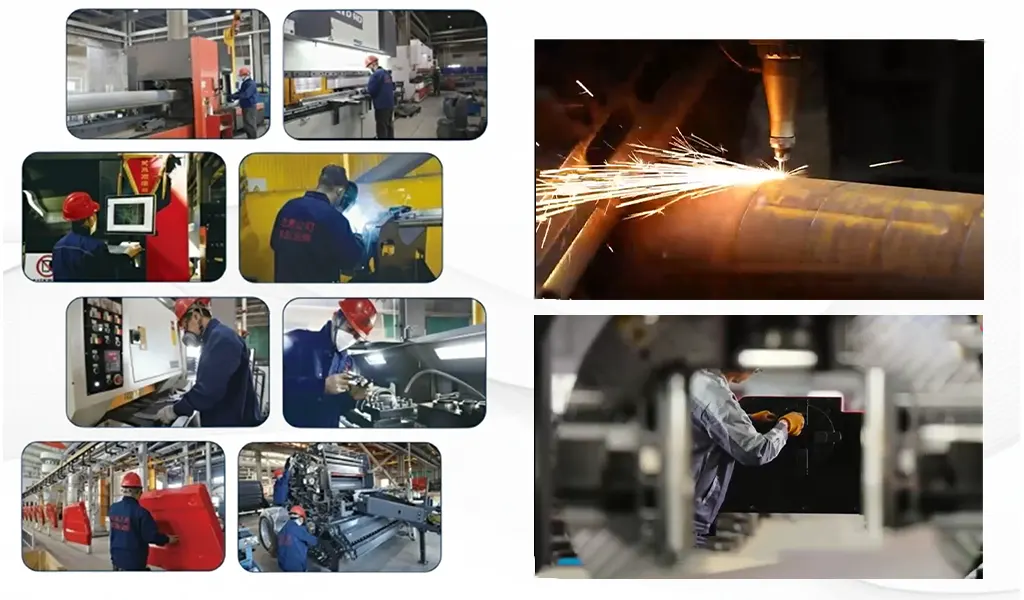
- ✔ 200+ machines on the production floor at the partner plant — CNC laser, robotic welding cells, automated paint line.
- ✔ ISO 9001 since 2023, AAA-rated supplier with regional distributors.
- ✔ Direct-from-factory pricing — typically 35-45 % below comparable Anderson or ProAG list prices.
- ✔ English-speaking field engineers based at our Sacramento operations center, USDT and ACH payment accepted, net-30 terms for verified fleet customers.
- ✔ Two-year chassis warranty with parts on the shelf for 90 % of common SKUs.
Frequently Asked Questions — 9JYY-4.5 Round Bale Transporter
How many round bales fit on one load?
8-10 typical 5×5 dry hay bales (≈ 450-560 kg each) or 6-7 wrapped silage bales at 700 kg each, up to the 4,500 kg payload ceiling. For 5×6 commercial hay bales running 700-800 kg, plan on 5-6 bales per load to stay inside the rating.
What is the maximum legal road speed in the U.S.?
The trailer is rated for 40 km/h (≈ 25 mph). Most U.S. states regulate ag-implement-of-husbandry road travel at 25 mph without additional requirements; check your specific state's ag-implement code and your county's road-permit rules before extended highway transport.
How many tractor hydraulic remote outlets do I need?
Two SCV remotes, both rated for ≥ 30 L/min flow at ≥ 16 MPa working pressure. One circuit drives the pickup arms, the second drives the chassis fold. Tractors with shared single-pump hydraulics may struggle when both circuits run simultaneously — talk to the application desk if you are running an older tractor with single-pump hydraulics.
Is the trailer DOT-legal in my state?
The 2.9 m (≈ 9 ft 6 in) transport width sits inside the over-width threshold in most U.S. states without a special permit. The 3.3 m transport height should be checked against bridge clearance on your typical route. SMV-emblem and red-flag lighting kits are included in the standard ship package; confirm your state's specific ag-trailer regulations with your local DOT office.
Do you ship the 9JYY-4.5 complete or knocked down?
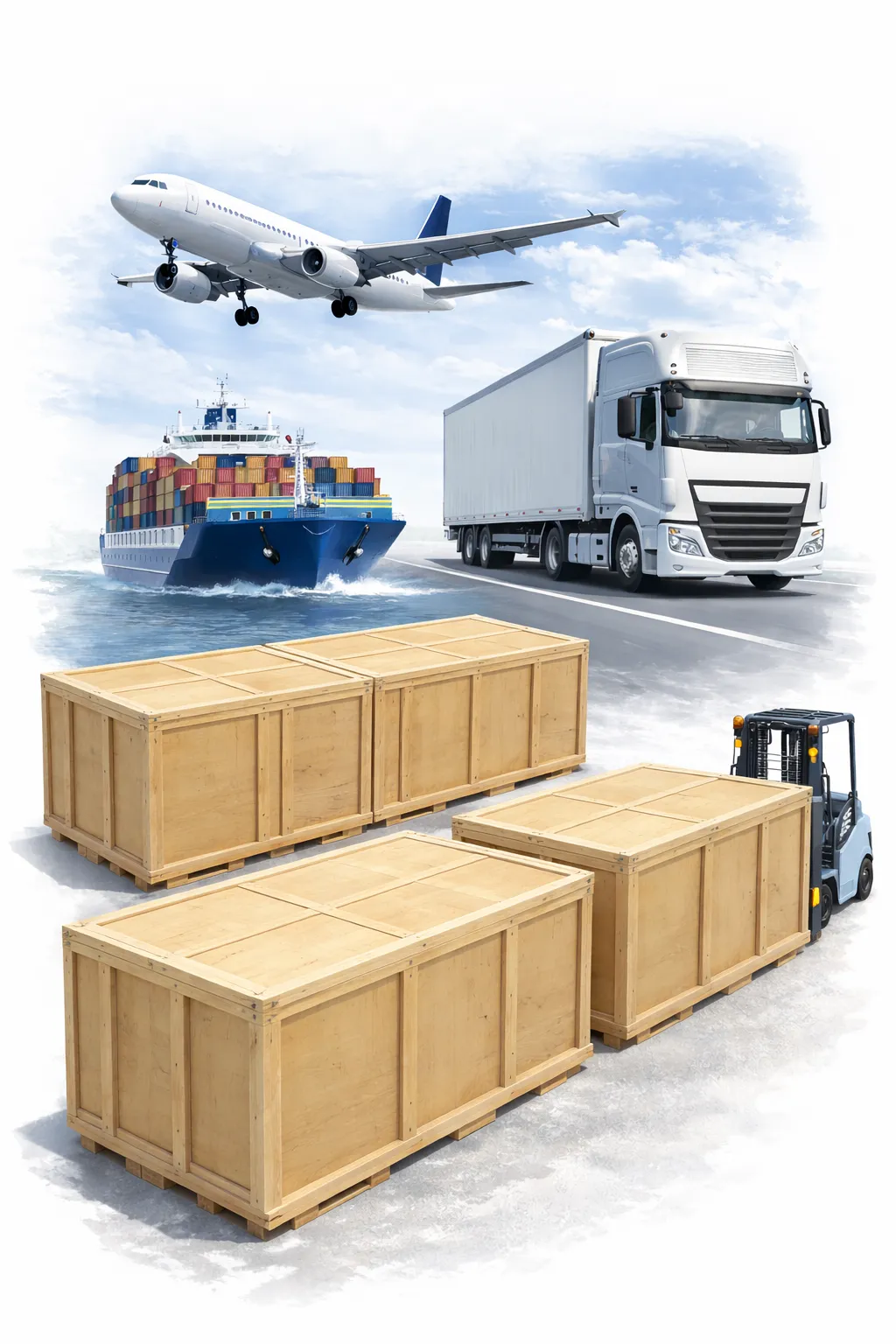
For U.S. domestic delivery from Sacramento, the trailer ships fully assembled on a step-deck flatbed. For ocean shipment to Hawaii, Alaska, or international destinations, the chassis ships partially knocked down (wings, drawbar, and tires removed) to fit a 40-foot high-cube container. Reassembly takes 4-6 hours with two technicians and standard shop tools.
How does the hydraulic loading sequence work?
The operator drives alongside a standing round bale, engages the first SCV lever to swing the pickup arms outward and under the bale, then reverses the lever to lift the bale onto the deck. Once the bale is on the deck, hydraulic clamps engage automatically when the second SCV reaches working pressure. Pickup-to-load-secured time runs about 40 seconds per bale on flat ground.
What is the lead time for replacement parts?
In-stock wear parts (clamp pads, bushings, hose service kits, abrasion sleeves) ship same day from Sacramento for orders placed before 11 AM Pacific, with UPS Ground delivery to most lower-48 zip codes in 2-5 business days. Hydraulic cylinders and major weldments are stocked at lower depth and may have a 7-14 day lead time during peak haying season.
Customer Reviews from U.S. Operators
All reviews below are from verified buyers and posted with permission. Names are real, locations are accurate to the county. Reviews are rotated quarterly — older reviews are archived but available on request from the Sacramento desk.
Wade J., Beef Rancher, Harney County, OR (fall 2025)
"We winter 2,400 head on grass hay we bale ourselves. Used to run a 16-foot flatbed and a Bobcat — three guys, half a day to clear a 200-bale field. Bought the 9JYY-4.5 for the 2025 season. Two trips per field, one operator on the Kubota M7-152, done by lunch. Drive train and hydraulics held up to the high-desert dust. Two seasons in, no warranty claims yet."
Carlos D., Custom Hay Hauler, Imperial County, CA (summer 2025)
"Custom haul alfalfa for six dairies in the Imperial Valley. Bills out at $5/bale, and the 9JYY-4.5 holds the math together at our volume. Two trailers running, two operators, 9-month season. The 2.9 m transport width was the deciding factor — Imperial County roads are narrow and we cannot run an oversize permit every week. One hose blew at 1,400 hours; Sacramento overnighted the replacement on a Saturday. No drama."
Heather B., Hay Exporter, Yakima County, WA (spring 2026)
"We stage timothy and orchardgrass bales from Yakima Valley growers to the Tacoma container yards. The 9JYY-4.5 sits at the dock and the 53-foot flatbeds pull up alongside; bales discharge straight onto the bed at the right stack height. Saved us 4 hours per truck on loading time. Built well, easy to maintain. Three trailers in our fleet now."
Jed K., Cow-Calf Operator, Humboldt County, NV (fall 2025)
"1,100 mother cows, winter feed program runs October to April. The trailer pulls behind a Deere 6155M without strain. Hydraulic flow on the 6155M is plenty even with both circuits going. The leaf-spring suspension handles our gravel ranch roads better than the air-bag wagon we replaced. Cost per bale moved dropped about 38 % vs the front-loader-and-flatbed setup."
Trevor M., Custom Operator, Twin Falls County, ID (summer 2025)
"Looked at an Anderson TRB-2000 and a ProAG 2014. Both were quality units but the price gap on the 9JYY-4.5 paid for a second trailer instead. Two units now, side by side. The 67-HP threshold means we can run the second trailer on a 2008 Massey 5455 we already had — did not need to buy a third tractor. Loading speed feels comparable to the Anderson at our bale weights."
Kalli W., Cow-Calf, Big Horn County, MT (fall 2025)
"Run 600 pairs and bale our own grass hay off 2,800 leased acres. Old wagon was a 1990s ProAG with the original cylinders still hanging on. Switched to the 9JYY-4.5 last fall. Cycle time to load 8 bales runs about 6 minutes. Twin-axle ride matters at 25 mph on the gravel between sections — the old single-axle would skip on washboards. Field engineer drove up from Sacramento for the install. Solid operation."
Pete R., Hay Producer, Sheridan County, WY (summer 2025)
"Bale 1,400 round bales of meadow hay each summer. Half stays here for our cows, half ships out to feedlots in Nebraska. The 9JYY-4.5 makes loading semis fast — pull alongside the flatbed, discharge, done. The 4,500 kg ceiling is the right size for our operation; bigger would not fit in the field gates. Paint is still in good shape after a winter outdoors. No regrets on the purchase."
Get a Quote on the 9JYY-4.5 Round Bale Transporter
If the 9JYY-4.5 round bale transporter fits your bale volume and tractor inventory, the next step is a freight-included quote to your zip code. Send your tractor model, hydraulic remote count, and target delivery week to the Sacramento desk and we will quote within 48 hours. Volume discounts apply at 3+ trailer orders, and net-30 terms are available for verified fleet customers.
Additional information
| Editor | Cxm |
|---|