Silage Baler for Dairy Farms: TMR Integration & Sizing
A worked scenario for a 600-cow Central Valley dairy — how baled silage fits into the TMR mixer, what tonnage you actually need, and how to size the equipment.
Most articles about silage equipment treat the dairy farm as a generic customer with generic needs. This one runs the math for a specific operation — a 600-cow Central Valley dairy that we will call Mid-Valley Dairy throughout — and shows how the equipment decision actually plays out at that operation, from herd-size forage demand through equipment sizing through annual cost. The numbers are realistic for a California dairy in this herd-size class. Adjust them up or down for your own operation; the structure of the analysis is what carries across.
600 lactating cows · Central Valley, CA
Why a Dairy Wants Baled Silage at All
A dairy operation lives or dies on the consistency of its TMR — total mixed ration. Lactating cows fed inconsistent forage produce inconsistent milk; the same cow drops 2–4 liters per day if her ration shifts noticeably between feedings. Dry hay alone struggles to deliver this consistency through a 365-day production schedule because hay quality varies bale to bale, leaf shatter loss accumulates during storage, and the open-stack environment exposes hay to mold during humid stretches even in California. Baled silage solves these problems by sealing forage immediately after baling, preventing further deterioration, and producing a predictable feed input cow after cow.
The other reason dairies invest in a silage baler is harvest-window control. Alfalfa hits peak protein within a 3–5 day window after each cutting, but converting that peak-quality forage to dry hay requires 5–7 days of low-humidity weather — and Central Valley weather rarely cooperates that perfectly four times per year. Baling at silage moisture (50–65%) compresses that window from 5–7 days to 24–48 hours. The dairy that can bale at silage moisture catches more of its forage at peak protein, and that protein advantage translates directly to milk yield. Most large dairies reach a point where the milk yield improvement from baled silage pays back the equipment investment within 18–24 months.
A third factor specific to California dairies: regulatory pressure on bunker silo runoff. Older bunker silo installations face increasing scrutiny on effluent management, and some Central Valley counties have effectively stopped permitting new bunkers within 1,000 feet of any waterway. Baled silage avoids this entirely — wrapped bales contain their own fermentation environment with no liquid runoff, and the storage pad can be located based on convenience rather than environmental setback. For Mid-Valley Dairy, this regulatory consideration is not theoretical; it is a real reason the operator is evaluating wrapped-bale options in 2026 rather than expanding the existing bunker.
How Much Silage Does Mid-Valley Actually Need
Forage demand for a dairy depends on herd composition and the percentage of TMR forage portion that comes from silage versus dry hay. The standard target for a Holstein lactating cow ration is 1.8–2.2 kg of silage dry matter per cow per day, supplemented with concentrate, grain, and minerals. For Mid-Valley’s 600-cow herd at 2.0 kg DM per cow per day, that works out to a daily silage DM demand of 1,200 kg per day, or roughly 3,600 kg per day of as-fed silage at 33% DM (which is the same as 67% moisture, slightly above the 50–65% baling target but typical for finished fermented silage).
Lactating cow demand:    600 cows × 2.0 kg DM/cow/day = 1,200 kg DM/day
Dry cow + replacements:  200 head × 1.0 kg DM/head/day =   200 kg DM/day
Total daily DM demand:                                   1,400 kg DM/day

Annual DM demand:        1,400 kg × 365 days = 511,000 kg = 511 tons DM/year

Bale specifications:
  Bale dimensions:       1.2 m diameter × 1.2 m wide
  As-fed weight:         ~700 kg per bale
  DM per bale at 35% DM: ~245 kg DM per bale

Annual bale count:       511,000 kg DM ÷ 245 kg DM/bale = 2,086 bales
Practical buffer +10%:                                    ~2,300 bales/year
2,300 bales per year is the planning number for Mid-Valley. Producing this volume requires either a single high-capacity machine running across all 4 cuttings, or a combination of owned equipment plus custom-hire on the largest cuttings. The 480 acres of alfalfa producing 7 tons DM per acre annually generates roughly 3,360 tons DM of total alfalfa output — enough to cover the dairy’s 511 tons of silage demand plus surplus that can be sold as standing-bale or processed as dry hay through other channels. This surplus position is important: it means Mid-Valley has flexibility to push silage production up or down based on weather and quality opportunities, rather than being forced to make silage out of every pound of alfalfa.
The 4-cutting alfalfa schedule produces 575 bales per cutting on average, but cutting volumes are not uniform. First cutting (April) typically produces 30% of annual yield; second cutting (June) 28%; third cutting (August) 25%; fourth cutting (October) 17%. So the largest cutting demands roughly 690 bales in 5–7 baling days, a peak production rate of about 100 bales per day on the busiest cutting. A baler running 22–25 bales per operating hour can hit this rate in a 4–5 hour daily window, well within the moisture-window constraints of silage baling.
The Wilting Window: Why Equipment Speed Matters
Silage baling at the right moisture requires hitting a window that is only 24–48 hours wide. Cut alfalfa starts at roughly 80% moisture (fresh) and drops to the silage target of 50–60% moisture during wilting in the field. In Central Valley June weather (low humidity, good wind, 28°C daytime highs), this drop takes 18–30 hours from cutting. If the baler cannot complete the cutting in this window, the field-edge windrows over-dry past silage moisture and have to be either baled dry (changing the program) or left to be raked back together before baling.
Single cutting acres:        120 acres (one quarter of 480 total)
Yield per cutting:            ~2 tons DM/acre = 240 tons DM/cutting
At 35% DM = 65% moisture:     ~685 tons as-fed (240 ÷ 0.35)

Bales per cutting:            ~575 bales (685 t ÷ ~1.2 t per bale weight basis)
Wilting window available:     24-36 hours (Central Valley June)

Required baling rate:         575 bales ÷ 30 hr = 19 bales/hr minimum
Required field hours:         575 bales × 110 sec/bale = ~17.6 baling hours
Days to complete cutting:     17.6 hr ÷ 8 hr/day operating = 2.2 days

Margin in window:             36 hr window - 53 hr (2.2 days × 24) = NEGATIVE
Conclusion:                   Single mid-tier silage baler can NOT cover
                              the largest cutting in the wilting window.
                              Need higher-throughput machine, or two units,
                              or split cutting timing across days.
This is the math that drives Mid-Valley’s equipment sizing decision. A standard 22-bales-per-hour silage baler cannot keep up with the largest cutting on its own. The dairy’s options are: (1) buy a higher-throughput commercial silage baler that runs 28–32 bales per hour, completing the cutting in 1.6–1.8 days; (2) buy two mid-tier silage balers that run in parallel; (3) accept that a portion of the largest cutting will go to dry hay rather than silage, which loses some protein but keeps the silage-grade output below the equipment ceiling; or (4) extend the cutting schedule by mowing in two batches 24 hours apart, so the wilting windows do not overlap completely.
Most 600-cow dairies in Mid-Valley’s situation choose option (1) — a commercial-grade silage baler with 28+ bales-per-hour capacity. The cost differential between mid-tier and commercial-grade is roughly $25,000–35,000, and that premium is recovered within 3–4 cuttings through the avoided custom-hire fees and protein retention from hitting the wilting window cleanly. Mid-Valley’s evaluation lands on a commercial wrapper-combo configuration.
Equipment Around the Silage Baler
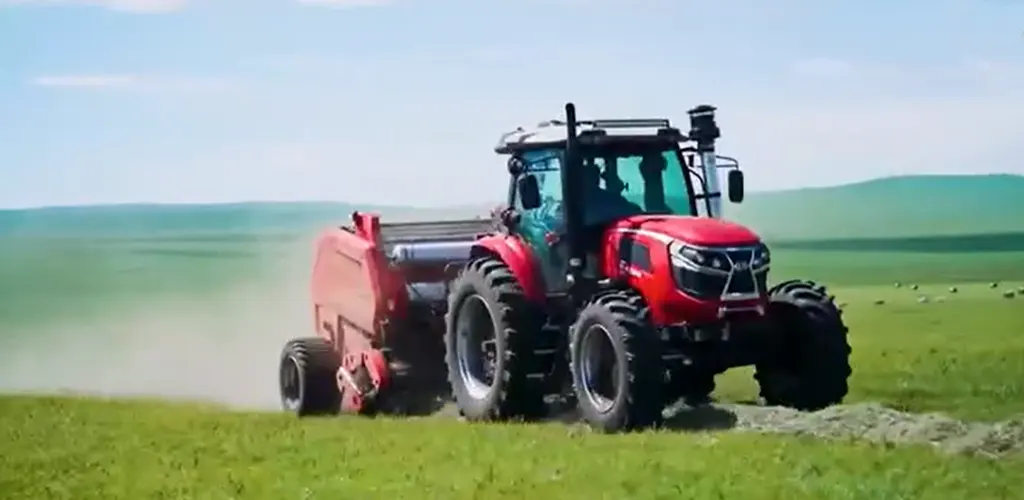
The baler-wrapper combo is one piece of a four-piece harvest chain. For Mid-Valley to hit its production rate, all four pieces need to run in balance. A 5-meter mower-conditioner can cover the largest cutting in 1.5 days at 8 km/h, conditioning the alfalfa as it cuts so wilting completes within the silage window. A 7-meter V-rake consolidates the swaths into uniform windrows the baler pickup can handle at speed. The commercial silage baler-wrapper combo runs at 28+ bales per hour. And finally a bale transporter moves the wrapped bales from field to storage pad within 30 minutes of placement, minimizing puncture exposure on stubble.
The capital cost of the full chain is approximately: $35,000 mower-conditioner + $28,000 V-rake + $90,000 commercial silage baler combo + $18,000 bale transporter = $171,000 total equipment investment. A common alternative is to keep the existing mower and rake (often already on the dairy from prior dry-hay operations) and add only the silage baler combo and transporter, reducing the new investment to $108,000. Mid-Valley’s path is the partial-upgrade path because the existing 4-meter mower-conditioner and 5-meter rake are both serviceable and would otherwise be sold for limited recovery value. The dairy plans to upgrade the rake to a wider 7-meter V-rake at the next replacement cycle, but for the first 2 seasons of silage operation the existing rake handles the consolidated windrows acceptably.

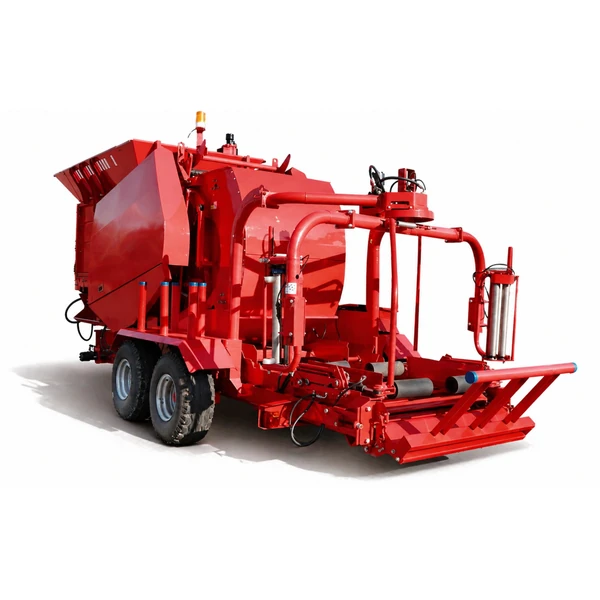
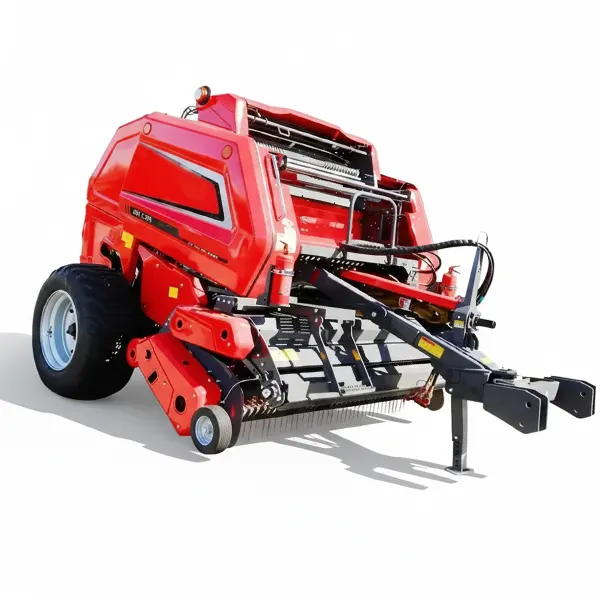
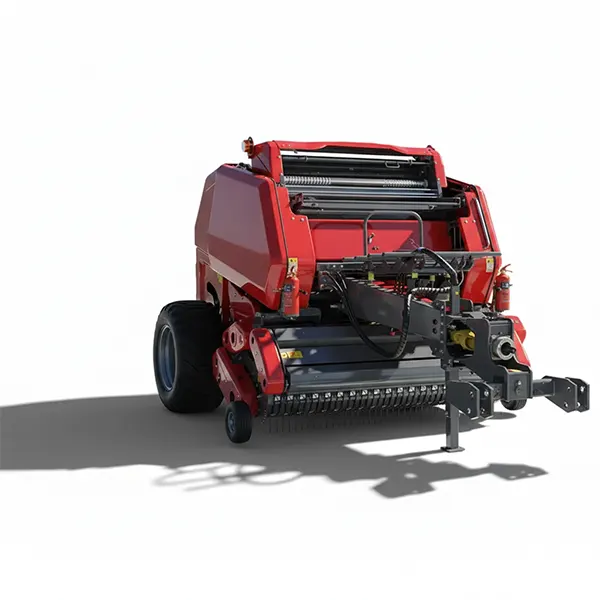
9YG-2.24D S9000 Ultra Commercial Silage Baler
The commercial-tier silage baler that matches the throughput requirement for a 600-cow dairy. 28+ bales/hr capacity, variable chamber, hydraulic density control, integrated combo wrap option.
Annual Cost Comparison: Own vs Custom-Hire
Mid-Valley’s existing approach is custom-hired hay baling at $20–25 per dry-hay bale. Switching to baled silage means either expanding the custom-hire arrangement (if a regional custom operator offers wrapped baling), or buying owned equipment. The economics depend on annual bale volume.
Annual silage bale demand:     2,300 bales

CUSTOM-HIRE PATH:
  Custom rate (silage):        $32/bale (regional avg, CA Central Valley)
  Annual custom fee:           2,300 × $32 = $73,600/year
  Plus wrap film cost:         2,300 × $4.50 = $10,350/year
  Total annual silage cost:    $83,950/year

OWNED EQUIPMENT PATH:
  Capital depreciation:        $108,000 ÷ 8 yrs = $13,500/year
  Maintenance + repair:        ~3% of capital = $3,240/year
  Wrap film + net:             2,300 × $5.20 = $11,960/year
  Fuel (40 hr × 25 L/hr):      1,000 L × $1.30 = $1,300/year
  Operator labor (40 hr):      40 × $35/hr = $1,400/year
  Total annual silage cost:    $31,400/year

ANNUAL DIFFERENCE:             $83,950 - $31,400 = $52,550/year savings

Equipment payback period:      $108,000 ÷ $52,550 = 2.05 years
The owned-equipment path saves Mid-Valley roughly $52,000 annually and pays back the new equipment in just over 2 years. For most 600-cow dairies running 4 cuttings of alfalfa, the math comes out in this range — payback periods of 2–3 years on silage baler investment, dropping to 18 months for larger 1,000-cow herds and stretching to 4+ years for smaller 250-cow herds. Below 250 cows, custom-hire usually wins on total cost; above 600 cows, owned equipment wins comfortably; the 250–600 range is the zone where the decision depends on local custom-hire availability and the dairy’s specific cutting schedule.
Sizing Across Operation Scales
Mid-Valley is one specific case. The same logic applied to other dairy sizes produces different equipment recommendations. The table below shows how machine choice scales with herd size.
| Operation Size | Annual Bales | Recommended Silage Baler |
|---|---|---|
| Small dairy 100–200 cows |
~600 | Custom-hire usually wins. If owning, compact 4×4 chamber silage baler with stand-alone wrapper. Payback 4–6 years. |
| Mid-size dairy 200–400 cows |
~1,200 | Decision depends on custom-hire availability. If owning, mid-tier 4×5 chamber unit with integrated wrapper combo. Payback 3–4 years. |
| Mid-Valley size 500–700 cows |
~2,300 | Owned equipment wins. Commercial-grade 5×5 baler-wrapper combo at 28+ bales/hr. Payback 2–3 years. The Mid-Valley reference case. |
| Large dairy 1,000+ cows |
~4,000+ | Two commercial machines running in parallel, or one high-density 5×6 commercial unit running extended hours. Payback 12–18 months. |
The pattern across operation scales is consistent: as herd size grows, the case for owned equipment strengthens, the recommended chamber size grows, and the payback period shrinks. The two thresholds that matter most are the 250-cow line (below which custom-hire usually wins) and the 800-cow line (above which a single commercial machine starts running near capacity and a second unit may be justified). Most dairies in the 300–700 cow range — like Mid-Valley — make a single commercial machine the centerpiece of their forage program and operate it across the full alfalfa schedule. Dairies above the 1,000-cow threshold often invest in two parallel silage balers, with one operator running the lead machine across mowed acres while a second operator follows behind with a chase machine on the same windrows. The redundancy also provides downtime insurance — if one silage baler fails mid-cutting, the other can still complete the wilting window without losing the cutting to over-drying.
What Mid-Valley Actually Decided
Walking through the math in this article reflects the actual evaluation a 600-cow dairy in Mid-Valley’s position completes during a silage baler purchasing cycle. The decision points are: the wilting window forces a commercial-grade unit rather than a mid-tier compromise; the 4-cutting alfalfa schedule means peak demand at first cutting is roughly 100 bales per day for 5–7 days; the equipment payback works out to just over 2 years against the existing custom-hire baseline; and the regulatory pressure on bunker silos provides a non-economic reason to lock in baled silage rather than considering bunker expansion.
The dairy’s final equipment choice was a 5×5 commercial silage baler-wrapper combo paired with the existing mower-conditioner and a new V-rake. Total new-equipment investment was $118,000, financed over 5 years with an effective payback of 26 months. Year 1 production hit 2,180 bales (slightly under the 2,300 target due to a wet first cutting), and the dairy’s TMR consistency improved measurably enough that the herd average milk yield rose by 0.6 L/cow/day — an improvement worth roughly $58,000 annually that was not captured in the equipment payback math at all.
Different dairies reach different conclusions because the input numbers vary — local custom-hire rates, existing equipment value, herd composition, climate, regulatory environment. But the structural logic is consistent: define the bale demand from herd size, check the wilting window against equipment throughput, run the own-versus-hire cost comparison, and stress-test the result against operation-specific factors like regulatory constraints. The math walks itself if you start from herd size and work outward.
Where to Go Next
For dairies similar to Mid-Valley, the next reading depends on which question is most pressing. The article on optimal moisture for silage baling covers the wilting window science in detail, including how to manage the 50–65% moisture target through different climates. The article on bale density covers the chamber pressure decisions that determine fermentation success. And the article on common silage baler problems is worth reading before purchase — knowing the failure modes helps frame the equipment-selection conversation with manufacturers.
If you would like to see the actual models that match the operation scales described in this article, our round baler and silage baler catalog covers compact 4×4 through commercial 5×6 configurations. The Sacramento application desk can also walk through the sizing math against your specific dairy’s herd profile, cutting schedule, and freight to your zip code.
Editor: Cxm